Soft Romance: The Runway Mood Challenging Quiet Luxury in 2026
Ruffled skirts and Victoriana details are displacing clean minimalism as fashion's defining mood in 2026, with Dior, Valentino, and Margot Robbie's press tour reshaping what heritage dressing looks like.
Quiet luxury had a long, prosperous run. Tonal dressing, unbranded cashmere, impeccable restraint: the aesthetic held sway for the better part of three years and gave wardrobes a kind of reassuring stillness. But something shifted on the runways this season, and the shift was not subtle. Fashion in 2026 is undergoing a radical and refreshing transformation, and the sterile minimalism of the early 2020s is giving way to something more emotive, more layered, and frankly more alive. The emerging counterforce has a name: soft romance. And it is arriving not as a fringe mood but as a full-throated editorial argument, made simultaneously on the runway, the red carpet, and the awards circuit.
The Runway Case for Romance
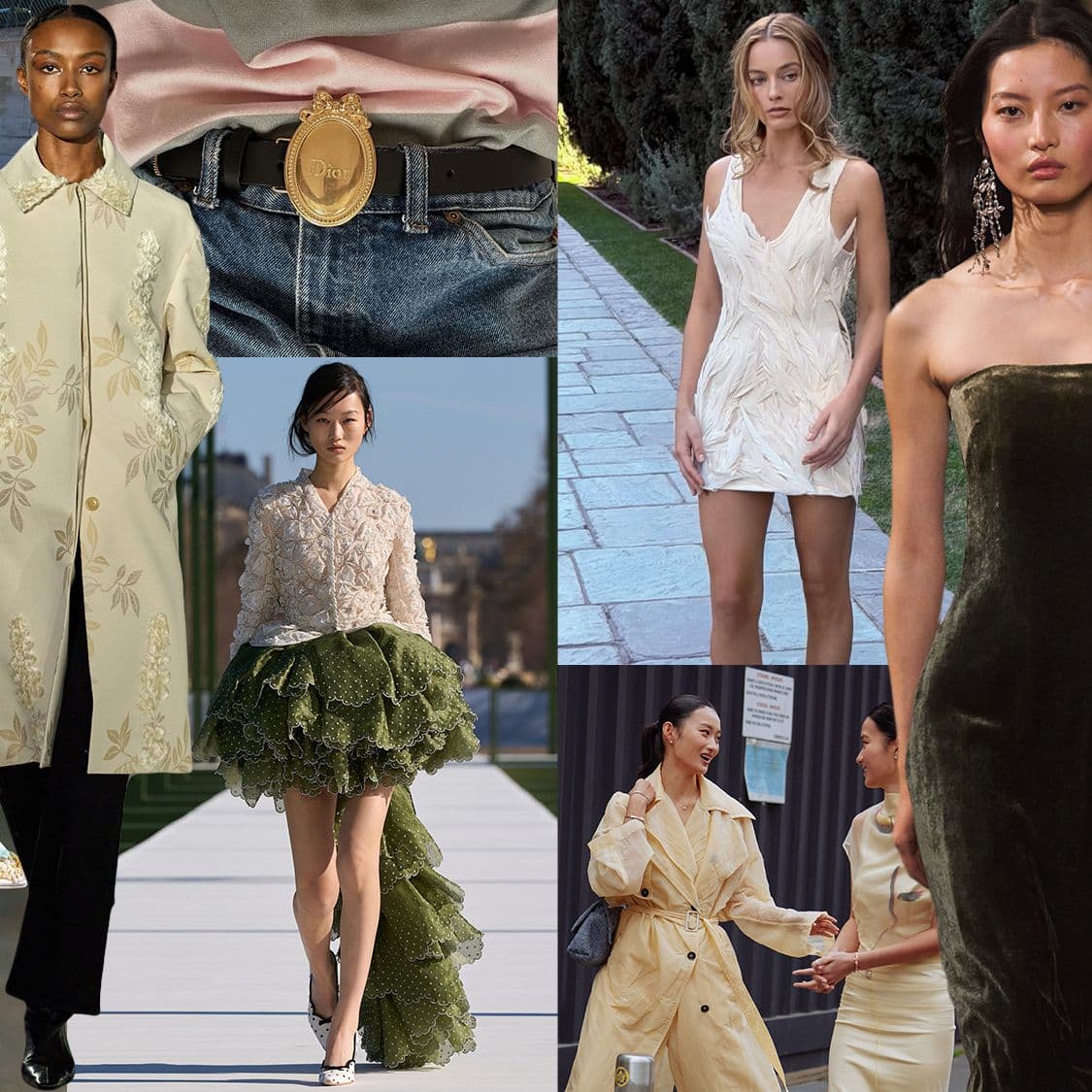
At Dior's Fall/Winter 2026 collection, Creative Director Jonathan Anderson sent models down the runway in voluminous and multilayered ruffled skirts, peplum jackets, and polka-dot heels. At Ralph Lauren and Valentino, cascading chandelier earrings were paired with velvet evening gowns, lace, and gathered taffeta skirts. These are not the gestures of a house tentatively testing the waters; they are declarations.
The Fall/Winter 2026 presentation took place inside a massive glass greenhouse built around an artificial water lily-filled pond, heavily inspired by Claude Monet and the historic Parisian tradition of promenading. The collection masterfully balanced masculine and feminine sensibilities, featuring reworked Bar jackets, delicate ruffle skirts, heavily embroidered jeans, and striking 3D floral footwear. It was immediately clear from the first look, which featured a polka-dotted ruffled tulle skirt with a flowing train, that this collection would be a delight. Anderson's concept was equally considered: the Fall/Winter 2026 collection imagines a group of "aristo-youth" wandering Paris as modern flâneurs. Their journey leads them to a commemorative plaque on Avenue Montaigne honoring Paul Poiret, the legendary couturier who revolutionized the early 20th century with fluid, global silhouettes. That framing matters for anyone thinking about old-money dressing: the aristocratic references are deliberate, but they are worn with restlessness rather than ceremony.
Anderson's brilliance lies in the way he remixes references with a streak of mischief, folding divergent codes into a single look. Smoking coat dresses and exuberantly ruffled blazers carried a rakish insouciance. Many looks featured a surprise bustle visible only from the rear, the sort of detail that might have caught the eye of a Baudelarian flâneur out for an afternoon stroll.
Across town, Chemena Kamali at Chloé was working in a similarly romantic but more bohemian register. Sculptural neo-bohemian pieces like frilly ruffled dresses came with serious heft, in shades of lilac and pale pink. The runway spoke softly yet confidently, balancing fluid silhouettes with tactile craftsmanship that feels lived-in rather than precious. Airy fabrics defined the collection's rhythm: whisper-light chiffons, washed silks, and breathable cottons flowed in elongated lines, creating motion without excess. This is lace and ruffle territory, but grown up, rooted in the kind of artisanal quality that reads as inherited rather than bought yesterday.
At Valentino, Alessandro Michele drew inspiration from an unusual place. Pier Paolo Pasolini published a letter in 1975 about fireflies, exploring their ability to endure even in the darkest conditions. This idea of resilience and hope captivated Alessandro Michele, and it translated to a collection described as channeling soft elegance and light romance: a counterpoint to the stripped-back functionalism that has dominated the luxury conversation for years.
The Celebrity Catalyst
If the runway sets the argument, the red carpet confirms it as a cultural moment worth paying attention to. Few press tours in recent memory have done more to crystallize a fashion mood than Margot Robbie's promotional circuit for Emerald Fennell's adaptation of Wuthering Heights in February 2026. Styled by Andrew Mukamal, Robbie stepped out in a custom Ashi Studio dress for the Australia premiere that keyed in on the romantically Victorian aesthetic she had been championing throughout the tour. The ivory design centered on a strapless bustier.
The tour was a lesson in how to wear cultural references rather than merely cite them. Alongside new designs by Thom Browne, Schiaparelli, and Matthieu Blazy for Chanel, Robbie also selected remarkable archival pieces, reinforcing a growing trend: stars looking to the past to say something new about the present. For the London premiere, Robbie wore a bracelet made of Brontë's own hair and a dress that was in a league of its own. The bracelet, recognized as Victorian mourning jewelry, featured an amethyst dangling from a bracelet woven with the hair of Emily and Anne Brontë.
At a London press conference, Robbie wore a pink feather-trimmed jacquard coat from John Galliano's Spring-Summer 1992 collection for Christian Dior. That detail is significant: it was not a contemporary piece packaged as vintage-adjacent. It was the real thing, and it proved that the language of soft romance is most powerful when grounded in actual history rather than its simulation.
The Red Carpet Confirmation
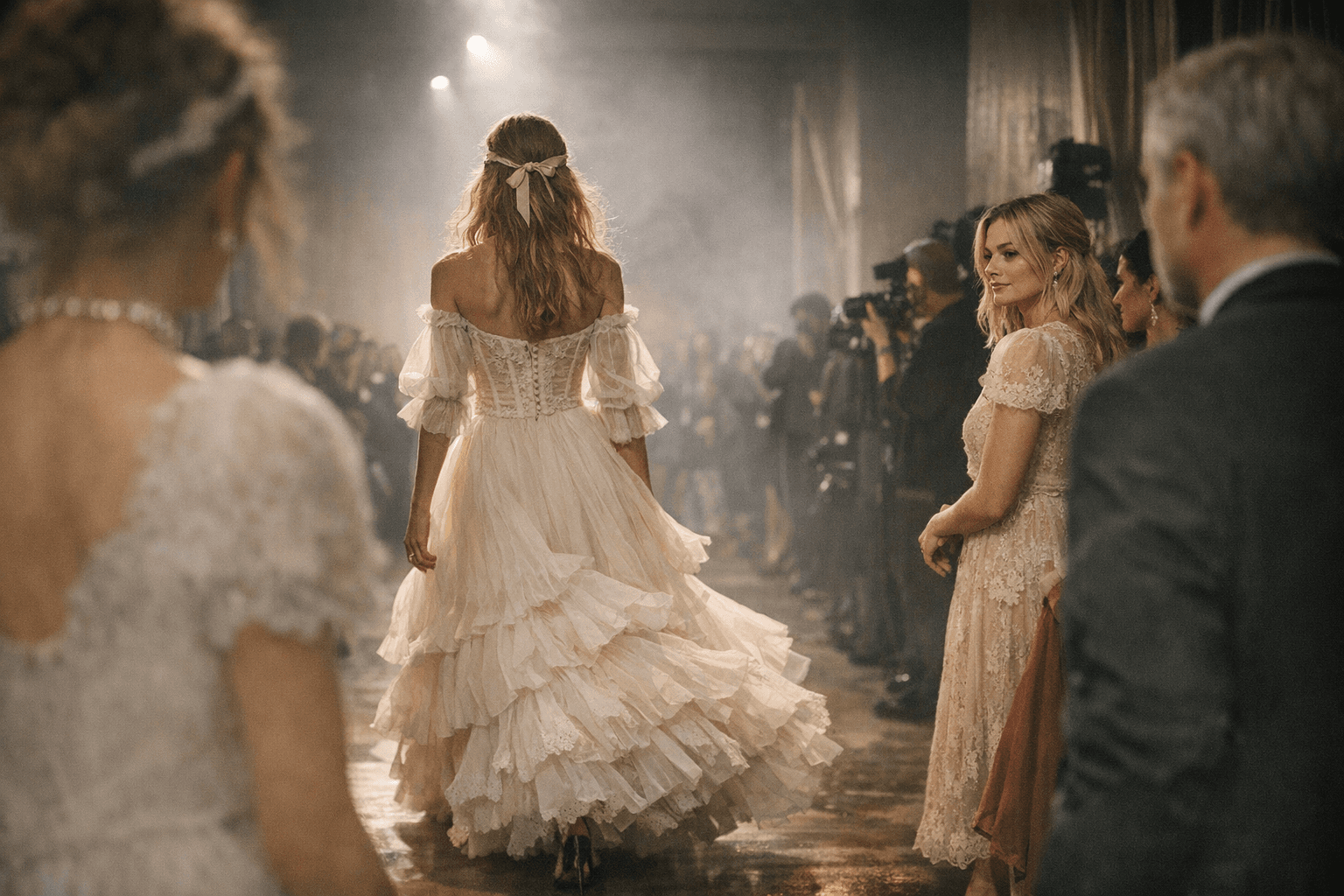
Victorian fashion made its official comeback on the 2026 BAFTAs red carpet, with high necks, ruffled collars, and puff sleeves appearing across multiple looks. The BAFTAs served as a kind of institutional endorsement: when the British film establishment collectively reaches for ruffled collars and Victoriana necklines, the trend has moved well beyond the avant-garde.
The market data reflects this shift. Demand for ruffled blouses is up 8% and ghillie lace-up shoes up 77%, according to Lyst. As one industry analyst put it, "Piratecore is shaping up to be one of 2026's most resonant trends. From Dior's romantic blouses and structural 'pirate' hats to McQueen's tall, slouched boots and lace-up necklines, we're seeing a return to soft drama through movement-rich pieces." Piratecore and soft romance may sound like opposite poles, but they share an impulse: the desire for clothes that move, that suggest a narrative, that carry history in their construction.
What This Means for Old Money Wardrobes
Here is where the trend becomes genuinely interesting for anyone who thinks about dressing in terms of longevity rather than seasonality. The old-money wardrobe has long been associated with restraint, with the idea that truly patrician taste announces itself only through cut and fabric quality. But that reading has always been partial. Think of the embroidered tablecloths that become heirloom gifts. The lace collar on a grandmother's blouse, stored in tissue paper. The velvet evening coat worn to three generations of Christmas dinners. Romance and heritage have never actually been opposites; quiet luxury simply asked us to forget that.
Soft romance, as it is taking shape in 2026, offers a way to reintroduce those details without abandoning the commitment to quality that defines old-money dressing. The key distinction is craft. An embroidered linen blouse from a small Portuguese atelier reads entirely differently from a mass-market ruffle. A gathered taffeta skirt in a house signature fabric is an investment, not a trend. The vocabulary is romantic; the grammar is still heritage.
How to Build It Into Your Wardrobe
The practical application does not require a full wardrobe overhaul. It requires one or two considered additions that soften an otherwise composed wardrobe:
- A blouse with a Victorian-adjacent detail, whether a high neck, a pintucked bib front, or a single ruffle cuff, worn with tailored trousers in a tonal neutral
- A gathered or tiered skirt in silk, linen, or fine wool crepe, treated as the point of the outfit rather than an afterthought
- An embroidered or lace-paneled layer, a cardigan, a blouse insert, or a vintage-inspired slip worn beneath something structured
- Archival or vintage pieces used as anchors: a single genuine heirloom carries more weight than a full look built from contemporary romantic pieces
The goal, as Dior's Anderson intuited with his "aristo-youth" flâneurs, is to feel collected rather than costumed. Soft romance at its most convincing looks like a wardrobe that has absorbed a century of taste, not one that checked a trend report in March and acted accordingly. The romance is real when the objects have weight behind them. That has always been the old-money principle, and in 2026, the runway has finally caught up with it.
This article was produced by Prism’s automated news system from verified source data, official records, and press releases, then run through automated quality and moderation checks before publishing. The system is built and supervised by the people who set the standards it runs under. Read our full AI policy.
Did this article answer your question?