Sustainable Cloud
The cloud couch has a sustainability problem. These boneless sofas fix it without sacrificing the sink-in linen aesthetic that defines quiet luxury in 2026.
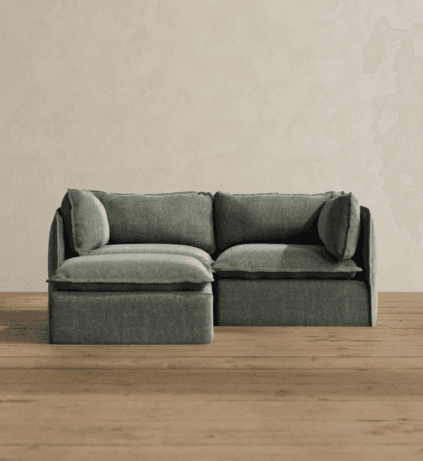
The same instinct that reaches for undyed linen trousers over polyester blends is now reshaping how people furnish their living rooms. Quiet luxury — that school of restrained taste that values material quality over visible logos — has moved off the body and into the home, and nowhere is its influence more visible than in the rise of the sustainable cloud couch.
The boneless sofa, named for its cushion-forward, frame-free aesthetic, is the furniture equivalent of an old money wardrobe: deeply tactile, studiedly low-key, and expensive enough that it reads as effortless. The challenge has always been that the viral cloud couch moment produced a wave of chemically treated, mass-produced pieces that contradict everything the look stands for. In 2026, a tighter group of brands is threading that needle — pairing the sink-in silhouette with fill materials, certifications, and construction quality that genuinely hold up.
What to Look For
Before committing to any boneless sofa, three factors determine whether it earns its place as a long-term investment rather than a fast-furniture regret.
Fill matters most. The classic cloud feel comes from layering: a high-density foam core wrapped in either ethically sourced feather down or a vegan down alternative. Both deliver that plush-yet-supported sensation, but vegan fills carry the added advantage of being hypoallergenic and cruelty-free. What to avoid is single-material foam construction with no outer wrapping — it compresses unevenly within two years and loses the billowy profile entirely.
Frame construction is the invisible investment. Solid kiln-dried hardwood frames, ideally FSC-certified, are the baseline. The FSC (Forest Stewardship Council) certification confirms the wood was sourced from responsibly managed forests, which matters both environmentally and for longevity. Kiln-dried wood resists warping and joint loosening in ways that engineered alternatives simply cannot sustain over a decade of daily use.
Washability determines real-world durability. Removable, machine-washable covers are not a convenience feature — they are a sustainability strategy. A cover you can launder at home extends a sofa's lifespan by years, reducing the pressure to replace it. Look for fabrics that are OEKO-TEX certified and free from PFAS, the class of "forever chemicals" found in many conventional stain-resistant treatments. Nontoxic DWR (durable water repellent) coatings now exist that repel liquid without the chemical burden.
The Brands Worth Knowing
Sixpenny sits at the top of The Good Trade's sustainable boneless sofa list, earning that position through two fill options: ethically sourced feather down and vegan polyester fill. The Grande sectional is built on a solid wood frame, with cushioning that layers your fill of choice around a high-density foam core, engineered for a deep, laidback, fluffy-yet-firm feel. Fabric choices span multiple linen weights, velvet, cotton canvas, and polyester weave, and everything is made to order — a deliberate move to sidestep mass production. The Grande starts at $4,780, a number that stings until you calculate cost-per-year against a $600 sofa you will replace twice in the same period.
7th Avenue launched in 2022 with a claim to have built "The World's Greatest Modular Sofa." Its covers and fabrics are OEKO-TEX certified, third-party tested, and formaldehyde-free, and the base is made from FSC-certified wood. Instead of traditional down, 7th Avenue uses a plush vegan, hypoallergenic, cruelty-free down alternative that delivers the same cloud-like comfort. Removable covers are machine washable and treated with a nontoxic PFAS-free DWR coating. Configurations run from compact two-seaters to sprawling sectionals, with pricing from $2,950 to over $10,400. For anyone who needs a sofa to adapt to different apartments or life stages, the modular architecture is the actual value proposition.
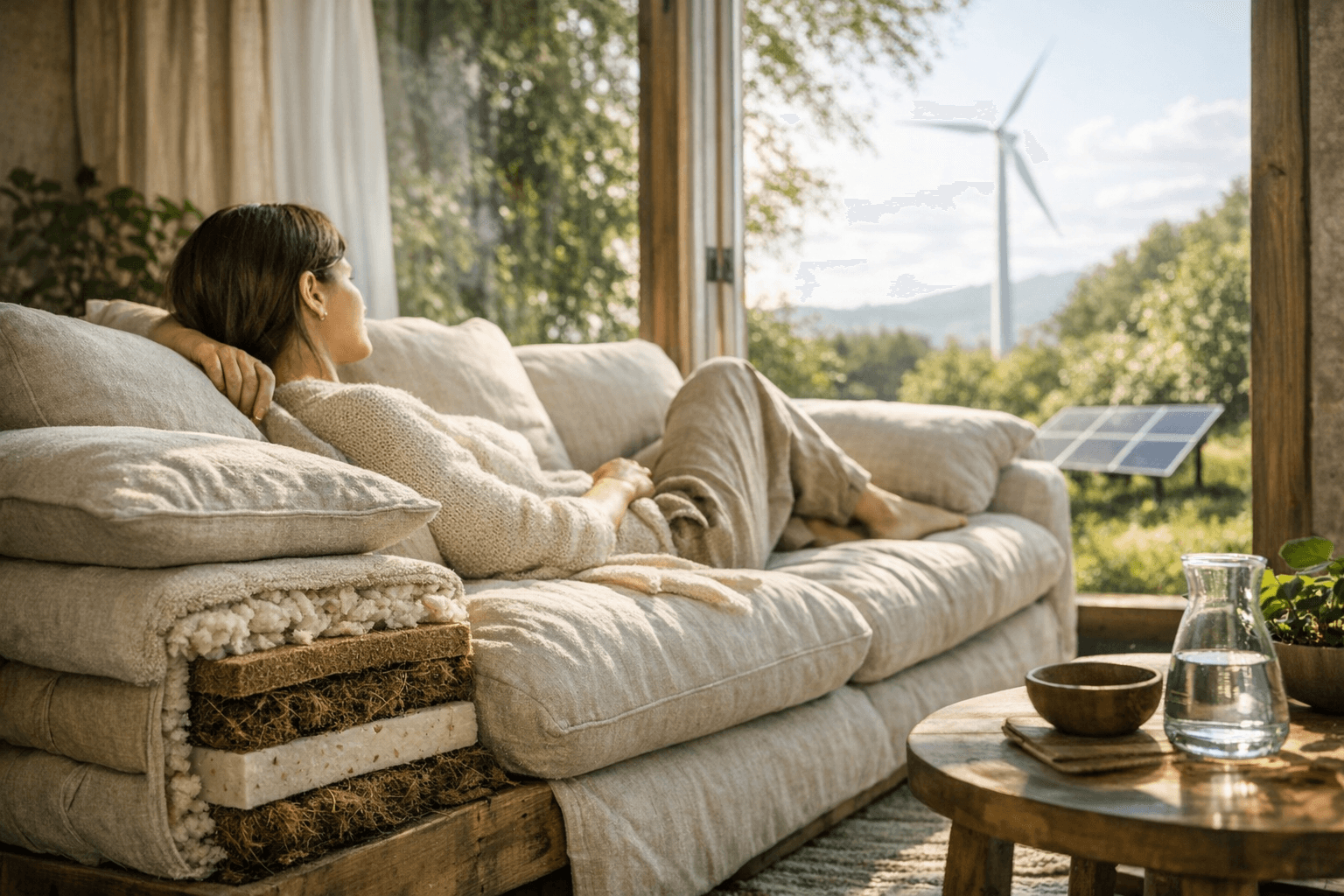
Sabai is made in North Carolina using natural fibers, FSC-certified wood, and recycled water bottles. The brand runs a closed-loop initiative and a secondhand shop, meaning there is a structured path for the piece at end of life rather than a landfill appointment. Pricing runs from $1,295 to $5,645, making it the most accessible certified entry point in the category. Homebody's sectionals are built with PFOS and PFOA stain-resistant treatment, fabrics made from recycled water bottles, and are flame retardant-free and made to order — starting at $3,740, with hidden phone chargers and remote pockets tucked into the design. Functional details that do not show, which is exactly the point.
The Palette Is Already There
The new neutral palette for cloud sofas in 2026 is earth-anchored: creamy oatmeal, deep terracotta, sandy beige, muted rust, rich olive green, chocolate brown. These are not coincidentally the same tones showing up in old money dressing — the oatmeal linen trouser, the camel overcoat, the dusty olive field jacket. The visual grammar is consistent across both domains: warm naturals, nothing that shouts, everything accumulating into a coherent atmosphere.
Rich, tactile textiles are essential to the quiet luxury interior because they add comfort without introducing clutter. Linen, boucle, and wool blends are doing the same work in upholstery that they do in suiting — creating depth through texture rather than pattern, signaling restraint through material choice rather than decoration. The cloud sofa, done correctly, is one more surface where that sensibility lands.
The Certification Shortlist
When evaluating any boneless sofa, these are the credentials that carry real weight:
- OEKO-TEX Standard 100: Confirms fabrics are tested for harmful substances including formaldehyde and heavy metals
- CertiPUR-US: Certifies foam is made without ozone depleters, heavy metals, and restricted phthalates
- FSC: Verifies responsible forest management for all wood components
- PFAS-free: Confirms the piece is free from per- and polyfluoroalkyl substances, including in stain-resistant coatings
The overlap between these certifications and what a slower, more considered approach to consumption demands is not accidental. The same impulse that makes you read a fabric tag before buying a jacket now applies to the sofa you plan to keep for fifteen years. That is the quiet luxury position in full: not the piece that impresses visitors immediately, but the one that still looks considered a decade from now, when everything cheap has already been discarded.
Know something we missed? Have a correction or additional information?
Submit a Tip