Tailoring Fixes Every Petite Woman Needs for a Perfect Fit
Off-the-rack clothes are cut for a 5'4" body. These five tailoring fixes will transform how everything fits on a petite frame.
There is a quiet frustration that lives in the dressing rooms of petite women everywhere: the blazer that hits mid-thigh instead of at the hip, the trousers that pool at the ankle before you've even left the store, the dress sleeve that ends somewhere near the knuckle. Ready-to-wear is, by industry default, drafted for a woman standing around 5'4" tall, which means that if you sit below that benchmark, even an otherwise perfect garment will betray you at the shoulder, the hem, and every proportion point in between. Tailoring is not a luxury add-on for petites; it is the difference between clothes that fit and clothes that wear you.
What follows is not a list of minor tweaks. These are the structural fixes that change how your entire wardrobe functions.
Shoulder seams: the fix everything else depends on
Start here, always. The shoulder seam is the architectural anchor of any structured garment, and on a petite frame it is consistently the first thing to go wrong. When the seam slides even half an inch past the natural shoulder point, the sleeve cap distorts, the chest gapes, and no amount of taking in or letting out elsewhere will correct it. You will recognize the problem instantly: a slight drag across the upper arm, a jacket that seems to shrug forward when you move.
A tailor moving a shoulder seam inward is more complex than a hem adjustment and will cost accordingly, which is why it is worth building this knowledge into how you shop. Before buying any structured jacket or coat, check the shoulder seam placement first. Everything else on a petite body is fixable with relative ease. A misaligned shoulder seam means significant reconstruction.
Sleeve length: where proportions become visible
Once the shoulder is correct, sleeve length becomes the most visible proportion signal on your body. A blazer sleeve that ends at the wrist bone or just above reveals the hand cleanly and maintains the long, unbroken line that creates the illusion of height. A sleeve that falls even an inch too long visually shortens the arm, adds bulk at the wrist, and makes the torso appear compressed.
For petites, this applies across all garment categories. Shirt sleeves, coat sleeves, and especially the sleeves of fine knitwear all behave differently when shortened, and a good tailor will understand how to reattach a button or reconstruct a cuff so the original detailing is preserved. The cost is usually modest, and the visual return is immediate.
Jacket length: the hip point that changes your silhouette
Jacket and blazer length is where most petite women feel the gap between what they try on and what they see in editorial images most acutely. The reason is geometric: a standard blazer is cut to end at or just below the hip on a taller frame, which creates a clean break and elongates the leg. On a shorter torso, that same jacket lands further down the thigh, cutting the body at its widest point and visually halving the leg line.
The fix is to shorten the jacket hem so it ends at or just above the hip bone. This single adjustment recalibrates the entire silhouette: legs read longer, the waist appears higher, and the blazer performs the proportional work it was designed to do. Single-breasted styles with minimal structure at the hem are the most straightforward to alter; jackets with pockets set into the hem seam require more skill but remain achievable for an experienced tailor.
Trouser rise: the adjustment most women overlook
Trouser rise is arguably the most underappreciated tailoring fix for petite women, and it is also one of the most transformative. Rise refers to the distance between the waistband and the crotch seam. On petite frames, a standard rise often means excess fabric in the seat and crotch area, which creates a sagging, unflattering drape that no belt can cure.
Shortening the rise brings the crotch seam up to where it should sit anatomically, which eliminates the drag, smooths the seat, and allows the trouser leg to fall cleanly from the hip. This is a structural alteration that requires a tailor comfortable with trouser construction, but it is transformative enough that it belongs on your list for every pair of trousers you intend to wear regularly. A well-fitted rise also makes a high-waisted trouser sit as intended rather than riding up uncomfortably through the day.
Hem: the obvious fix that still gets underestimated
Hemming is where most petite women start their tailoring relationship, and it is worth being specific about how to do it well. A trouser hem is not simply a question of removing length; it is a question of where on the shoe the break should fall. For wide-leg trousers, a full break or even a slight puddle is intentional and can work beautifully on petite frames provided the rise and waist fit correctly. For slim and straight-cut trousers, a clean hem that grazes the top of the foot is generally the most elongating choice.
Dress and skirt hems deserve equal attention. A midi skirt hemmed to the mid-calf on a petite figure often reads as dowdy rather than elegant because the hem cuts the leg at a visually heavy point. Bringing it up to just below the knee, or to the ankle for a more dramatic column silhouette, makes an enormous difference. Similarly, a maxi dress hemmed to the floor but with nothing underneath reads as height-forward; with even a half-inch of extra length dragging, the proportion collapses.
Building a relationship with the right tailor
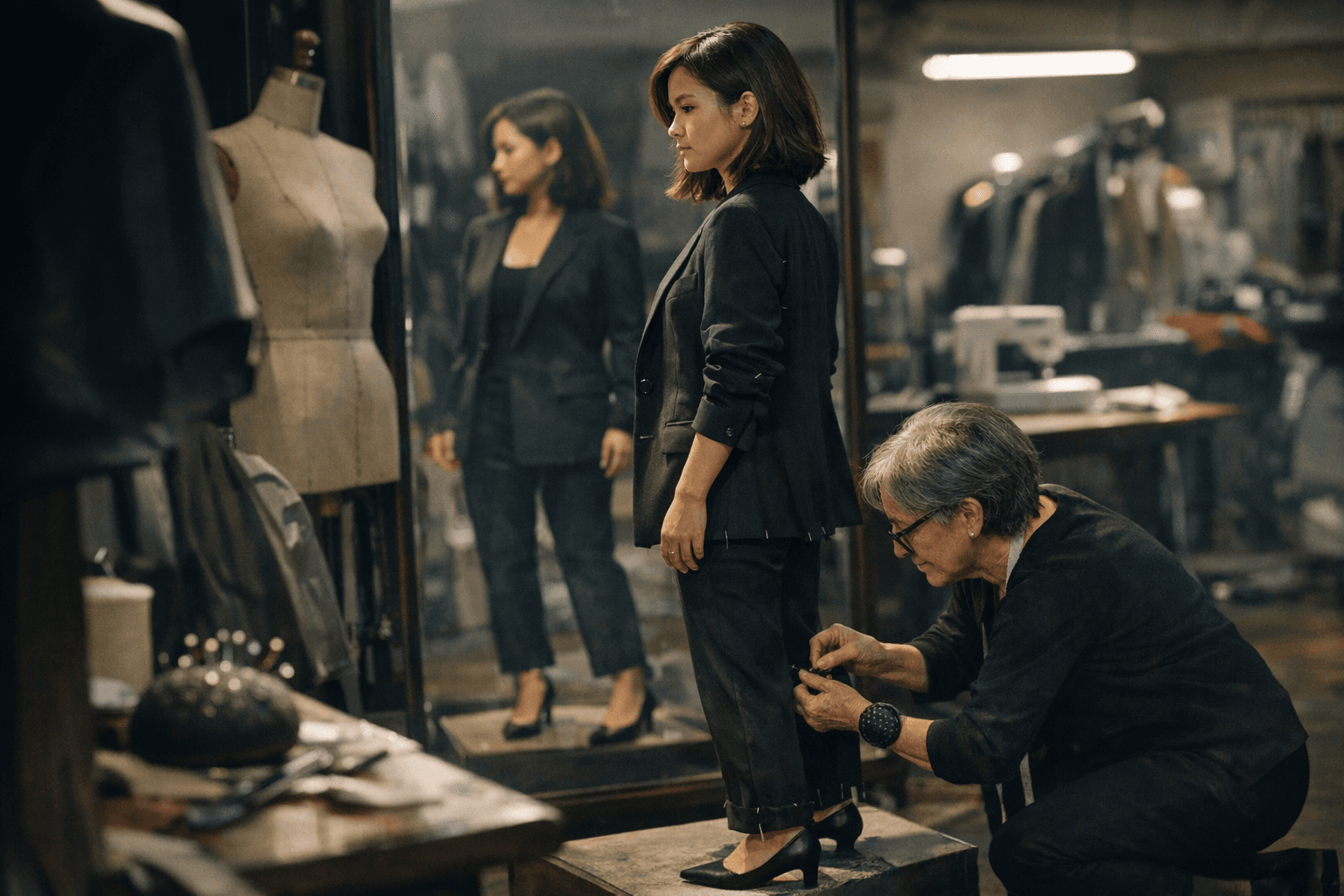
None of this is useful without access to a tailor who understands petite proportions specifically. Not all alterations professionals do. When you meet a new tailor, bring a garment you know fits you well as a reference point rather than describing the fit you want abstractly. Point to the shoulder seam position, the sleeve length, the jacket hem. A tailor who looks at those reference points and immediately understands what you are trying to achieve is someone worth returning to.
The cumulative effect of these five fixes across your wardrobe is not incremental; it is wholesale. Clothes that previously felt like compromises start to feel commissioned. That is the actual promise of tailoring for petite women: not perfection from scratch, but the intelligence to close the gap between what exists and what fits.
Know something we missed? Have a correction or additional information?
Submit a Tip