Why petite clothing is about proportion, not just shorter hems
Petite clothing works when the pattern is rebuilt for a shorter frame, not when a hem is simply chopped off. The real tells are in the rise, shoulders, sleeves, knee break and waist placement.
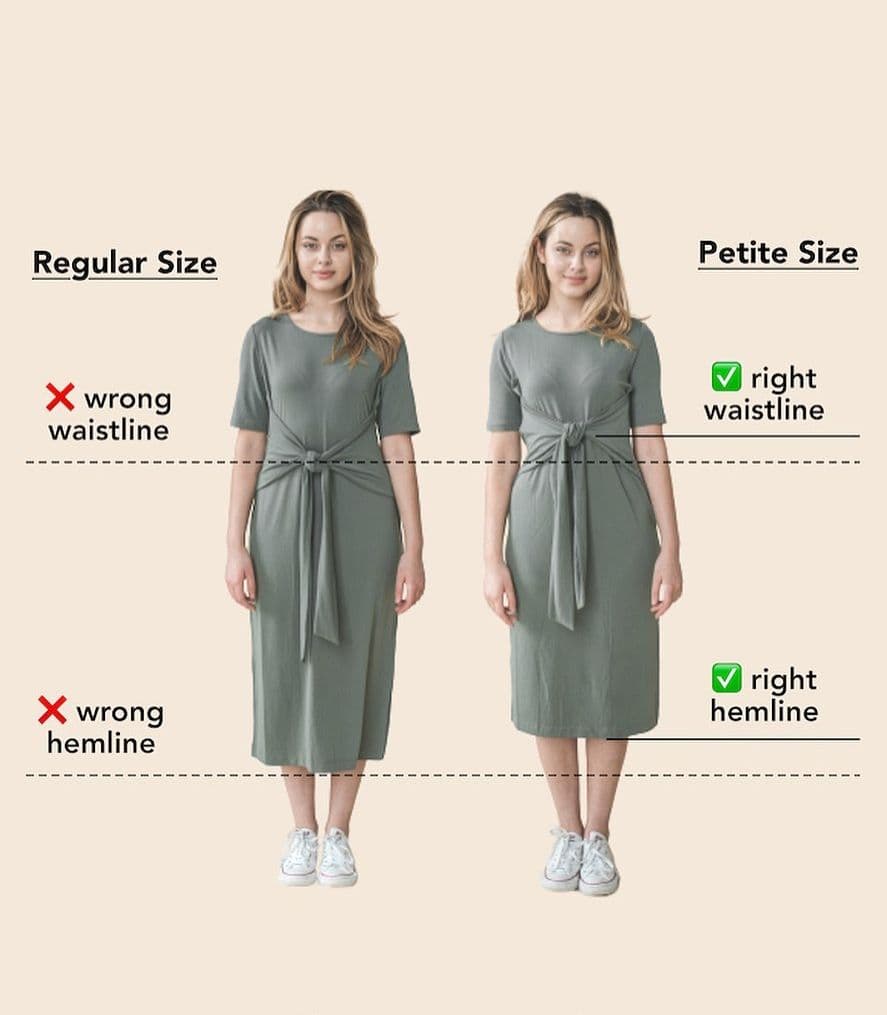
A blouse that pools at the shoulders, a pant rise that sits too low and a jacket button that lands in the wrong place cannot be fixed with a shorter hem. Petite clothing is about proportion: the garment has to be redrafted for a shorter frame, not merely trimmed down.
Why a regular-size garment can still fit badly after tailoring
The most common mistake is to treat petite as a length issue only. In practice, a regular-size piece can be hemmed and still look off because the waist sits too low, the armholes are too deep, the shoulder seams fall past the edge of the shoulder or the knee break lands too low on the leg. Petite shoppers feel this most sharply in jumpsuits, blazers and pants, where torso length, sleeve length and leg shape all have to work together.
Shoulder seams hanging down the arm, sleeves that swallow the wrist and jeans, skirts and shorts that still need tailoring all point to the same underlying issue: the garment was built on a longer block.
What true petite design actually changes
Nordstrom’s size guide places petite sizing at women 5'4" and under, and Stitch Fix places petite sizing at women 5'4" and under as a proportion category. The adjustment is not just inseam length. Short Story identifies the places that have to be reworked: shoulder seams, armholes, high-point shoulder-to-waist seams and pant rises.
Those are the details that change how clothing sits on the body. A shorter rise helps a waistband meet the natural waist instead of drifting south. A re-cut armhole keeps the upper arm from drowning in fabric. A shifted shoulder seam and a shorter shoulder-to-waist distance help a blazer or dress close where it should, rather than pulling through the torso.
Stitch Fix says petite sizing may also use extra stitches, pleats or darts for a more flattering fit. Pocket placement also affects the silhouette, because a pocket hung too low can drag the eye down and make the whole silhouette look heavier and shorter.
How to spot the difference on the rack
The easiest way to shop smarter is to stop looking only at the hem and start reading the proportions. A petite garment should look intentionally scaled, not simply shortened. Nobody’s Child says its petite line is “carefully re-crafted with precise adjustments” for women 5'3" and under and is “not just a shorter length.”
Look at where the waistband sits, whether the sleeve ends at the wrist bone, and whether the knee break sits where your leg actually bends and narrows. If the shoulder line looks wide on the hanger, or the jacket button appears too low, the fit will probably feel oversized even if the size number is correct.
- The waist should hit your natural waist, not your hip bone.
- The shoulder seam should sit at the edge of the shoulder, not slide down the upper arm.
- The pant knee should break at the right point, so the leg falls cleanly instead of puddling.
- The sleeve should finish at the wrist, not cover the hand.
- The pocket should sit in proportion to the body, not pull the eye downward.
A useful shortcut is to think in terms of visual balance:
Why petite sizing is a real category, not a niche label
Petite Femme says standard sizing was designed for women of above-average height, even though average female height in Australia, North America and the United Kingdom sits between 5'3" and 5'4". That helps explain why so many mainstream garments feel almost right and still look wrong. The issue is not vanity sizing or trend fatigue; it is a mismatch between the block and the body.
A Kyung Hee University abstract says current petite sizing charts may not accurately reflect actual petite women’s bodies, and that petite women’s body shapes should be categorized with fundamental body measurements used as a base size.
The category has history
Petite clothing is not a new retail invention. The Shortlist traces the history of petite fashion, and DEWEY maps its evolution over time. Petite Studio now makes clothing for women under 5'4".
This article was produced by Prism’s automated news system from verified source data, official records, and press releases, then run through automated quality and moderation checks before publishing. The system is built and supervised by the people who set the standards it runs under. Read our full AI policy.
Did this article answer your question?