B2B textile waste remains stuck at pilot scale, report says
Hotels, hospitals and construction sites are still sending usable textiles to landfill because sorting, data and economics fail before recycling can scale.
The problem is not a lack of waste. It is what happens before anyone knows what they have. Textile streams from hotels, hospitals, car plants, farms and building sites are still getting shoved into downcycling, energy-from-waste and landfill, while the recycling side stays trapped in pilot mode.
Reconomy says business-to-business textiles in commercial and industrial settings are a significant but largely unmanaged source of cost, risk and lost value. Its new report, Why B2B textiles are the next material risk, and opportunity, zeroes in on hospitality linens, healthcare linens, upholstered furniture textiles, automotive textiles, agricultural textiles and construction geotextiles. The sharp part is not the volume alone. It is the failure to intervene early enough, before clean material gets mixed with contamination, stripped of value and sent out the back door as someone else’s disposal problem.
That failure is brutally practical. Reconomy says the sector already has control points that could be used better, including industrial laundries, refurbishment programmes, dismantling sites, farms and construction projects. Yet most solutions still struggle to get beyond pilots, which means the cost of inaction keeps landing on operators that are already under pressure: hotel groups trying to reduce disposal bills, hospitals handling constant linen turnover, automakers managing complex dismantling, and construction firms dealing with bulky geotextiles and soft materials that are easy to ignore until they are expensive to move.
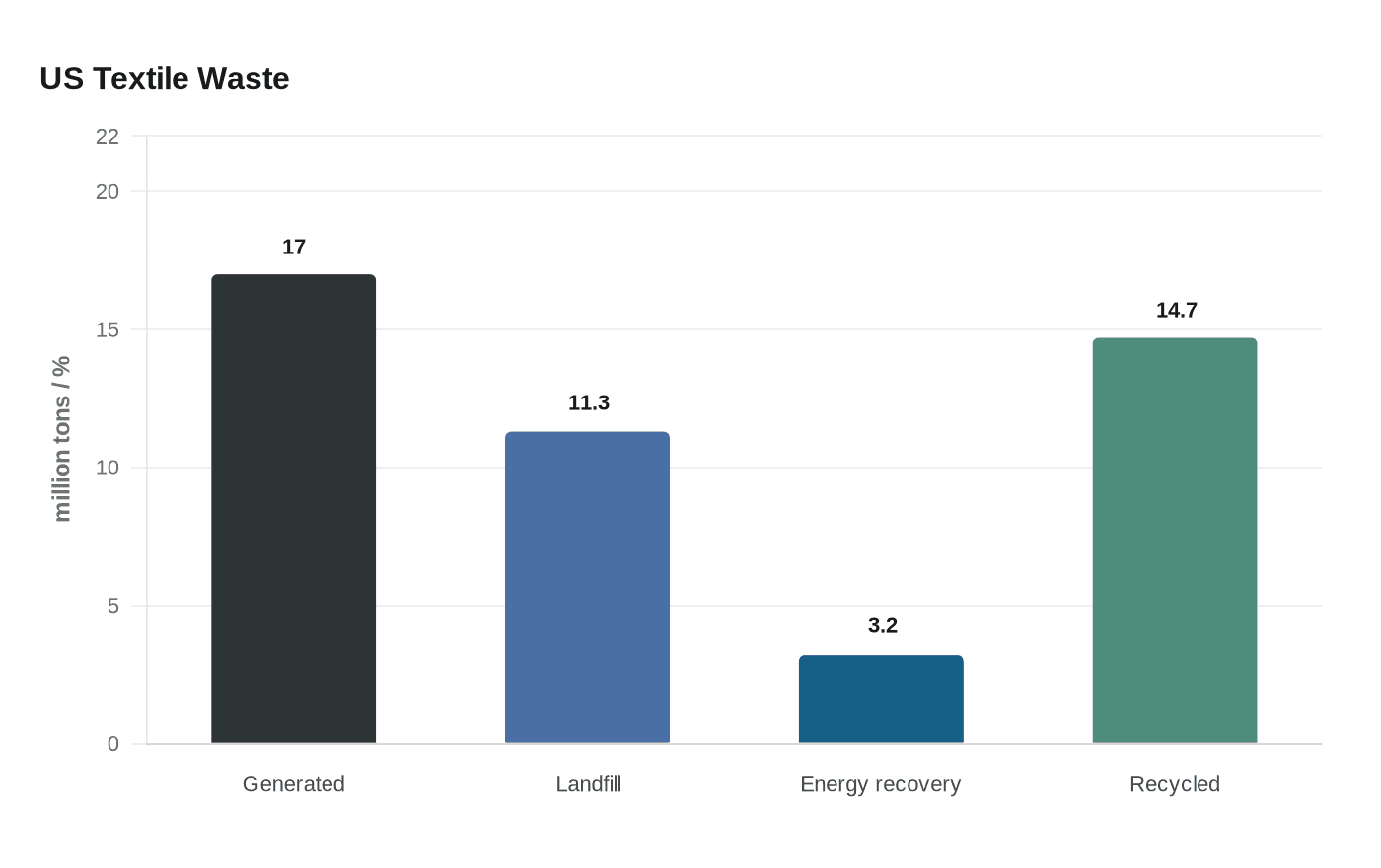
The scale of the mess is no small thing. Reconomy’s February 19, 2026 research estimated global textile waste at 120 million metric tonnes in 2024, with around 80 percent landfilled or incinerated. In the United States, the Environmental Protection Agency said textiles generated 17 million tons of municipal solid waste in 2018. Of that, 11.3 million tons went to landfill, 3.2 million tons were combusted with energy recovery, and only 14.7 percent was recycled. That is the gap in one ugly snapshot: a mountain of material, a thin sliver of recovery, and a recycling system that still cannot absorb the flow.
Policy is tightening, but policy alone will not sort a stained sheet or a mixed-fibre upholstery panel. The European Commission said the revised Waste Framework Directive entered into force on October 16, 2025, setting common rules for extended producer responsibility for textiles across the European Union. Reconomy’s July 14, 2025 EPR strategy says producers are being pushed toward responsibility for collection, reuse, recycling and disposal, with eco-modulation, Digital Product Passports and better supply-chain data at the center.
The bigger industry truth is the one the World Economic Forum has been flagging: textile circularity still suffers from poor standardization and weak reporting across countries. Until the sector can identify, aggregate and track B2B waste properly, the circularity pitch stays glossy and the material reality stays stuck in the bin.
This article was produced by Prism’s automated news system from verified source data, official records, and press releases, then run through automated quality and moderation checks before publishing. The system is built and supervised by the people who set the standards it runs under. Read our full AI policy.
Did this article answer your question?


