Bangladesh garment exports slide, layoffs and protests spread across factories
Bangladesh’s export engine is stalling: 79 factories cut 7,784 workers as orders thin, and protests have already shut the Dhaka-Aricha Highway.

Bangladesh’s garment industry is showing what happens when global brands squeeze prices and pull back orders: factories shed workers, wages wobble, and protests spill onto the highway. The country’s ready-made garment exports fell to $35.31 billion in the July-May stretch of FY2025/26, down 3.41 percent from a year earlier, while May 2026 exports slipped 8.29 percent to $3.59 billion.
The pain is landing first on workers, not boardrooms. At least 79 factories laid off 7,784 people in the first five months of the year through May 31, and the Bangladesh Garment Manufacturers and Exporters Association held an emergency board meeting to confront a decline that shows few signs of easing. In Savar, 1,868 workers were cut from seven Al-Muslim Group factories on June 6, and the layoffs sparked protests that briefly blocked the Dhaka-Aricha Highway.

This is not a clean economic slowdown. It is a supply-chain reckoning. Industrial police said the Savar and Gazipur layoffs were tied to insufficient work orders, excess labor relative to demand, labor unrest, and factory-rule violations. In Gazipur alone, layoffs between May 17 and June 7 affected 560 workers across 19 factories, a sharp sign that the pressure is spreading beyond one cluster or one employer.
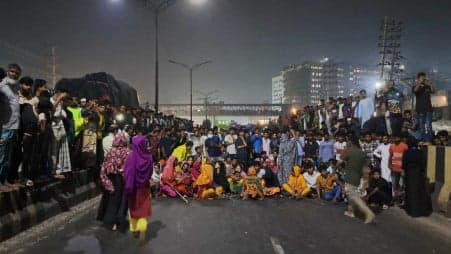
The geography matters. The hardest hits have been concentrated in industrial belts outside Dhaka’s metro jurisdiction, with Ashulia bearing the heaviest losses and Gazipur also absorbing substantial cuts. That is where the sector’s cheap, efficient, just-in-time image starts to fray. When orders tighten, the costs do not stay invisible for long. They show up in unpaid arrears, abrupt terminations, and workers forced into the street to demand reinstatement and wages.
Bangladesh still depends on garments to keep the country moving. Reuters reported in July 2025 that the sector accounts for more than 80 percent of export earnings, employs about 4 million people, and contributes roughly 10 percent of GDP. That makes every dip in demand bigger than a balance-sheet problem. It is a national stress test, especially for the brands that market sustainability and ethical sourcing while continuing to push down prices.

BGMEA has pointed to a knot of pressures behind the decline, including volatile global conditions, US reciprocal tariffs, high bank interest rates, poor port operations, and LDC-related issues. The broader contraction is already visible: BGMEA-linked reporting said 353 garment factories closed across Savar, Gazipur, Chattogram, Narayanganj, and Narsingdi over 14 months, leaving 119,842 workers jobless, while the Asia Floor Wage Alliance said more than 100,000 garment workers lost jobs over the previous year as at least 258 factories closed.

For fashion’s supply chains, that is the part no campaign can soften. When demand weakens, the burden falls fast on the people cutting, sewing, and finishing the clothes, and the promise of responsible sourcing is only as strong as the order books behind it.
This article was produced by Prism’s automated news system from verified source data, official records, and press releases, then run through automated quality and moderation checks before publishing. The system is built and supervised by the people who set the standards it runs under. Read our full AI policy.
Did this article answer your question?


