Brussels expo spotlights textile recycling systems and policy shift
Brussels will host more than 160 exhibitors as textile recycling shifts from conference rhetoric to the hard work of sorting, logistics and scale.
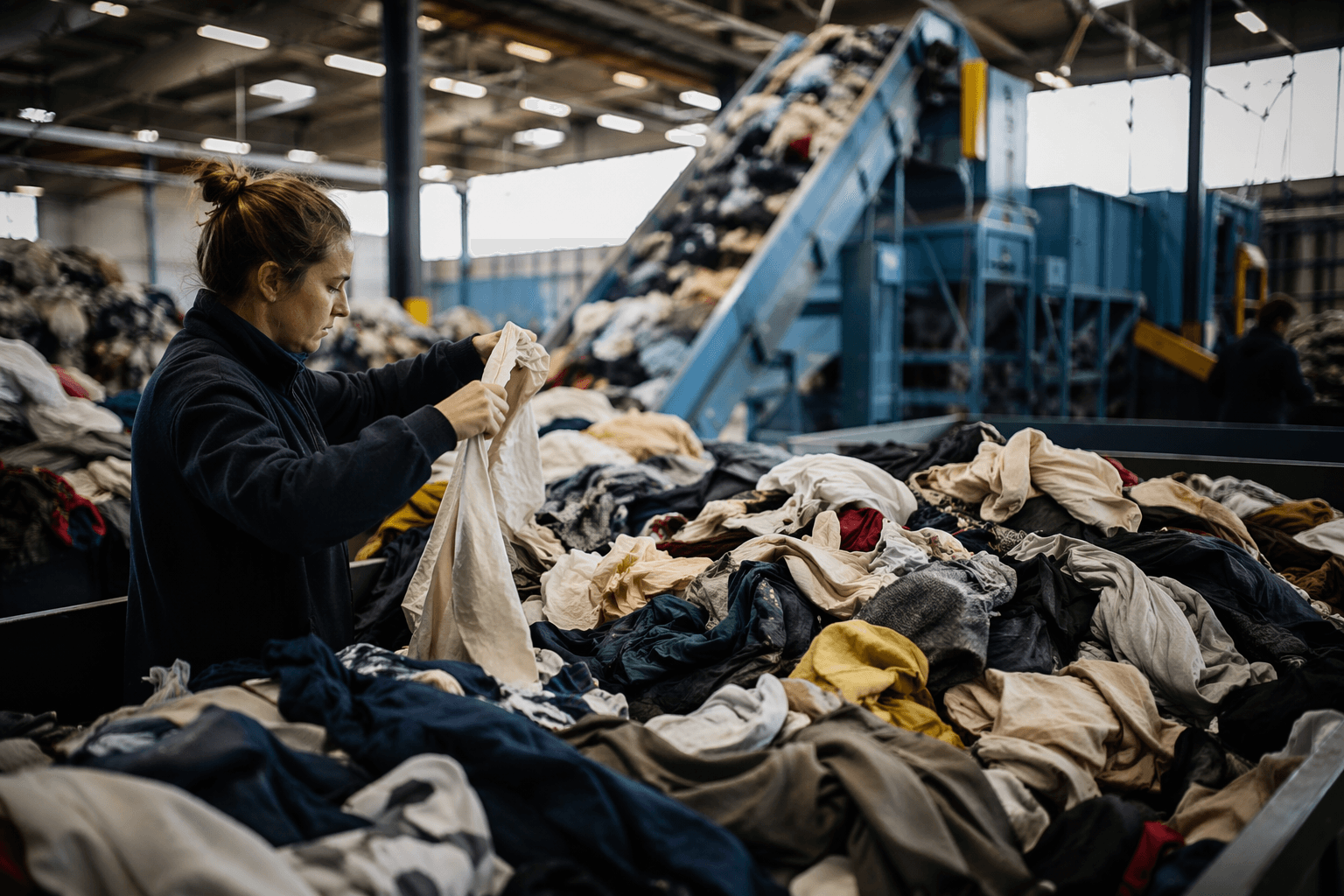
Brussels is about to become the test bed for textile circularity’s most stubborn problem: making recycling work at industrial speed, not just on a stage. The Textiles Recycling Expo will return to Brussels Expo on 24 and 25 June 2026, free to attend and held in person alongside the Future Fabrics Expo, with organisers framing the show less as a promise than as a hard look at what it takes to build a functioning system.
That system is where the fashion industry keeps stalling. The 2026 programme is built around policy and legislation, textile-to-textile recycling economics, collection and sorting, reverse supply chains, design for circularity, AI-driven sorting and advanced recycling technologies. A dedicated focus on uniforms, workwear and PPE adds a more utilitarian edge, a reminder that the circular economy is not only about runway-adjacent materials but also the dense, overlooked wardrobes that move through hospitals, warehouses and factories.
The exhibition floor is being billed as a large-scale working room, with more than 150 to 160 exhibitors, live demonstrations, an Industry Alliance Hub, a new Textiles Recycling Awards programme and networking spaces including the Reju VIP Lounge. That breadth matters because the bottlenecks are no longer abstract. Collection still lags far behind waste generation, sorting remains uneven, and the leap from recovered fibre to dependable feedstock for new garments is where many circularity claims unravel.
The European Commission’s numbers make the scale of the challenge impossible to romanticise. The EU textile and clothing sector generated €170 billion in turnover in 2023, employed 1.3 million people across 197,000 companies and produced about 12.6 million tonnes of textile waste in 2019. Only about one-fifth of that waste was separately collected for reuse or recycling. The Commission also says around 5 million tonnes of clothing are discarded each year in the EU, roughly 12 kg per person, and only 1% of material in clothing is recycled into new clothing.
That policy pressure is now sharpening. The revised Waste Framework Directive entered into force on 16 October 2025, requiring Member States to establish extended producer responsibility schemes for textiles and footwear and reinforcing separate collection of textiles from 2025. Against that backdrop, Brussels looks less like a trade-show stop and more like a checkpoint. If the expo’s first edition drew more than 3,300 attendees, the real question for 2026 is whether the crowd will find evidence that implementation is finally catching up with the industry’s rhetoric.
This article was produced by Prism’s automated news system from verified source data, official records, and press releases, then run through automated quality and moderation checks before publishing. The system is built and supervised by the people who set the standards it runs under. Read our full AI policy.
Know something we missed? Have a correction or additional information?
Submit a Tip