Kering reports 97% raw material traceability, 34% emissions cut
Kering says it can trace 97% of key raw materials while cutting emissions 34%, but the missing 3% is where luxury still gets messy.
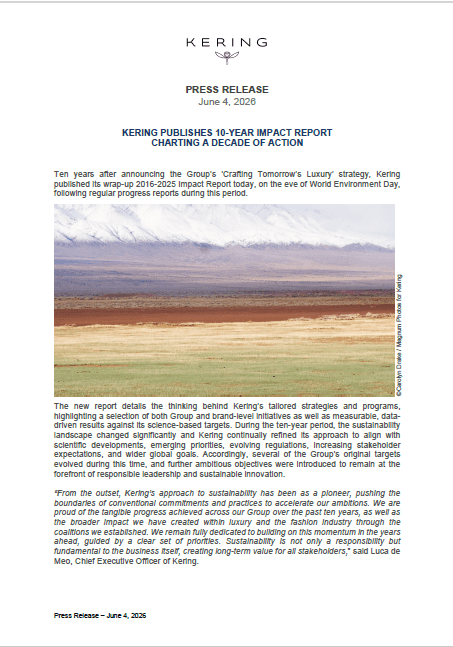
Kering’s new 10-year impact report reads less like a victory lap than a scorecard, and that is exactly why it matters. The French luxury group says it can now trace 97% of key raw materials and align 86% of them with Kering Standards, while also delivering a 34% absolute cut in greenhouse-gas emissions versus a 2022 baseline. Those are not slogan numbers. They are the kind that show whether a house group is actually getting its arms around leather, fibers, chemicals and sourcing, or just dressing up a promise.
The timing is pointed. Kering released the report on the eve of World Environment Day, a decade after launching “Crafting Tomorrow’s Luxury,” the framework that shaped its 2017-2025 roadmap around Care, Collaborate and Create. The company is now trying to show that the industry’s sustainability problem has moved past pledges and into system design. That means traceability, standards alignment and emissions cuts, not mood-board language about responsibility.

Some of the infrastructure has been in place for years. Kering says it founded the Material Innovation Lab in 2013, and that the lab now gives its Houses more than 3,000 sustainable fabric and textile samples to work with. It also partners with the Fashion for Good - Plug and Play Accelerator to back start-ups and disruptive innovation, which is where the real fashion-tech action lives when bio-based, recycled and lower-impact materials need to get beyond pilot purgatory. Kering’s Standards, developed with internal teams, external experts and NGOs, cover traceability, social compliance, environmental protection, animal welfare and chemical use. That breadth matters, because luxury can only claim control if it can control the whole chain.
The group has also spent the past few years making specific, public breaks. In September 2021, Kering said it would stop using animal fur across all its Houses starting with Fall 2022 collections, after Gucci and other brands had already begun moving away from it. In 2020, it helped create The Fashion Pact, which by October that year had more than 60 signatories, over 200 brands and about one-third of the fashion industry. That same year, it launched a biodiversity strategy aimed at net positive impact by 2025. Later came Science Based Targets Network work on freshwater and land, and in October 2024 Kering said it was one of the first three companies, and the only one in fashion, to adopt those goals. The targets are specific: cut freshwater use by 21% by 2030, land use by 3% by 2030, and source no leather from deforested land.
Still, the report’s cleanest numbers do not erase the hard questions. A 97% traceability rate leaves a gap, and a 34% emissions cut against a 2022 baseline says a lot about momentum but not yet enough about the pace needed to reach deeper decarbonization. Kering’s May 2025 Water-Positive Strategy, with a Net Water-Positive Impact target by 2050 and 10 critical basins starting with the Arno in Tuscany, shows the company knows the next frontier is water, land and supply-chain geography, not just carbon accounting. Ten years in, Kering is no longer selling the idea of sustainable luxury. It is trying to prove that luxury can be rebuilt around measurable restraint.
This article was produced by Prism’s automated news system from verified source data, official records, and press releases, then run through automated quality and moderation checks before publishing. The system is built and supervised by the people who set the standards it runs under. Read our full AI policy.
Did this article answer your question?