Resale Shifts From Fringe to
Resale grew 19% in 2025, outpacing traditional apparel retail 3.6 times over; here's how brands are turning secondhand into a margin-positive growth engine.
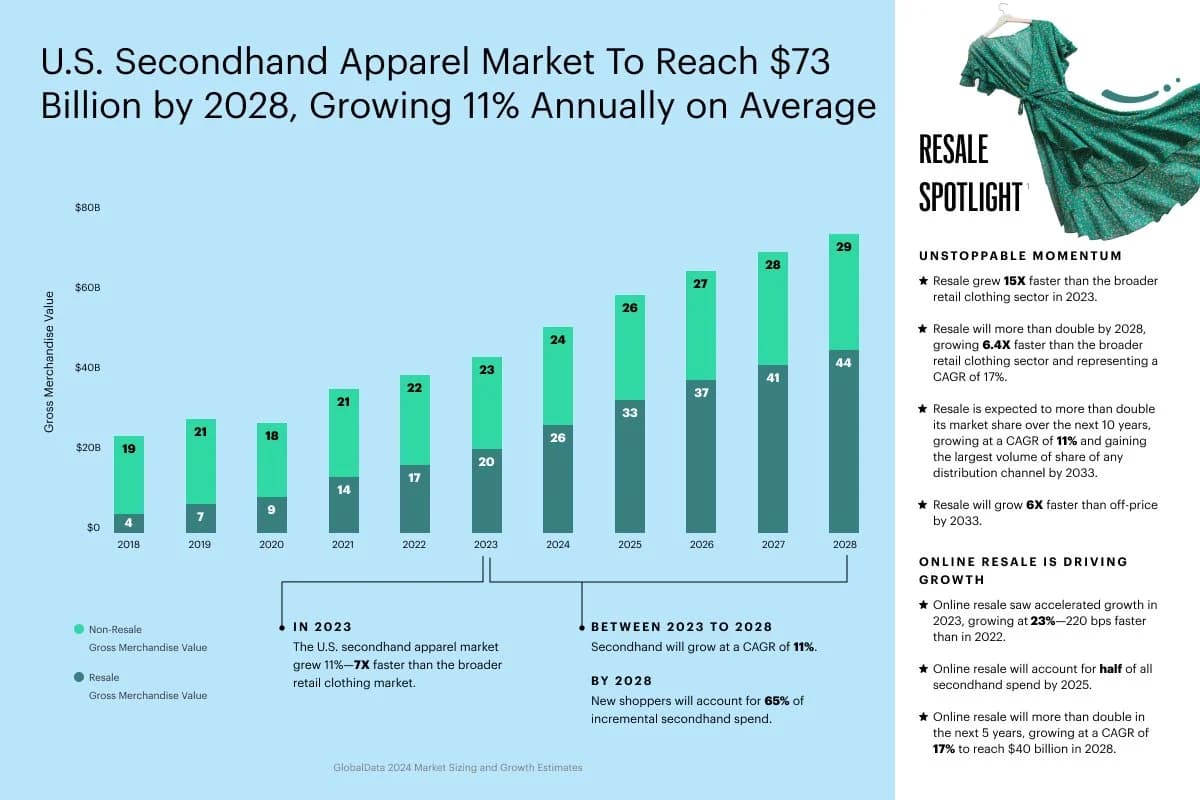
Fifty-nine percent of American consumers bought secondhand apparel in 2025, up seven points in just three years. That is not a niche number. According to ThredUp's 2026 Resale Report, the U.S. secondhand apparel market grew 19% last year, its strongest annual growth since 2021, outpacing the broader retail clothing market by 3.6 times. The global secondhand apparel market is now on track to reach $393 billion by 2030, representing roughly 10% of all global apparel spend. U.S. online resale alone is projected to hit $31 billion this year, up from $26 billion in 2025. As James Reinhart, CEO of ThredUp, put it plainly: "Resale is no longer just growing, it's taking share."
The strategic question for every brand is no longer whether to enter resale, but which model to use and how to make it profitable rather than merely virtuous. Four dominant structures have emerged, each with distinct implications for margin, inventory risk, and brand control.
The Four Operational Models
In-House Managed Resale
The most capital-intensive approach is also the one that delivers the greatest brand control and, potentially, the highest margin. Here, the brand buys back its own product, processes it internally, and sells it through a dedicated resale channel. Patagonia's Worn Wear program is the clearest proof of concept: the brand offers gift cards ranging from $10 to $100 per item, routes pieces to a dedicated logistics hub in Reno, Nevada, and lists them on wornwear.com after inspection and cleaning. Early results were striking: Worn Wear posted 40% growth in revenue, profitability, and customer count, and those new customers were, on average, a decade younger than Patagonia's typical buyer. The brand also operates 70 global repair centers that handle more than 100,000 items per year, embedding durability into the commercial model rather than treating it as a sustainability footnote.
Eileen Fisher pioneered the category even earlier. Launching its Renew take-back program in 2009, the brand accepts items in any condition for $5 per piece, refurbishes wearable garments for resale through dedicated Renew retail locations and an online shop, and repurposes damaged textiles into art and home goods. The inventory risk here is real: brands absorb the cost of acquisition, cleaning, photography, and fulfilment before a single secondhand sale clears. But the margin recaptured on brand-owned product, combined with the loyalty loop of returning customers spending store credit, makes this model attractive for labels with high product quality and strong repurchase rates. Coach, Lululemon, and Net-a-Porter's The Outnet have each built managed, brand-owned resale sites using this same logic.
Marketplace Partnership
For brands that want resale exposure without the operational overhead, partnering with an established external marketplace offers a faster entry point. Stella McCartney's 2017 partnership with The RealReal remains the canonical example: customers who consigned Stella pieces received $100 in store credit, creating a circular spending loop that drove traffic back to her mainline boutiques while publicly staking a claim on the durability of her product. The implicit message to the consumer was powerful: this label is confident enough in its construction to put a resale guarantee behind it. Burberry took a similar route through Vestiaire Collective.
The trade-off is brand control. On a third-party marketplace, pricing, presentation, and adjacency to other brands are largely out of the originating brand's hands. A $2,000 coat photographed on a white wall next to a blurry fast-fashion listing is not the same brand experience as a curated in-house resale page. Margin also flows primarily to the platform, making this model more useful as an acquisition and loyalty tool than as a direct revenue driver.
Buy-Back Credit via Resale-as-a-Service
The middle path that has attracted the most recent momentum is Resale-as-a-Service, or RaaS, in which a third-party platform builds and operates the resale infrastructure under the brand's banner. ThredUp's RaaS offering is the clearest example: Lands' End signed on in January 2026, giving customers a clean-out program that generates shopping credit redeemable at Lands' End, while ThredUp manages authentication, condition assessment, and fulfilment. Vestiaire Collective runs a structurally similar program: customers resell items on Vestiaire in exchange for store credit at the originating brand, keeping spend inside the brand's ecosystem.
This model distributes inventory risk to the platform operator while preserving the brand's customer relationship. Margin on the resale transaction is shared, but the real commercial value is in the credit mechanism: a customer who receives $40 in store credit is statistically more likely to spend beyond that amount than a customer entering cold. Customer lifetime value increases without the brand carrying the operational complexity of a secondhand fulfilment center.
Peer-to-Peer Brand Enablement
The fourth model removes the brand from the transaction almost entirely. A brand builds or licenses the infrastructure for customers to sell directly to each other on a branded resale platform, collecting a small facilitation fee while keeping activity within its own commerce environment. M.M. La Fleur, Outerknown, and Steve Madden have each experimented with this approach. The margin per transaction is thin, but the inventory risk is zero: the brand never takes ownership of the used item. The upside is data. Every peer-to-peer resale transaction tells the brand which products hold value, which silhouettes stay desirable, and which customers are most loyal, intelligence that can sharpen future design and pricing decisions considerably.
What Resale Does to Prices, Durability, and Design
The downstream effects on product strategy are significant and still underappreciated. When a brand's items appear on the secondary market, they acquire a publicly visible resale value. That creates a direct incentive to build better product: a jacket that sells for 60% of its original price on Worn Wear after five years of use is a more compelling first-purchase argument than one that surfaces on Depop for $12. Brands that have leaned into resale are increasingly treating durability as a marketing claim backed by observable market data rather than a subjective promise.
For the consumer, the immediate impact is access. U.S. online resale is growing at roughly 16% annually according to the BoF-McKinsey State of Fashion 2026, and the expanding supply of authenticated secondhand product is creating meaningful pricing pressure on new goods, particularly in the accessible luxury and premium outdoor categories where brands like Patagonia and Coach compete. A shopper who can find a near-perfect Lululemon Scuba hoodie for $55 on a branded resale site rather than $128 new is making a purchasing decision that the brand itself has now endorsed.
What to Look for When Buying Secondhand
Navigating resale well requires understanding a few structural differences from primary retail.
- Authentication: Prioritize platforms or programs with independent verification. Vestiaire Collective's brand-approved initiative allows brands to authenticate their own pieces directly; eBay extends its authenticity guarantee to handbags priced over £500; Vinted offers optional seller verification for designer items. In-house brand programs such as Worn Wear and Eileen Fisher Renew authenticate by default, since the brand controls the intake process.
- Condition grading: Look for standardized condition language before committing to a purchase. Terms like "excellent," "very good," and "good" vary by platform; the best programs include detailed written descriptions and multiple photographs of actual wear points (collars, cuffs, seams, zippers) rather than aspirational studio shots.
- Repair services: Patagonia's commitment to repairing more than 100,000 items annually before resale is a model worth looking for in any brand program. A resale item that has been professionally assessed and repaired by the original brand is meaningfully different from one listed by a private seller who assessed it in their bedroom.
- AI-assisted pricing and discovery: Platforms investing in machine-learning tools for dynamic pricing and personalized discovery (ThredUp and Vinted are both building in this direction) will surface better matches faster and price items more accurately against real market comps. This benefits both sellers seeking fair value and buyers avoiding overpayment.
The number that should end every brand conversation about resale: 94% of retail executives now report that their customers are already participating in the secondhand market, according to ThredUp's 2025 Resale Report. The question is not whether your customer is buying used clothing; she is. The question is whether your brand is part of that transaction or watching it happen on someone else's platform.
This article was produced by Prism’s automated news system from verified source data, official records, and press releases, then run through automated quality and moderation checks before publishing. The system is built and supervised by the people who set the standards it runs under. Read our full AI policy.
Did this article answer your question?


