Archroma Unveils Six Denim Innovations Targeting Cleaner Chemistry and Circularity
Archroma's six new denim technologies, including aniline-free indigo and mill-level ring-dyeing, could reshape how workwear denim performs and pollutes.

Denim has always been work fabric. Before it was a fashion category, it was utility material, and the chemicals used to color it were chosen for intensity and cost, not safety or environmental outcome. Archroma announced six denim innovations in early April that challenge that calculus directly, with new colorant chemistry and a novel mill-level dyeing process targeting cleaner production and better recyclability. The company plans to present all six at Kingpins Amsterdam, running April 15-16.
The most chemically significant entry is DENISOL® PURE INDIGO, a synthetic indigo formulated without aniline. Aniline is a byproduct of conventional indigo synthesis and a known hazardous compound flagged by major chemical safety frameworks for its links to aquatic toxicity and human health risk. Removing it from the indigo supply chain changes the safety profile of every yard of denim dyed with it, a genuine shift for workwear where fabric sits against skin for eight or ten hours at a stretch. For colorfastness and hand feel, aniline-free synthetic indigo maintains the deep-blue character that workwear buyers require without the chemical residue risk that has complicated conventional indigo's regulatory standing.
Alongside it, DIRESUL® EVOLUTION BLACK is Archroma's answer to sulfur black, the dyestuff most commonly used for black denim. Sulfur dyes have a long history in workwear for their washfastness and cost efficiency, but conventional versions carry a high environmental liability in discharge. The EVOLUTION BLACK formulation targets a lower lifecycle impact, which in practical terms means reduced chemical load in mill wastewater and a cleaner profile across multiple industrial wash cycles, critical for uniforms and utility workwear that spend their working lives in commercial laundry conditions.
The circular colorants, EARTHCOLORS® and FIBERCOLORS®, approach the problem from a different angle. EARTHCOLORS® are derived from agricultural waste; FIBERCOLORS® are derived from wool waste, both designed for recyclability and reduced virgin-resource dependency. For workwear brands navigating extended producer responsibility legislation in Europe and sustainability commitments at the brand level, colorant traceability and end-of-life recyclability are becoming purchasing criteria, not just marketing language.
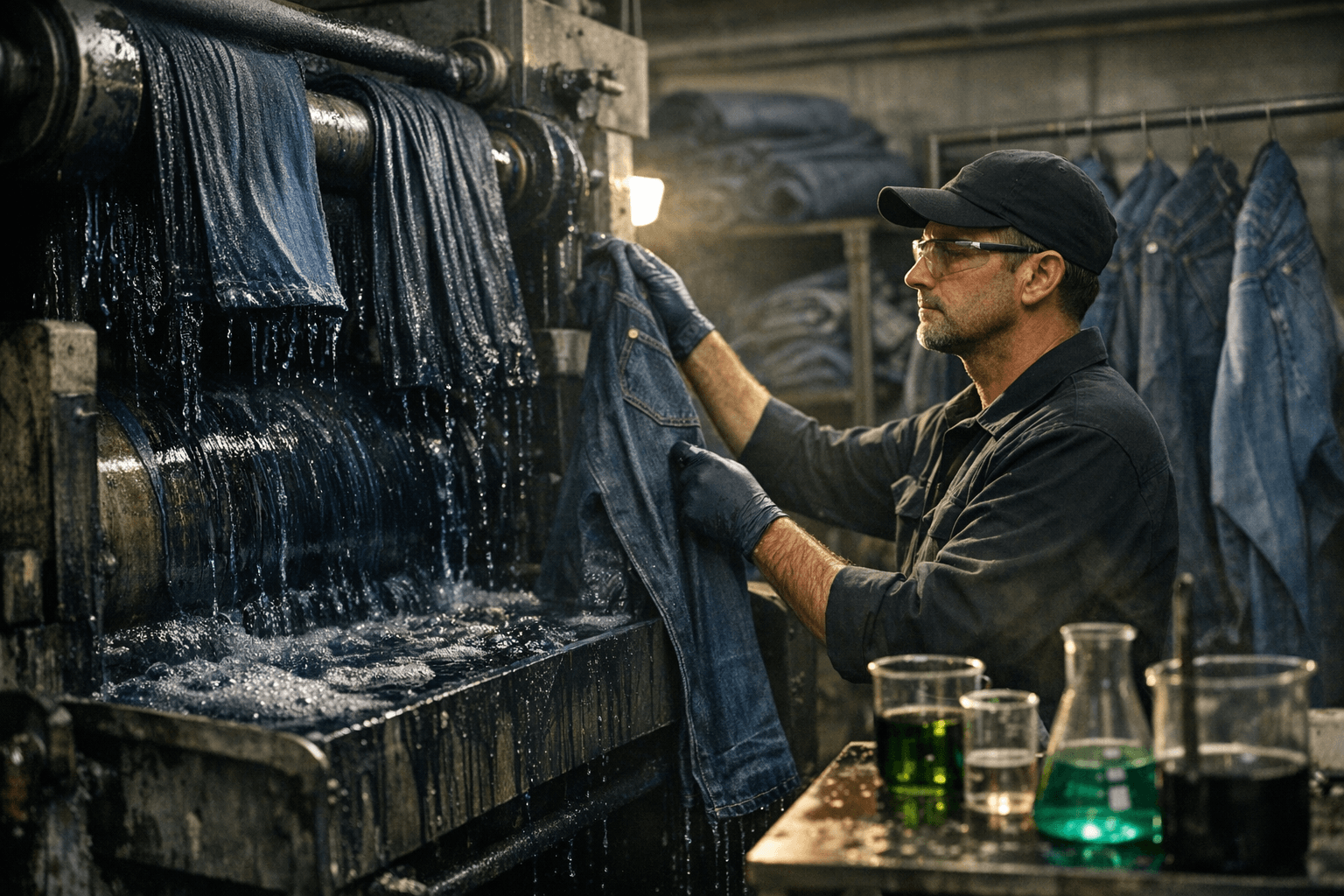
The process innovation with the most direct bearing on workwear performance is DENIM HALO, a ring-dyeing technique applied at the mill that reduces the need for downstream laundering and bleaching. Traditional denim finishing involves significant water and chemical use to achieve the worn-in appearance that both fashion and functional workwear demand. By shifting that effect earlier in the production chain, DENIM HALO can preserve more of the yarn's structural integrity, which translates to better abrasion resistance and dimensional stability in finished garments. Work pants that hold their shape wash after wash, and resist the fiber breakdown that aggressive finishing accelerates, are a meaningful performance argument for buyers sourcing at volume.
For brands evaluating these innovations at Kingpins and beyond, the questions to put to mills are specific: Which ZDHC-recognized test methods validated the aniline-free claim on DENISOL® PURE INDIGO? What washfastness and abrasion ratings did DIRESUL® EVOLUTION BLACK achieve under EN ISO standards? Can EARTHCOLORS® and FIBERCOLORS® supply full waste-source traceability documentation? What bleaching and finishing steps does DENIM HALO eliminate, and what is the water-volume reduction per meter of fabric? And across all six, what third-party certification is in place or in progress?
Archroma has built the framework. The accountability comes next.
This article was produced by Prism’s automated news system from verified source data, official records, and press releases, then run through automated quality and moderation checks before publishing. The system is built and supervised by the people who set the standards it runs under. Read our full AI policy.
Did this article answer your question?