Falcons unveil new uniforms ahead of 2026 season
Red is back in Atlanta: the Falcons' 2026 redesign revives 1966-era details that double as a masterclass in heritage workwear codes done right.
The Atlanta Falcons just delivered the most instructive uniform drop of the spring, and the lesson has very little to do with football.
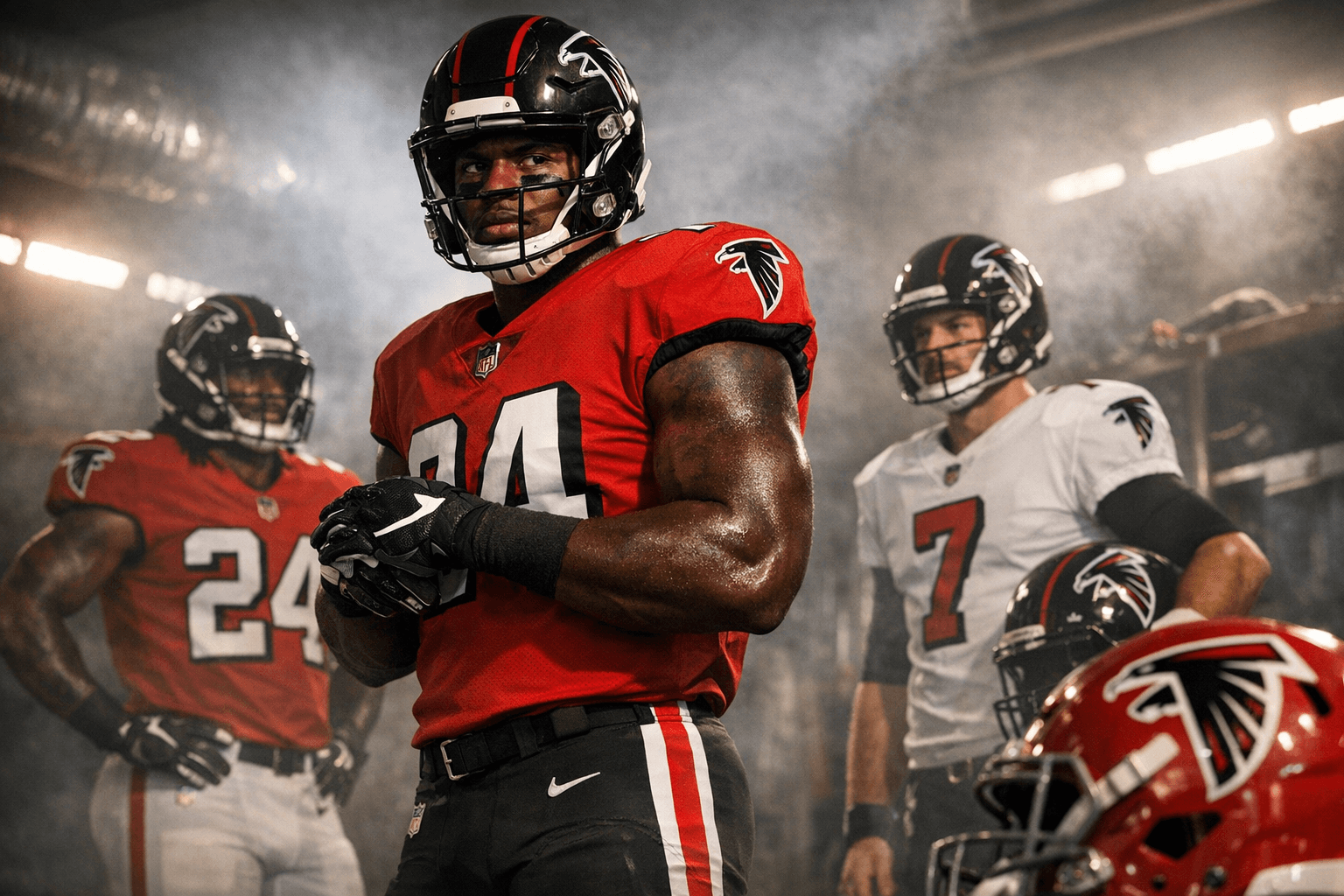
The franchise revealed its redesigned uniforms on April 2, debuting a set that simplifies its aesthetic while turning back toward red as a dominant element. Red returns as the primary home jersey color for the first time since 2019, reclaiming the identity that defined the team's most celebrated decades. The new number set features a mostly standard block design but with an angular mark on every digit, which the team refers to as a "wing tip." Across the chest on the home reds is the "Falcons" script, while the road whites read "Atlanta." The matching white road jerseys display a black "Atlanta" wordmark above primarily red numbers, which were a fixture of the Falcons' road uniforms from 1978-89 and 1997-2019.
What makes this redesign worth studying is the architectural decision-making underneath it. Inspired by the organization's inaugural 1966 uniform, the pant stripe traces the lineage of red and black while a sleek sliver of silver cuts forward, carrying the look into the modern era. The pants feature four-tone stripes down both sides. That silver layer is the thread connecting heritage to modernity, echoing the silver pinstripe running through the Falcons' primary logo and unifying the look from helmet to cleat. The numerals feature angular cuts into the digits, much less prominent than the typeface worn in East Lansing, Michigan, a product of simplifying their appearance while maintaining "forward-leaning angles" that evoke both traditional and modern sentiments.
On the helmet, the team moved away from a brushed nickel facemask to a more standard silver, ensuring consistency while making it easier for manufacturers to match the color. Both primary helmets will be paired with a low-gloss black shell with a gray facemask, replacing the black satin helmet with a silver chrome facemask. The logo also appears on the sleeves, favoring the design of the 1966 throwback uniforms, while the phrase "Dirty Birds" appears inside the back collar as a nod to the iconic touchdown celebration that defined the franchise's run to Super Bowl XXXIII.
The 1966-inspired throwback features a red helmet, black jersey, white pants, and tri-color (red, black, white) socks. It is the cleanest heritage set in the NFL right now, and its design logic is identical to what drives the best workwear: high-visibility accent color, bold insignia, durable simplicity. Nothing decorative that isn't also structural.
That logic translates directly off the field. Falcons red, a saturated primary with no gradient softening, functions exactly like a high-visibility accent in classic workwear. Introduced into a neutral base of black, white, or raw-canvas tan, it reads with the same intentionality as a red selvage stripe or a safety-orange pocket tee. The move is controlled pop, not costume: one red piece against straight-leg black work pants and a boxy white tee, or a red varsity layer over a black crewneck with clean white sneakers. The 1966 rule the Falcons themselves applied holds: keep the base dark and simple, let the red do the talking, and use silver or gray as the transitional neutral between the two.
Drake London, Bijan Robinson, A.J. Terrell, and Jalon Walker all modeled the new set for the reveal campaign. Cornerback A.J. Terrell said the uniforms "brought back a lot of childhood memories," which is precisely the emotional register that the best heritage workwear brands have been chasing for a decade. Falcons president and CEO Greg Beadles described them as "intentionally timeless," saying they "honor the past, reflect who we are today, and signal a new era powered by a young, exciting team ready to compete." That is the brief every serious workwear designer writes at the top of a mood board. The pieces that endure are the ones that understand their own history well enough to edit it, not replace it. Atlanta, on April 2, edited correctly.
Know something we missed? Have a correction or additional information?
Submit a Tip