Triarchy and Botter push premium denim toward digital, on-demand production
Triarchy turns jeans into an on-demand product, while Botter makes open-source design feel like the new luxury, and Milan shows why that matters.

Milan becomes a denim lab
Triarchy and Botter did not treat premium denim as a museum piece at Denim Première Vision. They treated it like an operating system: one that can be dyed digitally, produced on demand, and shaped through a more democratic design process that might actually change how workwear gets made. That is the real shift here. Not nostalgia, but a cleaner, faster route from idea to garment.
Denim Première Vision’s Milan edition, held May 20 to 21, 2026 at Superstudio Più under the patronage of the Municipality of Milan, framed that shift with unusual clarity. The show called itself the 9th Milanese edition, brought together more than 60 exhibitors from 13 countries, and leaned hard into innovation, inspiration and indigo. Its programming pushed the point further with an AW 27 to 28 trend seminar and a talk titled “Botter’s reboot is open source,” where democratizing was positioned as “the new luxury.”
Triarchy’s bet: fewer wash cycles, faster decisions
Triarchy is one of the clearest examples of where premium denim production is heading. The Los Angeles-based brand, founded in 2018, has already built its reputation by moving away from denim’s usual habits, first by avoiding stretch fabrics and later by adopting Candiani Denim’s Coreva technology, a compostable stretch alternative made with natural rubber yarn. That earlier move matters because it shows Triarchy is not just chasing a novelty finish. It is trying to rebuild the jean from the fiber level up.
Now the brand is going further. Triarchy will use Lab Denim’s bio-based, indigo-free, post-weave colorization process for a full Fall 2026 collection, and Adam Taubenfligel said the first sample set came together in 30 minutes. That speed is the headline, but the deeper implication is operational: if a sample can be turned that quickly, a brand can test colorways, reduce overproduction, and make decisions without the lag of a conventional dye house and wash process.
Lab Denim describes its system as patented indigo-free, post-weave colorization technology. WWD has also reported that the process runs through a digital machine powered by proprietary software and a unique indigo replacement, with claims that it reduces water use, harmful chemicals and labor-intensive finishing. For workwear, that is not an abstract sustainability gesture. It is a way to make durable-looking denim without the industry’s dirtiest habits, while opening the door to tighter inventory control and more controlled product drops.
The commercial logic is just as important. Taubenfligel said Triarchy’s digital design workflow is time-consuming and costly, but that all digital designs will retail at the same price. That is a rare kind of discipline in fashion, where color often becomes a hidden surcharge. Equal pricing across digitally produced designs gives the line a cleaner structure and helps Triarchy keep consistency across the rack, even as the brand experiments with more technical production.
Why on-demand colorization matters for workwear
Workwear is at its best when it feels built for actual use: the pair of jeans that can stand up to a long shift, the jacket that survives a dirty commute, the uniform that still looks sharp after repeat wear. Digital dyeing and on-demand colorization speak directly to that reality because they make production look more like demand and less like speculation. Instead of committing to vast runs of a single wash, brands can make smaller, sharper drops that reflect what people actually wear.
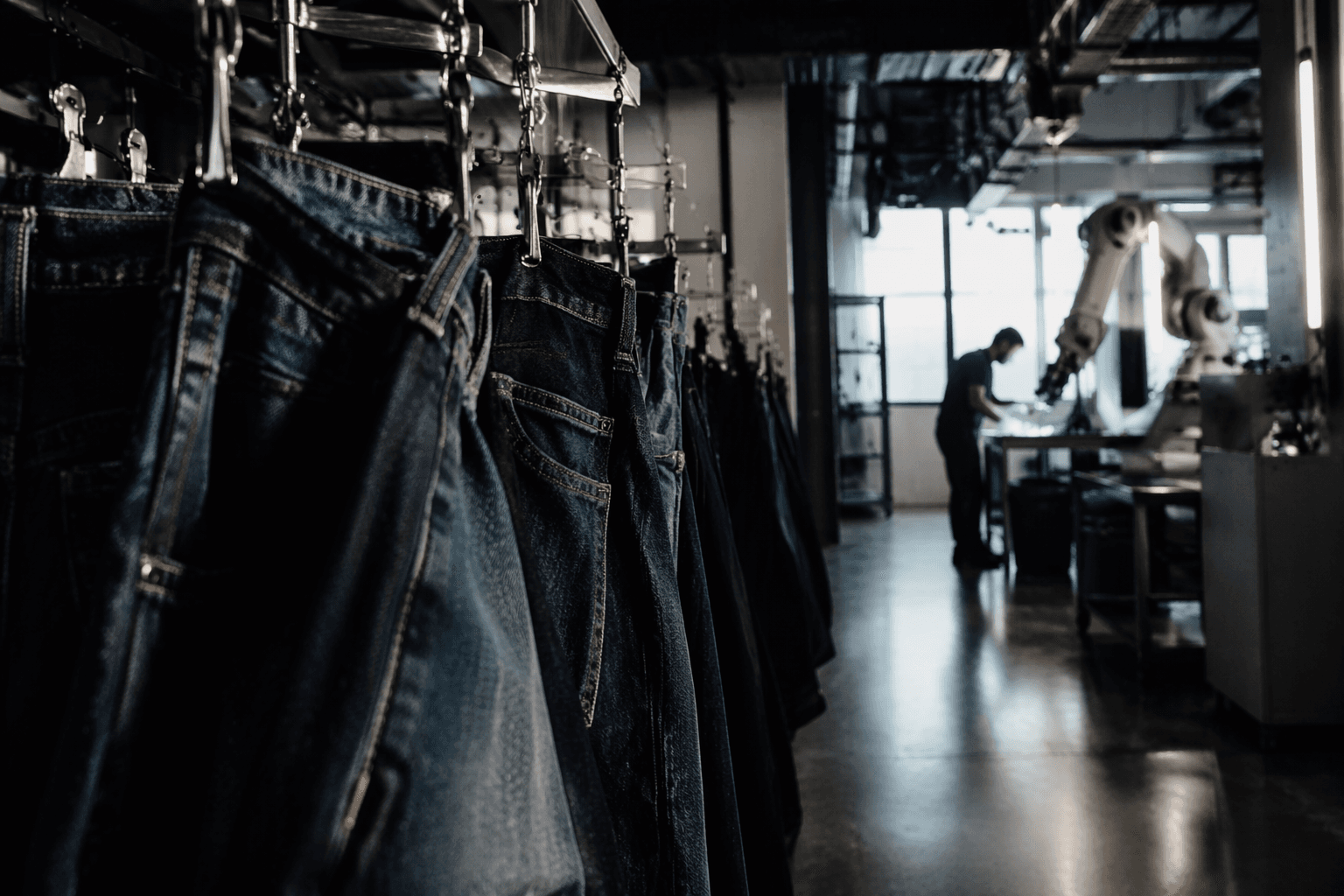
- Less waste, because fewer speculative washes and fewer unsold colorways need to be carried.
- Faster small-batch development, because sampling moves from a slow, industrial loop to a quicker digital one.
- More customized product drops, because color and finish can be adjusted without rebuilding the whole collection architecture.
The most realistic near-term gains are easy to see:
That is why Triarchy’s move feels bigger than a fabric story. It is a production story. The jean is still the familiar workwear object, but the method behind it starts to resemble modern product development, where speed, consistency and restraint matter as much as surface finish.
Botter’s open-source reset
If Triarchy is rewriting the machinery, Botter is trying to rewrite the culture around it. Founded by Rushemy Botter and Lisi Herrebrugh, the label is planning to relaunch in the fall with what the duo described as an open-source, collaborative model. At Denim Première Vision, the conversation centered on co-creation, supplier dialogue and an unconventional vision of the denim world. The phrase “Botter’s reboot is open source” may sound like a slogan, but it points to a real shift in how brands can build product: less closed authorship, more shared development.
That has consequences for workwear, which has always lived somewhere between utility and utility’s styling afterlife. When design becomes more democratic, the product can move faster through the chain. Suppliers become partners earlier, ideas can be tested with fewer layers of approval, and a brand can respond more nimbly to niche demand, especially for small-batch denim drops with a strong point of view.
Botter’s broader brand trajectory makes the timing especially interesting. G-Star Raw named Botter and Herrebrugh creative directors in April 2025, their first such appointment in more than five years, with a debut collection for the brand slated for January 2026. That move placed the duo inside a larger denim system even as they were pushing their own label toward a freer, more collaborative model. It is a useful contradiction: one foot in a major commercial platform, the other in a more open design experiment.
The bigger picture: innovation with industrial consequences
Denim Première Vision used its Milan stage to connect these individual experiments to a wider industry conversation. Show materials highlighted strategic partnerships, circular-economy projects and new dyeing initiatives, including the CBI-backed Circular Apparel Tunisia program supporting 18 Tunisian companies and a Chloris-led effort around Claessen Blue, a bio-based dye. Put together, these are not side notes. They are signs that denim’s next chapter will be written in chemistry labs, digital studios and supplier networks as much as in design rooms.
That is why the Triarchy and Botter stories matter for workwear style. The clothes still have to look good on the body, with enough structure to hold a line and enough texture to feel lived-in. But the more decisive change is behind the seams: a production model that can lower waste, speed up development and make customized denim less of a fantasy. The future of premium workwear may not be louder or more decorated. It may simply be smarter, more responsive and far less wasteful.
This article was produced by Prism’s automated news system from verified source data, official records, and press releases, then run through automated quality and moderation checks before publishing. The system is built and supervised by the people who set the standards it runs under. Read our full AI policy.
Know something we missed? Have a correction or additional information?
Submit a Tip