Dior and Chef Yannick Alléno Craft a Couture Chocolate Easter Egg
Yannick Alléno's debut Easter egg for Dior, succeeding Jean Imbert's creation at Le Jardin du 30 Montaigne, is the season's most uncompromising luxury gift object.

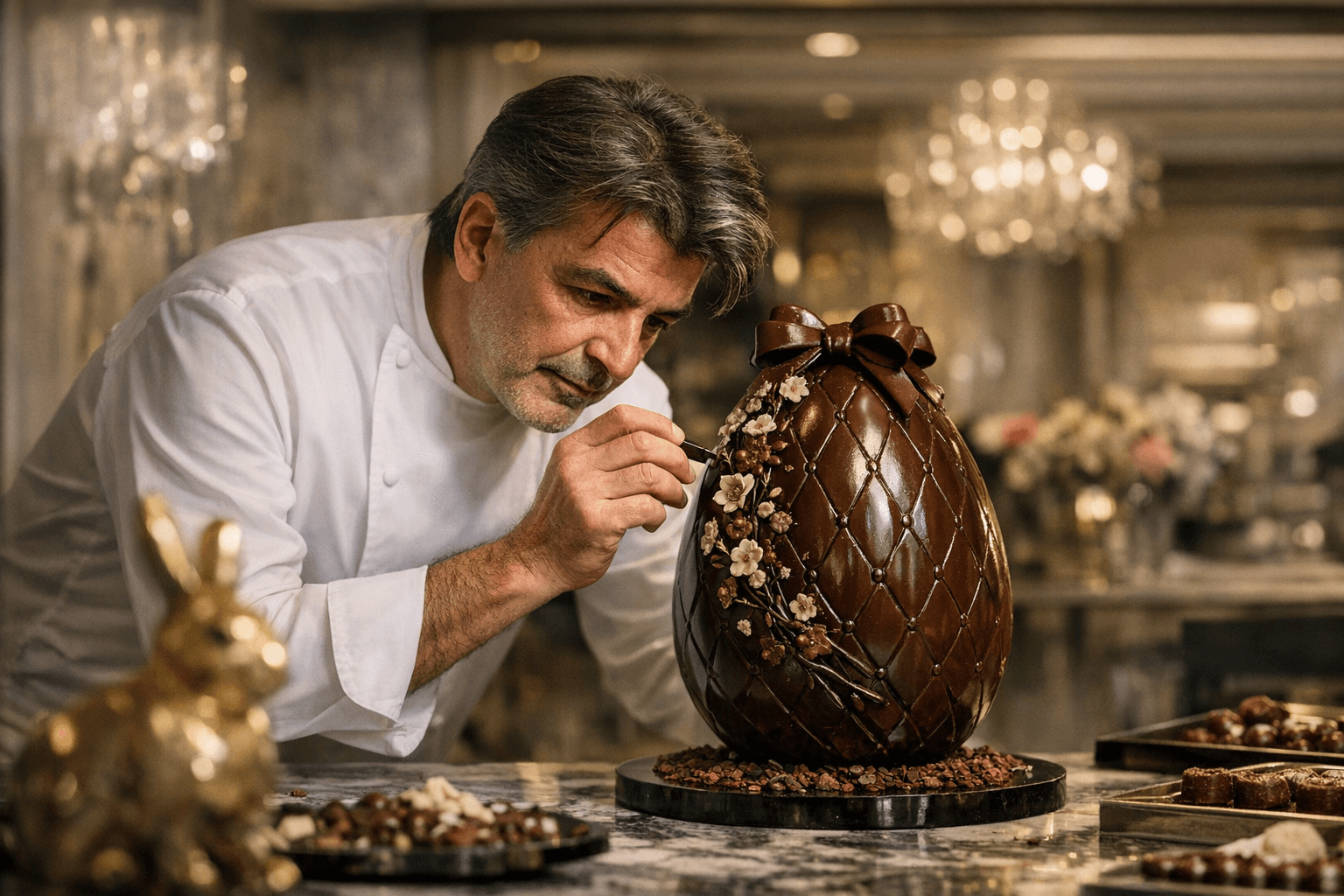
Within fashion's broader luxury ecosystem, Easter chocolate has become an unexpectedly competitive category, and Dior arrived for 2026 with the strongest claim on the field. The house unveiled a monumental chocolate egg on March 23 at Le Jardin du 30 Montaigne, executed in collaboration with multi-starred chef Yannick Alléno: his debut seasonal creation for Dior, and the first Easter egg produced under his tenure since he succeeded Jean Imbert at the helm of the maison's Avenue Montaigne gastronomic operations.
The egg itself reads as a sculpture before it reads as food. Constructed from dark and white chocolate, it references the Christian Dior signature medallion punctuated by a bow, motifs that have anchored the house's visual language since its founding. The surface is architectural; the interior is where Alléno's culinary point of view asserts itself. Hidden inside are multiple bite-size pieces bearing the house's cannage quilting, couture button forms, and the "CD" initials. The fillings layer hazelnuts, toasted almonds, and puffed-rice praline alongside sobacha, a roasted buckwheat tea pressed into a crispy textural element. That last ingredient signals a chef with a genuine aesthetic agenda rather than one lending a name to a seasonal SKU.
The Alléno collaboration represents a measurable departure from the Imbert era. Where Imbert brought a brasserie sensibility to Dior's table, Alléno's vocabulary is more precise, more technically ambitious, and more internationally calibrated: he has built his Pavylons concept across multiple cities and will expand aboard the Orient-Express sailing ship from this year. The egg reflects that seriousness of purpose. It is the right gift for a host whose table is already composed, for a top client who has received every standard luxury hamper, or for a collector who treats seasonal objects as acquisitions.
Securing one requires planning. The egg is available at Le Jardin du 30 Montaigne at 30 Avenue Montaigne in Paris's 8th arrondissement, with select international Dior locations also carrying the collaboration. It went on sale March 23, meaning the window for collection before Easter is narrow; this is a Paris pick-up proposition for those with the itinerary to support it.
Dior Maison's accompanying trompe-l'œil ceramic plate occupies an entirely different gifting register. The piece depicts a lifelike hen surrounded by colorful eggs, rendered in 18th-century French faïence style with the kind of illusionistic precision that makes trompe-l'œil a sustained tradition rather than a novelty. Unlike the chocolate egg, it is a permanent object, and it is the more considered gift for someone whose home you actually know: a host who would place it alongside period ceramics rather than a seasonal centerpiece.
For those whose travel schedule or gifting timeline rules out the Dior egg, three alternatives bracket the market credibly. At a comparable prestige level, Pierre Marcolini's 2026 Haute Couture collection covers similar conceptual ground with Easter eggs rendered in single-origin dark chocolate from Ecuador and São Tomé, their interior drawers filled with fashion-house-inspired praline forms; his Paris boutiques and international web shop make it accessible without a transatlantic connection. A tier below, Claridge's hotel in London produced a Valrhona milk chocolate egg embossed with the property's Art Deco chevron, each one taking three days to produce, at £70: a recognizable provenance at a price point that works as a client gift without requiring explanation. For the host who prefers something more architectural, the Shangri-La Paris's pastry chef Timothy Lam debuted the Imperial Hive for Easter 2026, built around honey and praline in a form designed for display as much as consumption.
What distinguishes the Dior and Alléno egg from all of them is that sobacha: an ingredient that has no business appearing in a branded Easter egg unless someone in the kitchen genuinely cared about the result. That specificity is what makes it collectible rather than merely expensive.
This article was produced by Prism’s automated news system from verified source data, official records, and press releases, then run through automated quality and moderation checks before publishing. The system is built and supervised by the people who set the standards it runs under. Read our full AI policy.
Did this article answer your question?