Luxury Jewellery Houses Leverage Scarcity and Partnerships for Collectible 2026 Gifts
Haute Couture week has quietly become luxury gifting's highest-stakes arena, with five major maisons unveiling invitation-only high jewellery as gold hits record highs and collectors chase pieces that outperform handbags.
When Couture Week Became the Year's Most Competitive Gift Moment
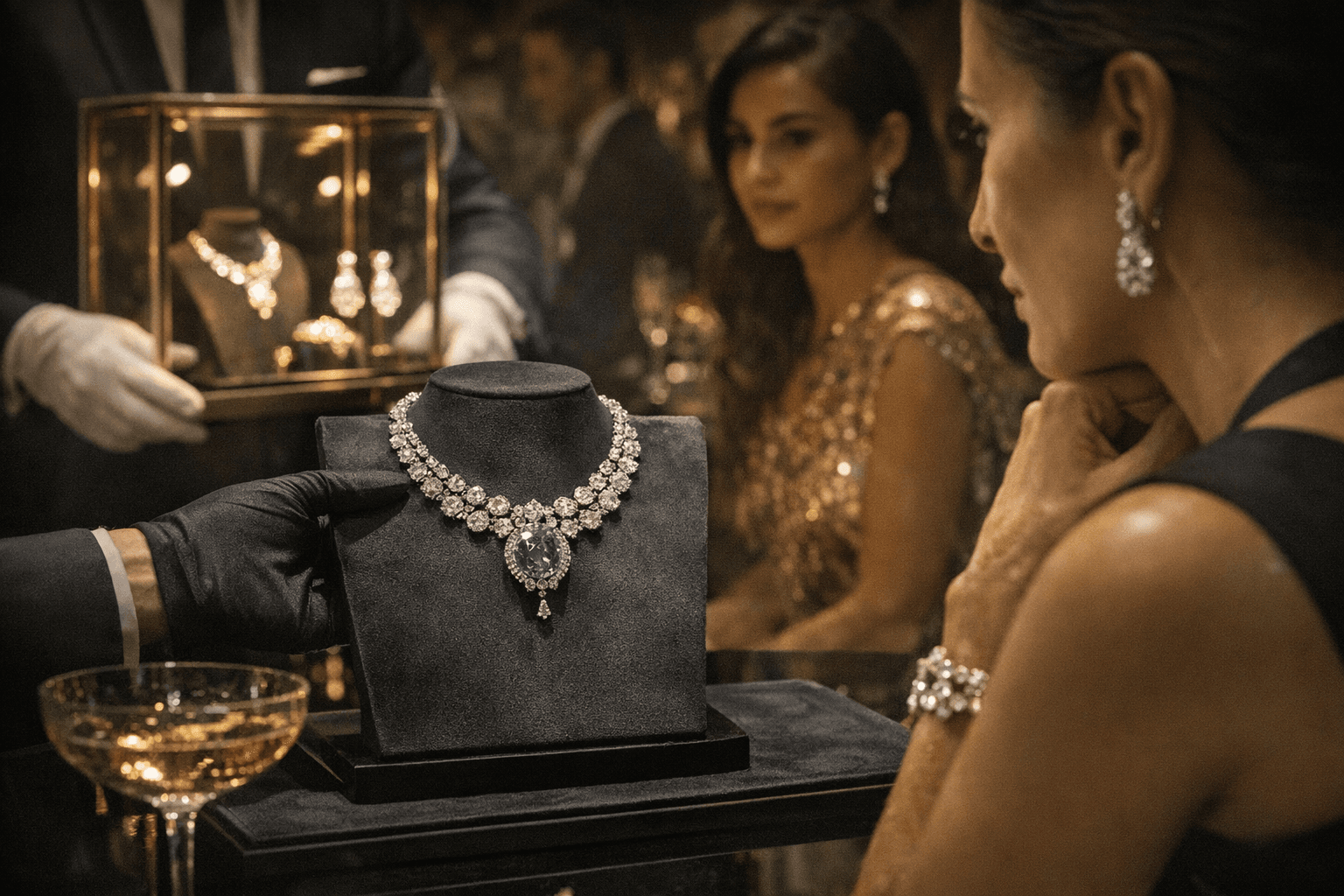
Haute Couture week in Paris has always been fashion's most rarefied calendar event, but a parallel drama now unfolds a few streets away, around the Place Vendôme. This January, Boucheron, Chaumet, Graff, Dior and De Beers all unveiled new high jewellery collections within days of each other, turning a concentrated stretch of the French calendar into the year's most coveted gifting window. Through tightly edited collections and invitation-only unveilings, couture week has become a critical moment for high jewellery maisons to reinforce their heritage and articulate their creative direction. The strategy is deliberate: like haute couture itself, haute joaillerie serves as a beacon for a brand's entire jewellery business, giving every collection below it a halo of cultural prestige and desirability.
The timing is no coincidence, and neither is the intensity of competition. Jewellery has outpaced the broader luxury sector, increasingly seen as having a stronger value proposition than handbags. Geopolitical tensions have sent gold and silver to new highs while the dollar sinks, a paradox the houses have learned to navigate: soaring raw material costs make pieces more expensive, yes, but they also communicate intrinsic value in a way that a leather bag simply cannot.
The Collections: Wearable Art That Cannot Be Replicated
What distinguishes the 2026 high jewellery moment is a shared commitment to pieces built around movement, modularity and archival depth rather than static showmanship. Each maison arrived with a distinct creative language, but the underlying grammar was the same: one-of-a-kind works that borrow as much from architecture and sculpture as from traditional jewellery-making.
Cartier presented the third chapter of its En Équilibre High Jewellery collection at the Musée des Arts Décoratifs, a venue whose historic interiors mirror the collection's own sense of balance and weight. The Euphonia necklace brought together two rare, perfectly matched batches of rubies and diamonds, united by emerald cuts that give the piece its graphic clarity. Colour takes a more expressive turn in Ondora, where chrysoprase, spinels and turquoise are balanced against diamonds in a composition inspired by the drifting motion of jellyfish. Light, mobile and transformable, it reveals Cartier's technical mastery while remaining rigorously composed.
Chaumet's Envol collection drew on nearly 250 years of history and the maison's dialogue with its French royal heritage, tracing its inspiration back to the archival bird-inspired neo-antique style tiaras created when founder Marie-Etienne Nitot and Empress Joséphine Bonaparte shared a fascination with the natural world. The aigrette tiara, capable of being worn four different ways, glitters with brilliant-cut pavé diamonds adorning a pair of grand feu enamel wings. Equally versatile is the pavé diamond white gold necklace adorned with a 10.96-carat cushion-cut Madagascar sapphire. Modularity is the operative word: a piece that can be worn four ways is not just design ingenuity, it is a gifting argument. The recipient gets not one jewel but a collection of moods in a single object.
At Boucheron, creative director Claire Choisne, who has led the maison for 14 years, presented Histoire de Style, a high jewellery collection conceived as a portrait of founder Frédéric Boucheron. Choisne is consistently present at presentations to explain her creative journey, and models wear the pieces so the jewels can be examined closely. This season, a series of archival mini-films further clarified the collection's dialogue with Boucheron's history, a move that transforms the unveiling from product launch into cultural event, giving collectors context and narrative to carry with the piece.
At Dior, Victoire de Castellane's Belle Dior haute joaillerie collection comprises 57 pieces and centres on movement, jewellery designed to sway, convert and respond to the body, borrowing its logic from couture as much as from the garden. The collection includes a ring set with a 6.50-carat pink spinel, cut to shift from cushion to flower. This shapeshifting quality, pieces that look different depending on how they fall or how light catches them, is central to the "wearable art" framing that now defines high jewellery's aspirational pitch.
Scarcity as Strategy
The invitation-only format is more than a logistical necessity; it is the mechanism through which these houses manufacture desire. Through tightly edited collections and invitation-only unveilings, couture week has become a critical moment for high jewellery maisons to reinforce their heritage and articulate creative direction. When a piece is genuinely one-of-a-kind and revealed to a room of several dozen clients, the scarcity is not marketing language. It is structural. The object cannot be re-ordered.
Maisons use this platform to reinterpret their most enduring codes by referencing archives and savoir-faire into contemporary, one-of-a-kind works. Motifs rooted in gardens, wings, architecture and transformation are reworked through modularity and modern proportions, reinforcing high jewellery's role as both a strategic brand asset in curating desire and as a form of cultural expression. That dual function is what separates a truly collectible piece from an expensive one: it must carry meaning beyond its materials.
Van Cleef & Arpels, operating from 22 Place Vendôme since 1906, offers the clearest illustration of what sustained scarcity looks like over decades. The brand's prestige is anchored by its legendary Alhambra clover motif, which has maintained extraordinary value retention in the resale market. Collectors also prize the maison for high-jewellery innovations such as the Mystery Set and the transformable Zip Necklace, which frequently command record prices. These are not just jewels. They are benchmarks.
The Collector's Calculus: Liquidity Meets Beauty
The gifting case for high jewellery in 2026 rests on a shift in how serious collectors think about acquisition. Today's collectors think in terms of optional liquidity: even when purchasing for love, they want confidence that a piece can be resold, traded, or placed at auction if circumstances change. Luxury resale is no longer speculative; it is structured, with auction results, private sales and dealer networks creating measurable benchmarks. Jewellery that sits outside these systems carries higher long-term risk.
This recalibration matters enormously for gifting decisions at the high end. A piece from a house with deep auction history, a recognisable archival motif and limited production numbers is not simply a gift; it is an asset with a traceable value trajectory. The long-term collector prioritizes objects that cannot be scaled, not styles that can be endlessly reproduced. The best gifts in this category share that quality: they were made once, by hand, for someone.
Meeting the Market at Every Level
For all the palace-tier spectacle of the Couture Week presentations, the maisons are acutely aware that their wider businesses depend on accessibility. Products at entry-level price points will be key for brands seeking to capture middle-class shoppers who are under financial pressure and looking for value for money. The high jewellery unveiling generates the cultural heat; the rest of the collection range is where that heat converts to revenue.
This two-tier dynamic explains why the dramatic one-of-a-kind pieces shown at the Musée des Arts Décoratifs or in private salons on Place Vendôme matter beyond their immediate sale. They set the creative and emotional register for everything a house produces that year. When a collector gifts a Boucheron Histoire de Style bracelet from the mainline collection, she is gifting something that shares a creative DNA with the archival portraits shown at Haute Couture week. The story travels down the price ladder, even when the piece itself does not.
The houses that understand this architecture best, the ones that treat a tightly curated launch not as a product drop but as a cultural moment with resonance across the entire catalogue, are the ones now defining what luxury gifting looks like in 2026. Gold may be expensive, but a gift with genuine scarcity, archival depth and a collector's resale floor behind it is a different proposition entirely.
This article was produced by Prism’s automated news system from verified source data, official records, and press releases, then run through automated quality and moderation checks before publishing. The system is built and supervised by the people who set the standards it runs under. Read our full AI policy.
Did this article answer your question?