Decorating Pros Are Obsessed With These Faux Egg Swaps for Easter
Reusable faux eggs in wood, foam, and paper-mâché are replacing dyed real eggs as personalized keepsakes that come back every spring with a name already on them.
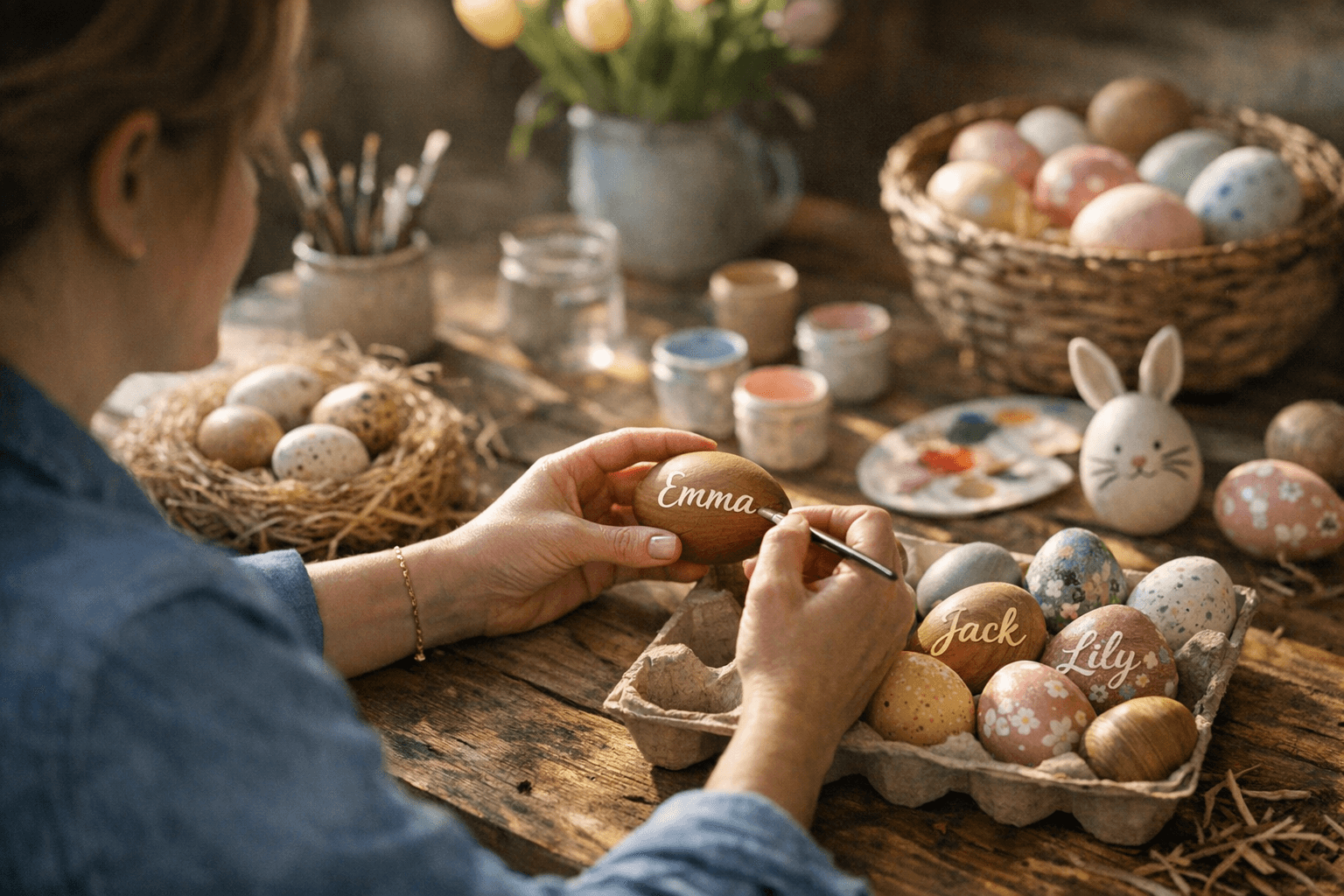
The Easter egg section at most craft stores used to be stocked for one purpose: dyeing real eggs that would be composted by Monday. The category looks different now. Decorating pros and indie makers have pushed a new wave of reusable faux eggs in wood, foam, and paper-mâché into the mainstream, and the most useful versions ship already personalized with a name, a date, or a family phrase. These aren't DIY project fodder. They're ready-to-use keepsakes built for the kind of repeat display that justifies a real purchase.
Why Faux Eggs Are Replacing the Real Thing
Hard-boiled eggs have a two-hour window at room temperature before food safety becomes a concern, a two-day shelf life in the refrigerator, and zero reuse value. Faux eggs sidestep all of that. Foam, wooden, and paper-mâché versions hold paint, vinyl decals, and laser engraving without any of the structural fragility of a shell, and they pack neatly into a storage bin after the holiday. The practical math is compelling: a personalized set that costs $30 this year costs nothing next year. That logic is what's converted even traditionalist hosts who wouldn't have considered a fake egg five years ago.
Material Guide: Durability and Kid-Safety by Format
Not all faux egg materials perform equally, and the right choice depends on how hard the eggs will be handled.
Foam is the most widely available entry point. JOYIN produces a 32-piece assortment in pastel speckled finishes suited to centerpiece bowls and Easter baskets, while Gemscream's floral-printed foam eggs measure 1.57 by 2.36 inches, a size close to a standard chicken egg. Blayvorn offers a 64-piece set with a woven paper rope texture at 1.97 inches, leaning toward a more tactile, farmhouse-style finish. Foam accepts paint and light decoration well, but it dents under pressure, which makes it a better choice for display than for hands-on egg hunts with young children.
Wooden eggs are the durability leader across all formats, and also the most kid-safe. CALPALMY's 24-piece set of hyper-realistic white wooden eggs uses natural wood with a smooth, non-peeling finish, and the brand notes that they can be painted, dyed, or decorated with sequins and beads without degrading. Artsadd's beechwood eggs, available on Amazon, are sanded to a silky finish with no splinters and no toxins. The flat-bottomed construction common to wooden craft eggs means they stand upright without a holder, a practical detail that matters for table settings and mantle arrangements. CALPALMY's packaging guidance is straightforward: display them in the open or store them in a dry place for later use.
Paper-mâché sits between foam and wood on the durability spectrum. It accepts paint and decoupage beautifully, including the paper-mâché flower egg look that decorators have been circulating, but it's more vulnerable to moisture. Store paper-mâché eggs in a sealed container and keep them indoors.
Plastic fillable eggs are the most structurally durable for egg hunts but require more preparation for personalization. Testing by craft educators has found that both wood and plastic craft eggs benefit from a matte finish for paint and vinyl to adhere cleanly. If you're buying plastic eggs with the intent to personalize them at home, look for eggs with a flat matte surface rather than a glossy shell.
How Personalization Actually Works
Three methods dominate the ready-to-buy market, and each has a different durability profile.
- Permanent vinyl is the fastest and most visually striking option. Etsy sellers are applying name-and-motif vinyl decals to jumbo plastic eggs in pink, green, blue, and purple, pairing a name with a bunny graphic in a single application. The vinyl reads cleanly from across a table and holds up through multiple seasons of storage and handling.
- Paint pens offer maximum creative range on wooden or paper-mâché surfaces, allowing names, dates, and small illustrations without specialized equipment. The tradeoff is longevity: paint-pen lettering on a handled surface will show wear over a few seasons, making this method better suited to display pieces than to high-contact egg hunts.
- Laser engraving is the category's most permanent personalization and the method that most convincingly earns keepsake status. Artsadd's beechwood eggs on Amazon use precision laser engraving that the brand describes as producing a finish that won't fade or peel. Etsy makers offering engraved wooden eggs allow buyers to specify a single name, date, scripture reference, or word. One widely purchased Etsy listing notes that engraved wooden eggs work equally well as Easter basket additions or place settings at an Easter dinner table.
Ready-to-Buy Picks by Gifting Moment
*For basket fillers:* The CALLIE Jumbo Personalized Fillable Easter Egg on Amazon accepts a name or initials paired with a bunny design, and the fillable construction means it can hold small treats on top of its display function. Etsy's jumbo vinyl name eggs in four pastel colorways are a strong alternative for families who want a more graphic, bold look in a basket.
*For Easter table place cards:* Engraved wooden eggs are the cleanest solution for hosting. A set engraved with each guest's name replaces printed place cards with something people actually want to take home. Because the flat bottom allows them to stand without a holder, placement requires no additional hardware or support.
*For keepsake ornaments:* The Amazon pastel faux egg with laser engraving accommodates up to nine characters and is designed to stand upright on a mantle, end table, or tabletop. Treat it the way you'd treat a dated Christmas ornament: a first name and a year on a beechwood egg becomes more meaningful with each passing Easter, not less.
Storage and Display
Faux eggs require minimal storage infrastructure. Wooden and plastic eggs nestle into standard cardboard egg cartons for off-season storage, which also makes labeling by child, year, or family member easy. Paper-mâché eggs need a sealed box to prevent moisture damage. For display, the flat-bottomed wooden egg is the most versatile format: it stands on a mantle, groups naturally in a shallow bowl, or lines a windowsill without any additional stands or supports. Foam eggs work best in vase fillers and deep centerpiece containers that prevent rolling.
The logic underlying all of this is identical to how most people already approach Christmas ornaments: buy once, personalize it, store it properly, and let the collection accumulate meaning over years. An egg with a child's name and the year etched into beechwood will be more interesting to that child at fifteen than it was at two. That's the actual value proposition here, and it's one that a dyed hard-boiled egg can never compete with.
This article was produced by Prism’s automated news system from verified source data, official records, and press releases, then run through automated quality and moderation checks before publishing. The system is built and supervised by the people who set the standards it runs under. Read our full AI policy.
Did this article answer your question?