Personalized Name Jewelry: 2026 Customization Playbook
Engraved name jewelry commands a 41% higher order value than generic pieces — here's how to source, brand, and sell it profitably in 2026.
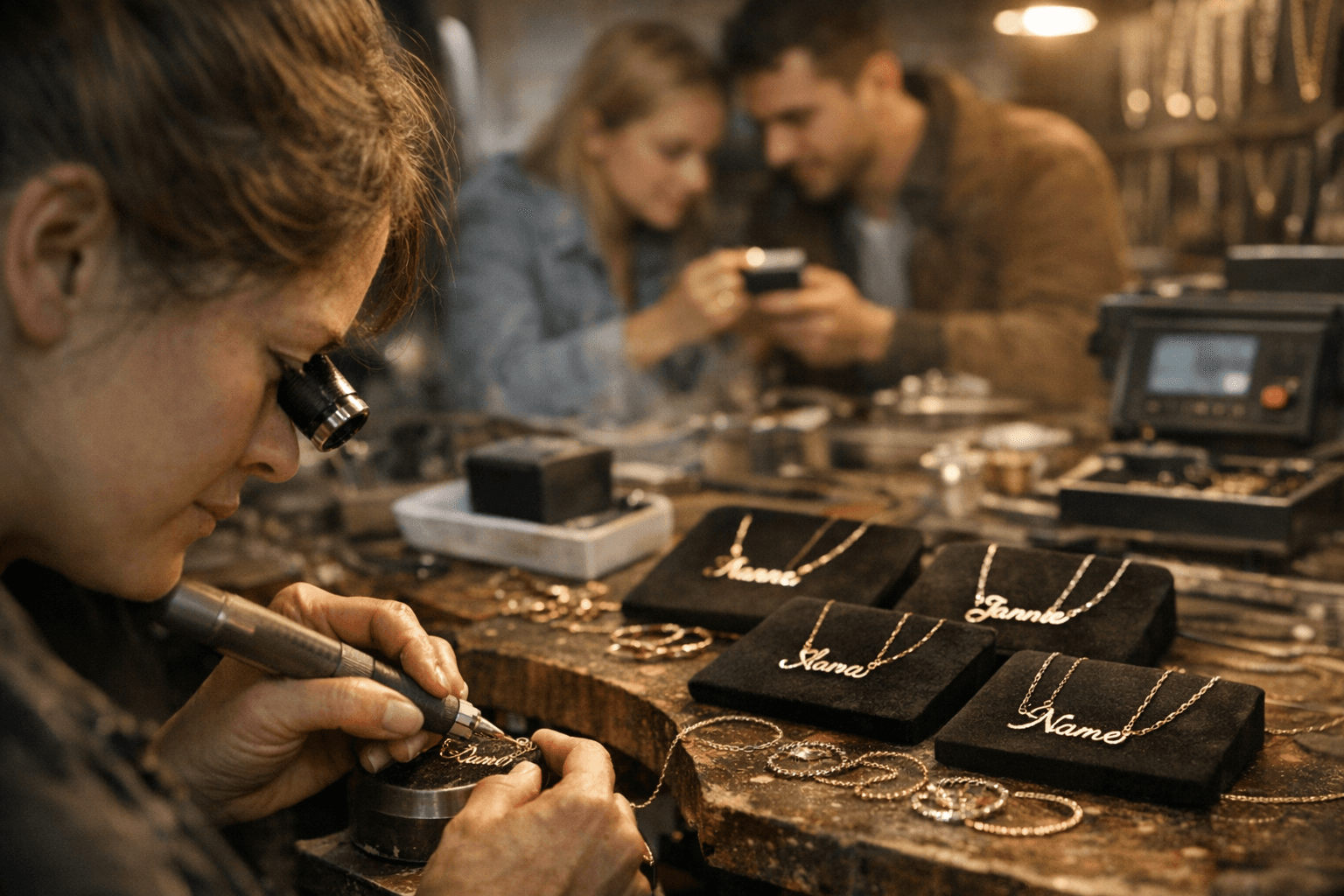
Personalized name jewelry is one of the few ecommerce categories where the product literally cannot be returned to a shelf and resold. That constraint, far from being a liability, is the entire business model. In 2026, the median online jewelry order has risen to $374, but customized and engraved pieces command a median order value of $527 — 41% higher, according to a Shopify Commerce Trends report analyzing over 4,200 jewelry retailers globally. That gap is not a fluke of demographics or geography. It is the premium buyers pay to make something irreplaceable.
The global personalized jewelry market reached USD 42,512.2 million in 2024 and is expanding at a compound annual growth rate of 8.60% through 2031, according to Cognitive Market Research. North America holds the largest share, accounting for more than 40% of global revenue. For ecommerce founders and boutique owners building a product line today, the category offers unusual timing: mainstream demand is accelerating while most competitors are still competing on price rather than craft.
The core argument: quality personalization versus print-on-demand
The clearest strategic divide in this category is between high-craft personalization and cheap print-on-demand. As the research puts it directly: "Engraved and name jewelry consistently outperforms generic jewelry in both Average Order Value (AOV) and repeat purchase rates." The mechanics behind that finding matter. When a customer orders a piece with handwriting engraving, a fingerprint transfer, GPS coordinates, or a signet-style initial, they are not comparing it to a similar item on a competitor's site. The comparison set collapses. Personalized jewelry reduces price sensitivity precisely because personalized products are less directly comparable across sellers, which typically results in higher margins and lower competition.
Print-on-demand platforms can deliver name necklaces at speed, but they cannot replicate the production depth required for a handwriting engraving pulled from a customer's uploaded photograph. That production depth is exactly where margin lives, and it is the reason this playbook argues that investing in stronger production controls and clearer customer communications is not overhead. It is the product.
Supplier vetting: what to look for before you commit inventory
Not every supplier who claims to offer engraving can deliver it at commercial quality. Vetting a supplier for personalized name jewelry requires scrutiny across several dimensions:
- Sample approvals before volume orders. Request physical samples with real engraving across your planned font options and metal finishes. A font that renders beautifully on a wide cuff can become illegible on a 5mm bar pendant.
- Font legibility standards. The size of the item is the ultimate constraint for engraving quality: a detailed, intricate font that looks beautiful on screen may become illegible on a small piece. For delicate charms or the inside of a thin ring, simple sans-serif fonts prevent characters from blurring together.
- Resize and revision policies. Confirm whether the supplier accommodates ring resizes after engraving (most do not without a surcharge) and what their policy is on engraving corrections.
- Artwork approval workflows. High-volume personalization requires a formalized digital proof step where the customer approves their exact text, font, and placement before production begins. Suppliers without this step built into their workflow are a fulfillment risk.
- Lead time transparency. Customized jewelry cannot ship in 24 hours. Suppliers should be able to give consistent production windows, not aspirational ones.
Margin benchmarks and pricing architecture
Retail jewelry entrepreneurs report profit margins between 50% and 300%, depending on the product and sales channel. For personalized name jewelry specifically, the customization premium justifies pricing well above standard keystone. A sterling silver initial necklace sourced at $18 landed cost can retail at $95 to $140 without triggering price resistance, because the buyer is not searching for the same item elsewhere. Coordinate and handwriting pieces, which require more production complexity, support even wider spreads.
The practical implication for margin management: do not treat the personalization surcharge as a line item addition to a base product price. Build the customization into the product identity and price from the ceiling down. A piece marketed as "your grandmother's handwriting, engraved in sterling silver" is a $120 to $160 product. A "sterling silver bar necklace with engraving" is an $85 product. Same metal, same process, completely different positioning and margin.
Seasonal demand calendar: when to activate and when to prepare
Personalized jewelry has identifiable demand peaks, and the critical production insight is that peak demand requires pre-peak production readiness. The three highest-volume windows are:
- Valentine's Day (late January through February 14). Coordinate jewelry, initial necklaces, and handwriting pieces all spike. Begin marketing in early January and clearly post lead times by January 20 to capture buyers who need guaranteed delivery.
- Mother's Day (late April through second Sunday in May). The strongest annual window for name and birth-month formats. Handwriting pieces featuring children's signatures or drawings perform particularly well because no two are identical.
- Holiday season (November through December 24). The broadest peak. Signet rings, name plates, and personalized chain jewelry all run simultaneously. Extended lead times must be posted prominently by November 1 or customer service volume will spike alongside revenue.
Between these peaks, graduation season (late April through June) and wedding season (May through September) sustain demand for coordinate jewelry and initial formats at lower but consistent volume.
Go-to-market tactics: drops, creators, and format innovation
The most effective go-to-market mechanism for personalized jewelry is not broad paid social. It is demonstrated specificity. When a creator shows their actual engraved handwriting piece on camera, names the detail they chose (their late father's signature, their children's birth coordinates), and describes why, the content carries social proof that no product photo can replicate.
Creator collaborations for this category work best when the creator is genuinely given a personalized product rather than a generic sample. The resulting content is authentic by construction. Limited drops work for the same reason: a 72-hour window on a specific format (a fingerprint signet, a coordinate cuff in a new metal finish) generates urgency without requiring a discount.
Format innovation is also worth pursuing systematically. The high-performing product formats right now are:
- Handwriting engravings transferred from a customer's photograph or uploaded scan
- GPS/coordinate formats on bar necklaces, cuffs, and signet rings
- Initial and monogram signets in gold vermeil and solid gold
- Fingerprint transfers on disc pendants and wide bangles
Operational safeguards: proofing flows and customer communication
The fulfillment risk in personalized jewelry is asymmetric. A misspelled name engraved on a gold piece is a full remake, not a discount coupon. Operational safeguards are not optional infrastructure; they are the difference between a scalable business and a customer service crisis.
A viable proofing flow has three gates: customer text input at checkout, a digital mock-up approval email within 24 hours of order, and a hold on production until approval is confirmed. Skipping the middle step to accelerate production is the most common error at scale. The second most common error is font default: if a customer does not specify a font, do not assume. Offer two or three clearly shown options and require a selection.
Clearly posted lead times, displayed on both the product page and at checkout, reduce inbound inquiries by a measurable margin and reduce chargebacks almost entirely. A customer who knows their order will ship in 7 to 10 business days does not open a dispute on day three.
The production-quality floor that protects the category
The long-term health of the personalized name jewelry category depends on buyers receiving what they ordered and wearing it long enough to buy again. Repeat purchase rates, one of the two metrics cited in the research alongside AOV, are driven entirely by whether the first piece met the expectation set at purchase. A handwriting engraving that the customer can actually recognize as their loved one's script generates a second purchase. A blurred approximation does not.
That is the compounding logic of investing in production quality upfront: every satisfied customer in a personalized category is a higher-probability repeat buyer than any satisfied customer in a generic one, because the emotional attachment to the object is built into the object itself.
This article was produced by Prism’s automated news system from verified source data, official records, and press releases, then run through automated quality and moderation checks before publishing. The system is built and supervised by the people who set the standards it runs under. Read our full AI policy.
Did this article answer your question?