PUMA's AI Store Concierge Guides Shoppers With Real-Time Inventory and Language Detection
PUMA's Las Vegas AI kiosk auto-detects language, speaks Mandarin, Arabic, French and Spanish, and checks live inventory without storing any personal data.
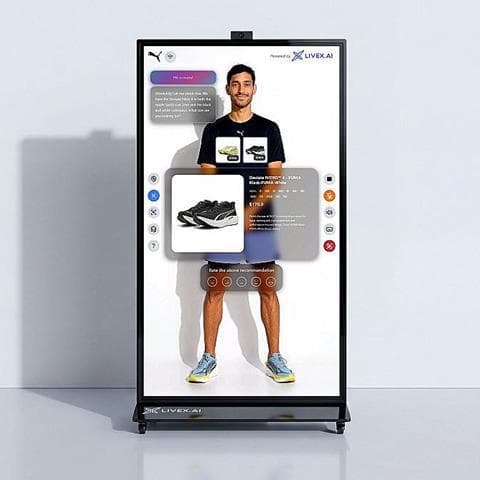
A visitor steps off the Las Vegas Strip and into PUMA's three-story, 25,000-square-foot flagship at the BLVD. They need a running gift for someone back home, their English is limited, and the floor associate is helping another customer. A large digital display near the entrance reads their spoken Spanish and begins a conversation: What distance does this person run? What is the budget? What size? Within seconds it surfaces three specific options from the performance running floor, confirms each is physically in stock, and flags a store team member when the conversation moves toward a fitting.
That is precisely the problem PUMA's AI Store Concierge was built to solve. Introduced at the Las Vegas flagship in March 2026, the system supports five languages automatically: English, Mandarin, Spanish, French and Arabic. It detects which language a customer is speaking without requiring any selection or input from the shopper. It does not track or store any personal data.
The concierge was built in collaboration with Google Cloud and LiveX.AI, a holographic AI agent company, and is powered by an NVIDIA Nemotron model. Ivan Dashkov, PUMA's head of emerging marketing technology, presented the project alongside Jia Li, LiveX.AI's president and chief AI officer, at NVIDIA's GPU Technology Conference in late March in a session titled "PUMA's Smart Stores: Agents and Digital Humans Redefine Customer Interaction." PUMA has also consolidated its global e-commerce data and workloads onto Google Cloud, deepening the technical partnership that underpins the concierge project.
At launch, the concierge focused on PUMA's performance running category, providing shoppers with fit guidance and technical product details. Its real-time inventory integration means it surfaces only what is actually available in that store, not the broader online catalog, removing one of the most persistent points of friction when a gift needs to be found and bought today.
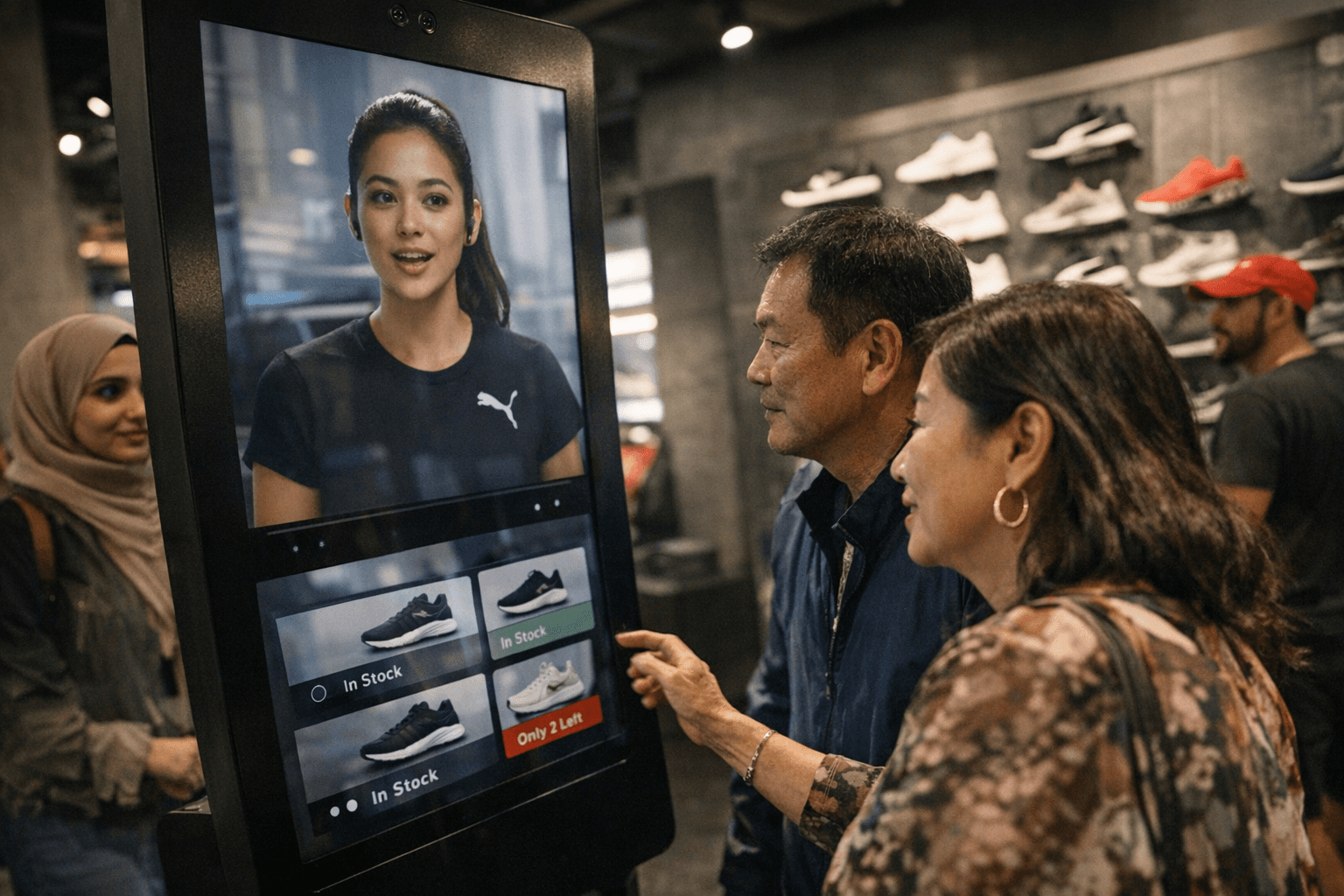
The system is designed to support PUMA retail associates, allowing conversations with shoppers to transition seamlessly to store teams who can provide more personalized advice. PUMA framed the pilot explicitly as a way to free associates from repetitive discovery questions so they could concentrate on relationship-building and higher-value service interactions.
Las Vegas is a logical proving ground. The BLVD, where the flagship is located, is one of the largest standalone developments on the Strip and attracts millions of visitors annually, many of them international travelers who may prefer, or require, a language other than English. A kiosk that removes that barrier without requiring a dedicated multilingual hire for every language PUMA serves closes a gap that is simultaneously a service problem and a conversion problem.
The flagship itself opened in November 2024 and already housed a professional F1 racing simulator, an interactive arcade, and a customization studio where customers can personalize PUMA apparel and footwear. The AI concierge extends that infrastructure deeper into the transactional layer of the shopping experience, not just the entertainment one. PUMA described the Las Vegas rollout as a pilot, with shopper and associate feedback informing the decision on whether to expand the format. With Google Cloud, NVIDIA and LiveX.AI as infrastructure partners, the technical commitment signals this is a proof-of-concept designed to scale.
Know something we missed? Have a correction or additional information?
Submit a Tip