Ring Engraving
A personalized ring engraving can turn a $200 band into a $500 heirloom — and in 2026, the options go far beyond initials and dates.

Few gifts carry the permanent weight of an engraved ring. The inscription doesn't fade with a thank-you card or get deleted with a text thread. It stays, pressed against skin, for decades. And right now, the techniques available to engrave a ring have expanded dramatically, giving buyers a spectrum of options that range from a simple set of initials to a full fingerprint rendered in metal. Knowing which format fits your recipient, and which technology to use to execute it, is what separates a thoughtful gift from a generic one.
"In 2026, diamond ring engraving trends are shifting toward personalization, hidden meanings, and modern technology like fingerprint and coordinate engravings." That shift is visible across both independent jewelers and direct-to-consumer band makers, and it's reshaping how buyers think about the engraving step entirely — not as an add-on, but as the primary design decision.
The Five Engraving Formats Worth Knowing
Minimalist Initials and Dates
The classic choice still holds, and for good reason. A set of initials or a meaningful date is legible decades later, ages gracefully on any metal, and works on even the narrowest band. The trick here is restraint: two or three initials in a clean sans-serif or traditional block font will outlast anything trendy. This is the right format for someone who wears rings daily and values subtlety, or for a gift where you're not certain of the recipient's aesthetic.
Hidden Interior Messages
Interior engravings — messages inscribed along the inside of the band — are private by design. Only the wearer sees them, which makes them the natural format for intimate gifts: a phrase between partners, a parent's handwriting, a date that only two people would recognize. Interior placement also protects the engraving from daily wear and abrasion, making it more durable than exterior work. From a production standpoint, interior engravings have a practical ceiling: most jewelers work with a maximum of 20 to 25 characters to maintain legibility, so brevity is both an aesthetic and a technical requirement.
Coordinate Engravings
GPS coordinates of a meaningful location — the street corner where you met, the hospital where a child was born, the venue of a wedding — have become one of the fastest-growing engraving formats. Coordinates work especially well on wider bands, where the longer string of numbers and decimal points has room to breathe. The visual effect is unexpectedly modern: a row of numerals that looks minimal but carries a story that requires explanation. For gifting purposes, this format translates well to milestone occasions like anniversaries, graduations, and first-home celebrations.
Fingerprint Engravings
A fingerprint engraving captures an actual print from a person — typically submitted as a photograph or an ink impression — and etches it into the surface of the band using laser technology. The result is genuinely one-of-a-kind: no two fingerprints produce the same mark, which means no two rings are identical. This format is particularly resonant as a memorial gift or as a way for partners to carry each other's prints. Because the ridges and loops of a fingerprint require fine, closely spaced lines, fingerprint work is almost exclusively done on the exterior of the band and almost always via laser. Sterling silver, gold, and rose gold are the most common metals used; their relative softness allows the laser to render fine detail cleanly.
Handwriting Engravings
Handwriting engravings convert an actual sample of someone's script — a signature, a note, a few words in their hand — into a permanent metal inscription. The emotional logic is straightforward: it preserves not just words but the physical gesture of the person who wrote them. Handwriting engravings are particularly common in sympathy and memorial jewelry, but they also appear on anniversary bands where one partner's actual handwriting carries more weight than any selected font. The technical requirement is a high-resolution photograph or scan of the original writing; quality varies significantly depending on clarity of the submitted sample.
Laser vs. Hand Engraving: What Actually Matters
The technology choice affects cost, depth, detail level, and longevity. Understanding the trade-offs is straightforward once you know what each method excels at.
Laser engraving uses a focused beam to burn or vaporize a shallow mark into the metal surface. It is the dominant method for fingerprints, handwriting, coordinates, and any design involving fine lines or irregular shapes. Laser work is precise, repeatable, and accessible: most jewelers and many online services offer it, with pricing typically ranging from $30 to $60 for standard text engravings. The limitation is depth. Laser marks are shallow, which makes them slightly less tactile than hand work, and on high-gloss finishes, they can appear faint over time.
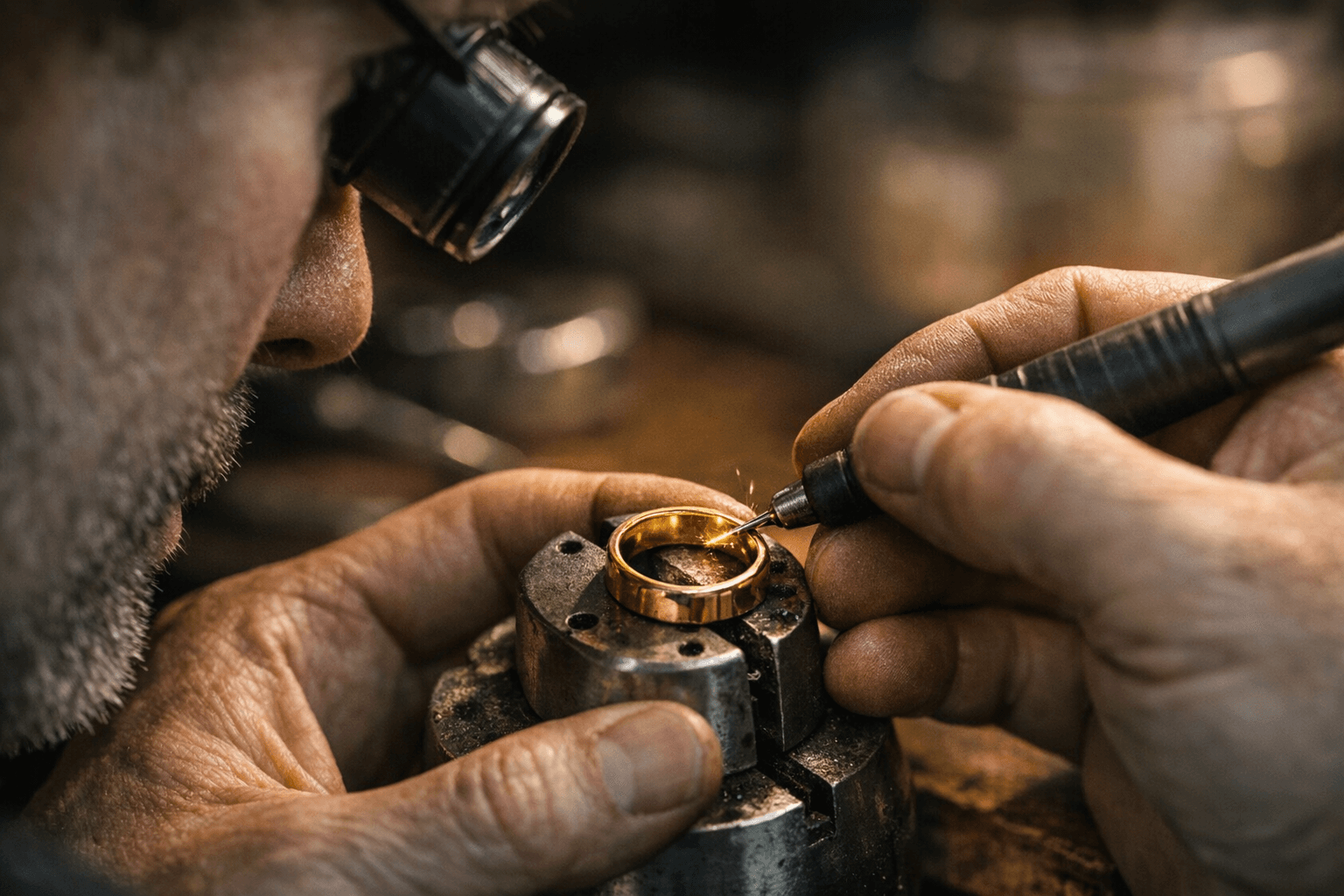
Hand engraving is performed by a master engraver using a graver tool, cutting directly and deeply into the metal. The marks are more expressive, carry a visible artisanal quality, and create a tactile groove that survives decades of wear. It is, accordingly, more expensive: hand engraving typically starts around $80 for simple inscriptions and can range from $150 to $250 for complex or artisanal work. Gold and platinum are the preferred metals for hand engraving because, as one jeweler notes, "you can polish out any errors during the process." For harder alternative metals like tungsten or titanium, hand engraving is not an option; laser is the only viable method.
The practical decision for most buyers: if the design involves letterforms only (initials, dates, a short phrase), either method works well, and budget is the deciding factor. If the design involves imagery, fingerprints, or handwriting, laser is required. If heirloom quality and depth are the priority and cost is secondary, hand engraving is worth the premium.
Font Selection and Placement
Font choice is where many buyers make their only mistake. Script fonts are beautiful in theory but can become illegible at small sizes or on narrow bands. Deep-cut engravings hold up best with bolder, blockier typefaces that maintain their edges over time. Laser engravings can handle finer and more detailed fonts, including cursive script, but the key test is how the letters read at actual ring scale, not on a proof.
For placement, interior engravings offer protection from wear but limit character count. Exterior engravings are visible and expressive but require a band wide enough to give the engraving room. On very thin bands, a single row of small initials is often the maximum. Eternity rings and highly stone-set designs may have no viable engraving surface at all; a jeweler should assess the ring before any engraving work is commissioned.
Metals and Practical Buying Guidance
Gold (in yellow, rose, or white) and platinum are the most engraving-friendly metals, accepting both hand and laser work and allowing for polishing if corrections are needed. Sterling silver accepts engraving cleanly and is the most affordable option. Tungsten, titanium, and stainless steel require laser engraving but are genuinely durable once marked.
For buyers briefing a jeweler or ordering through an online service, a few specifics make the process go smoothly: confirm the character count limit before writing your inscription, request a digital proof before final execution, and specify whether you want the engraving on the interior or exterior. For fingerprint and handwriting orders, submit the highest-resolution image you can provide; the detail of the final engraving is only as good as the source material.
The best-engraved rings aren't the most elaborate ones. They're the ones where the inscription was chosen deliberately, executed in the right technique for the design, and placed where it will last. That combination, more than any font or format, is what makes an engraved ring feel irreplaceable.
This article was produced by Prism’s automated news system from verified source data, official records, and press releases, then run through automated quality and moderation checks before publishing. The system is built and supervised by the people who set the standards it runs under. Read our full AI policy.
Know something we missed? Have a correction or additional information?
Submit a Tip