Advance Monthly Sales for Retail and Food Services (February 2026)
Americans set a Valentine's Day spending record of $29.1 billion as February retail sales climbed 3.7%, but the gap between what people bought reveals a smarter way to split the budget.
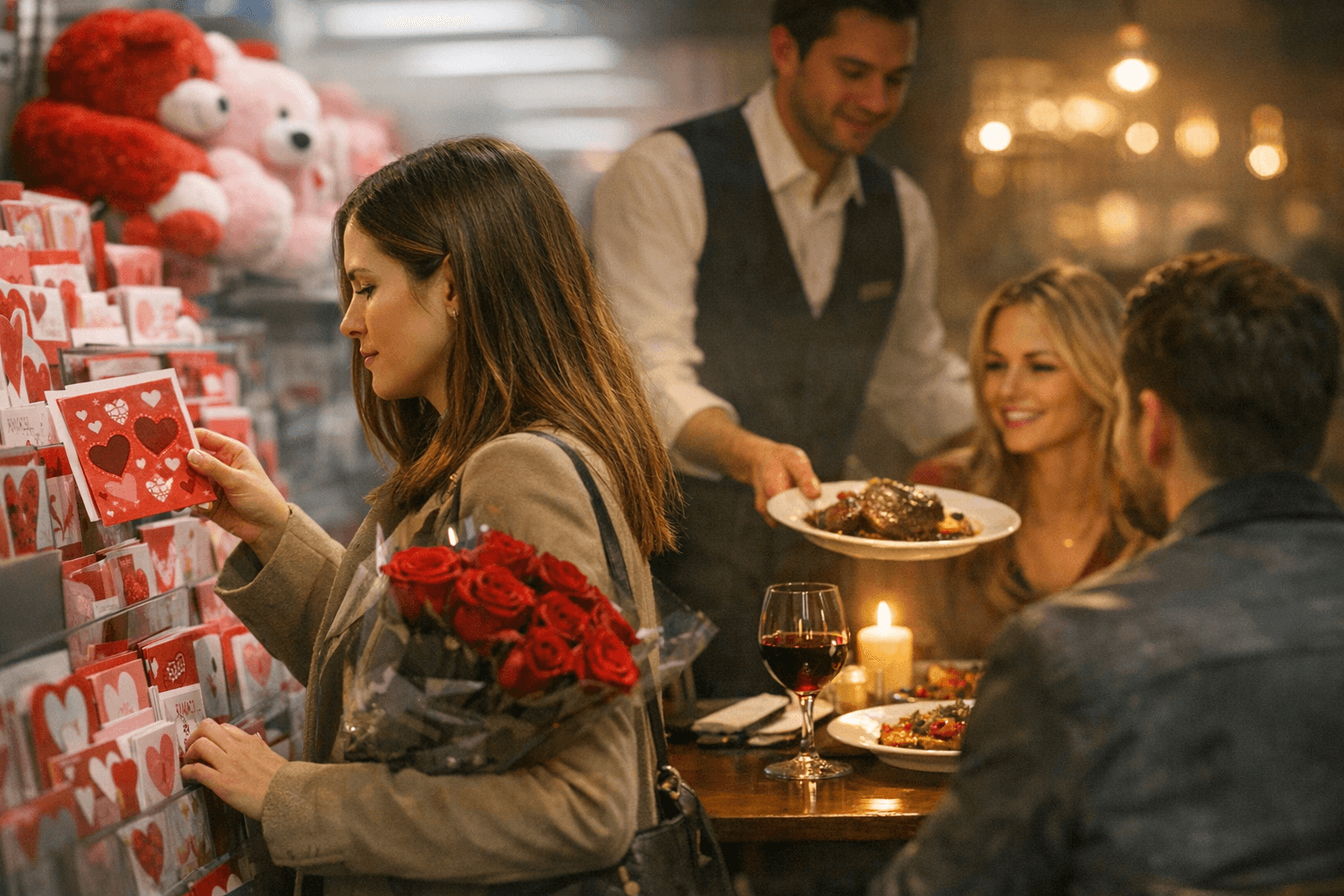
The number that should have changed how you spent on Valentine's Day this year is $738.4 billion. That is the U.S. Census Bureau's advance estimate for total retail and food services sales in February 2026, up 3.7 percent from February 2025 and modestly higher than January. Inside that figure is a split that tells you something specific about where holiday dollars traveled this year, and where, with a little planning, they could have worked harder.
Nonstore retailers, the online channel where most gift shopping now originates, grew 7.5 percent year over year in February. Food services and drinking places, the category that captures restaurant spending, grew 5.2 percent over the same period. The gap is not enormous, but its direction matters: people leaned slightly more toward buying things than going out. That tilt gains meaning when you layer in the National Retail Federation's Valentine's Day breakdown, which tells a more surprising story about the things people actually chose.
Total Valentine's Day spending reached a record $29.1 billion this year, surpassing the previous record of $27.5 billion set in 2025. But the category-level split inside that number is where conventional wisdom about romantic spending falls apart. Shoppers spent the most on jewelry, at $7 billion, followed by an evening out at $6.3 billion, clothing at $3.5 billion, and flowers at $3.1 billion. Jewelry was purchased by only 25 percent of consumers. Flowers were purchased by 41 percent. Yet jewelry captured more than twice the total dollars that flowers did. A smaller group of buyers, making a single concentrated purchase, drove nearly a quarter of all Valentine's spending while the majority of the country bought something far less expensive and gave it far less thought.
NRF Vice President of Industry and Consumer Insights Katherine Cullen noted that "Valentine's Day is a cherished holiday that resonates with many Americans," pointing to the record-breaking figures as evidence. The average household planned to spend $199.78, up from $188.81 in 2025. That is the number worth building a framework around, because it is close enough to $200 that a thoughtful allocation across dinner, flowers, and a keepsake becomes genuinely achievable without any category feeling underfunded.
Dinner should claim the largest share, somewhere between $90 and $110, but with conditions attached. Valentine's Day fell on a Saturday this year, the first time since 2015, and full-service restaurant reservations were extraordinarily competitive by early February. The National Restaurant Association reported menu prices rose 4.1 percent year over year to start 2026, meaning a dinner that cost $160 for two in February 2025 ran closer to $166 before the first drink arrived. Anyone who waited until the week of February 14 to book was negotiating for 5:30 seatings or accepting prix-fixe minimums at spots they would not ordinarily choose. The reservation window for a Saturday Valentine's Day, in most major cities, opened in late January and filled within days.
The trade-down that does not feel like a trade-down is booking a neighborhood restaurant rather than a destination one. Neighborhood bistros rarely impose prix-fixe structures on Valentine's weekend, service is more personal, and the meal becomes about the conversation rather than the spectacle. A $90 dinner at a place you genuinely love outperforms a $200 dinner at one chosen for its reservation difficulty.
Flowers should account for $35 to $50 of the $199.78, and the math around timing is severe enough to mention. A dozen long-stemmed red roses from a florist during peak Valentine's week runs $65 to $85, but drops by roughly 40 percent when ordered in late January. Grocery store roses cost $15 to $25 even during peak week, and the quality gap between a well-chosen grocery arrangement and a florist's standard bundle has narrowed considerably in recent years; the price gap has not. The $3.1 billion Americans spent on flowers this Valentine's Day almost certainly includes a significant premium paid for procrastination rather than for better petals.
The remaining $40 to $65 belongs to a keepsake, and this is where most spending either becomes memorable or evaporates. The $7 billion jewelry figure reflects two things simultaneously: meaningful purchases made by people who knew exactly what their partners wanted, and impulse purchases made by people who treated price as a proxy for effort. A small, specific keepsake chosen because it reflects genuine knowledge of your partner, a first-edition paperback of a novel they mentioned once, a small fragrance from an indie house they had been curious about, a ceramic piece by a maker whose work appears in their saved folder, consistently outperforms a generic piece of gold purchased because the occasion seemed to demand something expensive. The research, effort, and specificity are the luxury, not the price tag.
The broader signal from the Census Bureau's February data is that consumer spending continued to grow through what was, for many households, an uncertain economic moment. The three-month period from December 2025 through February 2026 ran 3.1 percent ahead of the same stretch a year earlier. The online channel's 7.5 percent year-over-year growth reflects not just convenience but the comparative advantage of shopping with price visibility, which is exactly the behavior that helps a gifter avoid paying peak-week florist markups and instead spend that savings on something that actually landed.
Valentine's Day records in aggregate spending do not tell you whether the people who set them felt the money was well placed. But the category breakdown does. The concentration of dollars in jewelry among a small minority of buyers, the underinvestment in flowers relative to the number of people buying them, and the outsized share going to a single dinner night all point toward the same conclusion: most Valentine's spending is reactive rather than planned. The Census data confirms the dollars were there. The NRF data confirms how they moved. The gap between the two is where next year's plan should begin.
This article was produced by Prism’s automated news system from verified source data, official records, and press releases, then run through automated quality and moderation checks before publishing. The system is built and supervised by the people who set the standards it runs under. Read our full AI policy.
Did this article answer your question?