3D Printing Hardens Cast Parts Only Where Wear Hits Hardest
Metal gets added only where cast parts wear hardest, and that narrow reinforcement window shows makers how hybrid manufacturing extends life without printing whole parts.
Where the wear hits, the metal follows
Hardfacing is built around a simple idea: do not rebuild the whole part when only one zone is failing. Instead, apply a protective layer to the hot spot, the scrape point, or the edge that takes the punishment, and leave the rest of the component alone. That layer can improve wear resistance, corrosion resistance, erosion resistance, and resistance to high-temperature oxidation, which is why the process keeps showing up wherever metal parts are damaged by repeated load rather than a single catastrophic break.
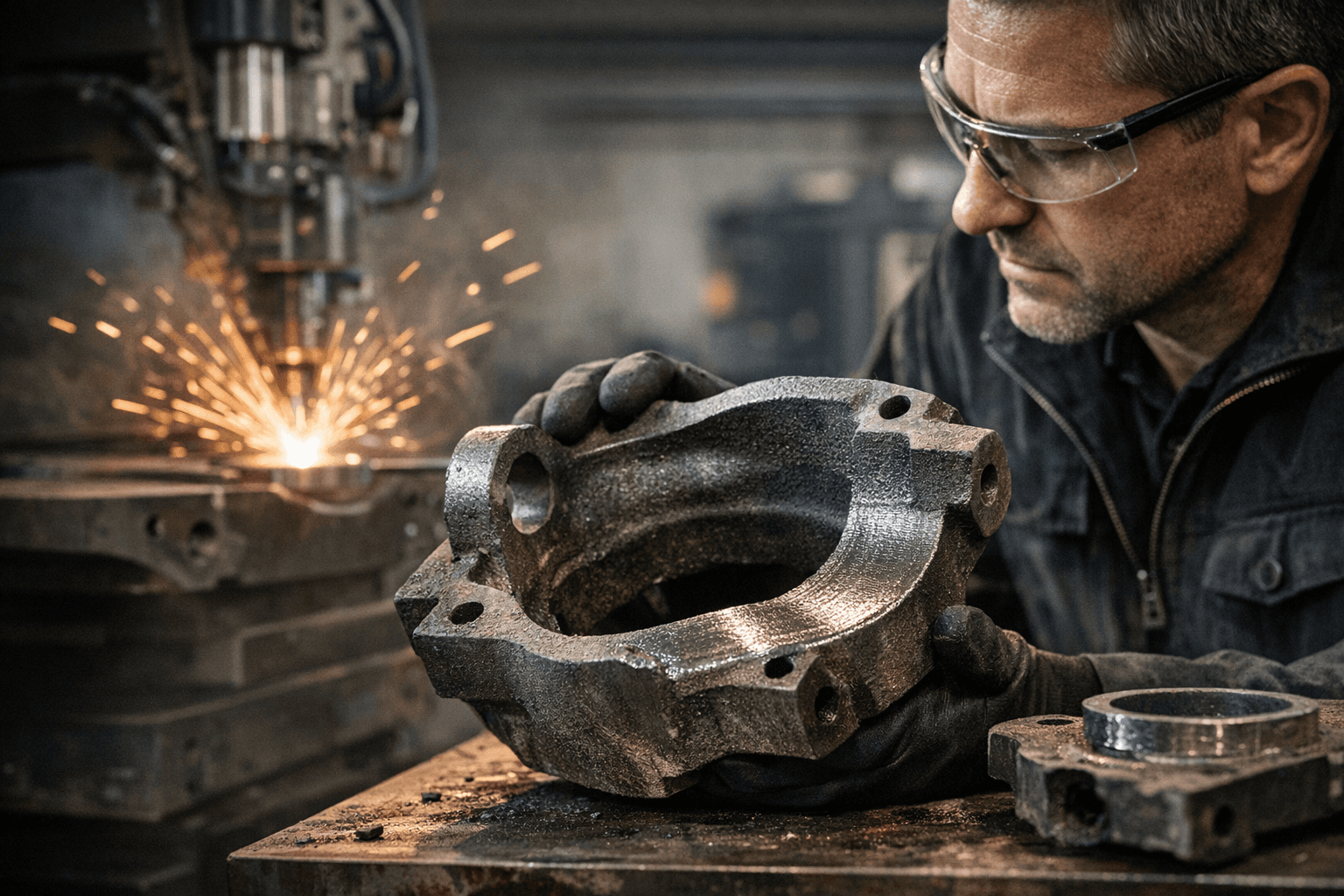
The material choices tell the story too. Common hardfacing consumables include tungsten carbide and cobalt-chromium alloys such as Stellite, both of which are used because they hold up where softer base metals would round off, pit, or scale away. Technical literature also describes hardfacing as a route to functionally graded components, where the outside of a part is engineered differently from the core so the surface handles wear, impact, corrosion, or temperature while the body underneath keeps the part light enough, tough enough, or machinable enough for the job.
How hybrid manufacturing changes the repair equation
This is where additive manufacturing enters the picture, not as a replacement for casting but as a local reinforcement tool. Fraunhofer IPT describes additive manufacturing as building components layer by layer by adding material rather than removing it, and Fraunhofer IFAM frames hybrid casting as a way to combine casting with integrated structures or local strengthening of cast components. In practice, that means the process chain can start with a cast body and then add only the features or material needed to survive the load.
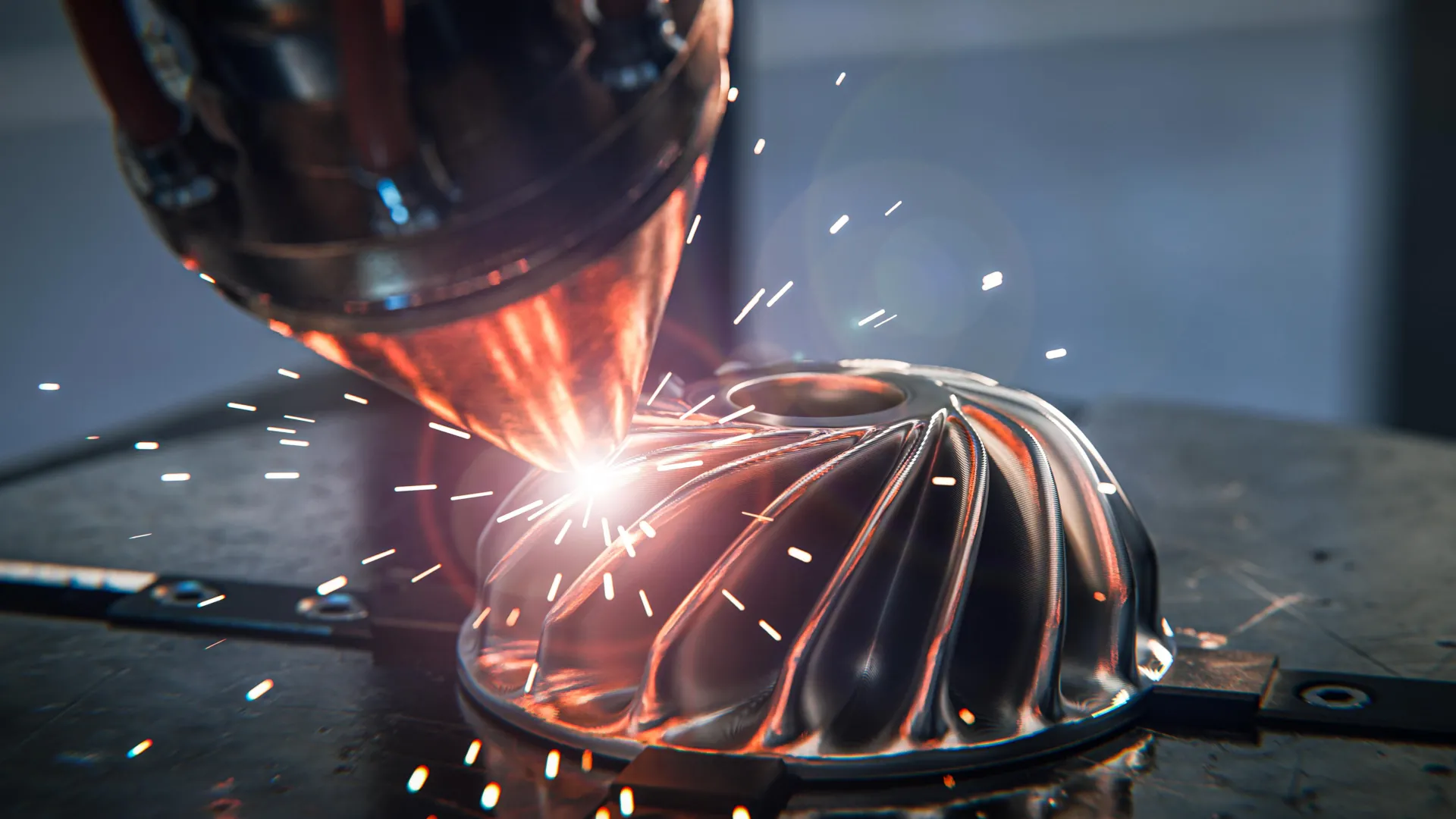
Fraunhofer IWS says laser-based direct energy deposition is already an established industrial technology for coating and repairing metal parts. That matters because it shows the industry is past the stage of treating metal deposition as a novelty. Laser-based deposition is used to place material where it is needed, and that can be paired with casting, machining, and repair workflows instead of forcing a part to be made by one process from start to finish. Fraunhofer IFAM’s hybrid-casting work pushes in the same direction, focusing on cast components with locally strengthened areas rather than wholesale redesign.
Why this is a manufacturing shift, not just a materials story
The real change is not simply that a harder layer can be printed on top of a softer base. It is that companies can now aim expensive metal only at the places that are actually failing. That reduces breakdowns, cuts repair costs, and saves material, time, and production steps compared with reworking or replacing the entire component.
A patent filing describing a cast body with at least one feature deposited by a solid-state additive process points in the same direction. The logic is consistent across the research notes: the future of metal parts is increasingly mixed-process, with casting, additive deposition, machining, and inspection each doing the work they are best suited for. In that model, the added material is not decoration. It is a structural answer to a known weak point.
What the Toyota tooling example proves
Fraunhofer ILT’s work on additive tooling makes the industrial logic easier to see. In 2025, the institute said a hybrid, large-volume tool was created for the transmission housing of the Toyota Yaris Hybrid, using a specially manufactured preform and conformal cooling channels. Fraunhofer ILT also said the newly developed L-40 tool steel enables additive manufacturing of heavily loaded, large-volume tools and that smaller tools already in series production at Toyota had significantly longer service life.
The scale matters. Fraunhofer ILT said the gantry-based large-format system used in that work can reproducibly print complex resistant tools with a volume of over 20,000 cm³. That is not the realm of desktop hobby machines, and that is exactly the point. This is industrial metalworking solving a load-bearing problem at a size and temperature regime far beyond polymer printing, while still using additive methods to shape performance only where the part needs it most.
Conformal cooling adds another clue about why hybrid manufacturing keeps gaining ground. Instead of treating the tool as a solid block and hoping heat leaves efficiently, the tool can be designed with internal cooling paths that follow the geometry. That is a different mindset from traditional machining, and it is one reason additive processes are increasingly tied to tooling, repair, and reinforcement rather than just to standalone printed parts.
The boundary line for hobby printing
For the 3D printing community, the value of this story is not a fantasy of printing metal castings at home. It is a clearer boundary line. Desktop printers are excellent at prototyping geometry, testing fit, and making low-cost sacrificial parts, but they are not competing with gantry-scale systems depositing tool steel or hardmetal onto loaded cast bodies. Fraunhofer IKTS has shown that 3D-printed hardmetals can reach material properties comparable to hardmetal tools made through conventional shaping routes, but that only underscores how specialized the process has become.
The lesson for makers is more practical than glamorous. If a part fails at a boss, a pin bore, a corner, or a sliding face, design for that weakness from the start. Leave room for inserts, wear pads, sacrificial skins, or replaceable interfaces. Think like a process engineer: the cheapest fix is often not stronger material everywhere, but stronger material exactly where the load path proves it needs to be.
That is the real takeaway from hardfacing, hybrid casting, and additive repair. The industry is learning to strengthen cast parts only where the wear hits hardest, and the same mindset can make printed parts smarter even when the machine on the bench will never lay down tungsten carbide, cobalt-chromium, or L-40 steel. The future of additive manufacturing is not just printing more parts. It is knowing which surfaces deserve the armor.
Know something we missed? Have a correction or additional information?
Submit a Tip