All3DP updates Bambu Lab buyer’s guide as lineup grows crowded
Bambu Lab’s buyer’s guide now maps a lineup that runs from the A1 to the 7-nozzle H2C, where the real choice is workflow, not price.
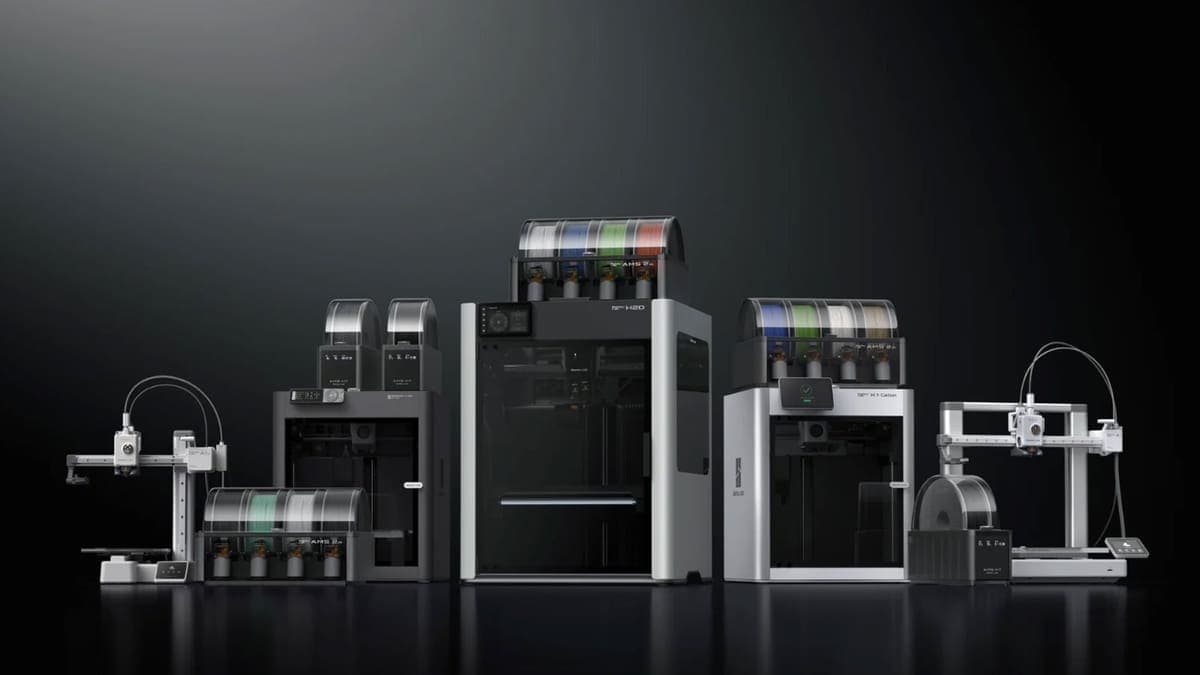
All3DP’s updated Bambu Lab buyer’s guide lands in a moment when the brand’s range has become dense enough to confuse even people who already own a printer. Bambu’s comparison page now stretches from the A1 and A1 mini through the P1S, X1C, X1E, H2S, H2D, H2C, P2S, A2L, and X2D, which turns shopping into a question of architecture: open or enclosed, single-material or multicolor, simple automation or a machine built to scale with a more demanding workflow.
Start with the job, not the badge
That is the guide’s most useful shift. The old habit of sorting desktop printers into “cheap” and “premium” does not help much here, because Bambu’s stack is really organized around what the machine is meant to do all day. The A1 is the clearest gateway model in that range: Bambu markets it as a beginner-friendly, fully automated printer with AMS Lite support for multicolor printing, and TechAdvisor put its launch price at $399 for the printer and $559 for the Combo.
The size tells part of the story too. The A1’s 256 x 256 x 256 mm build volume matches the larger P1S and X1C, so the entry point is not tiny. That makes the A1 less like a toy step-up and more like a first printer that can stay relevant after the novelty phase, especially if the buyer wants a machine that can handle the same-sized parts as more expensive models without immediately moving into a more complex chassis.
When color stops being a feature and becomes the workflow
The next fork in the road is multicolor architecture. On the A1, AMS Lite is the add-on that opens the door to color work without turning the machine into a science project. That makes sense for occasional accents, small runs, and the kind of hobby printing where color is a nice extra rather than the thing driving the whole setup.
The H2C sits at the other end of that decision tree. Bambu’s H2C page says the machine supports six-color printing plus a seventh nozzle for support or another color, and the store listing describes it as having 7 smart-swapping hotends with support for up to 24 filaments. That is not just a spec bump. It signals a printer built for users who are thinking in terms of material routing, swap efficiency, and how much of the color complexity happens inside the machine instead of around it.
For a lot of hobbyists, that is the real divide in the lineup. A multicolor add-on changes what a printer can do; a multinozzle platform changes how the printer is organized around the job. The buyer’s guide matters because it helps separate those two ideas before the wrong purchase turns into wasted filament, missed throughput, or a bench space headache.
The brand behind the stack
Bambu’s rapid expansion explains why the lineup now feels crowded. The company was launched with the X1 series after a Kickstarter pre-order announcement in May 2022, and the X1 quickly became the flagship that defined the brand’s reputation for high-speed motion and multi-color capability. Bambu now says it has sites in Shenzhen, Shanghai, and Austin, Texas, a footprint that matches how aggressively the product line has moved from one breakout machine into a whole family of printers.
That family now spans beginner machines, fast single-material systems, and more advanced multi-tool or multi-nozzle concepts. The practical result is that Bambu is no longer selling one obvious upgrade path. It is selling several, and each one is aimed at a different kind of maker, from someone buying a first printer to someone planning around higher throughput and more complex material handling.
The A1’s safety history still matters
The A1 also carries the clearest safety footnote in the lineup. In 2024, the U.S. Consumer Product Safety Commission recalled about 12,800 Bambu Lab A1 printers because early units’ heatbed cables could be damaged and create electric shock and fire hazards. Bambu’s recall page says the affected printers were sold before January 30, 2024, and the remedy offered was either a full refund or a free replacement heatbed and cable fix.
That matters because the A1 is not just the entry-level machine that many buyers meet first. It is also the model that became a public test of how Bambu handled a hardware problem in a fast-growing consumer category. For shoppers reading a buyer’s guide in 2026, that history sits right next to the appeal of the machine itself: beginner-friendly automation, a real multicolor path through AMS Lite, and enough build volume to feel like a serious printer rather than a starter toy.
The crowded lineup makes the guide more valuable, not less. The real question now is not whether Bambu has a printer for every budget, but which architecture fits the way the bench actually gets used, from the A1’s straightforward first-printer appeal to the H2C’s 7-hotend, 24-filament complexity.
This article was produced by Prism’s automated news system from verified source data, official records, and press releases, then run through automated quality and moderation checks before publishing. The system is built and supervised by the people who set the standards it runs under. Read our full AI policy.
Did this article answer your question?