Bambu Lab patent hints at new flexible TPU feeding system
Bambu Lab’s new patent points to a softer-TPU feeding fix that could cut jams and buckling, but today’s AMS workarounds still set the limits.
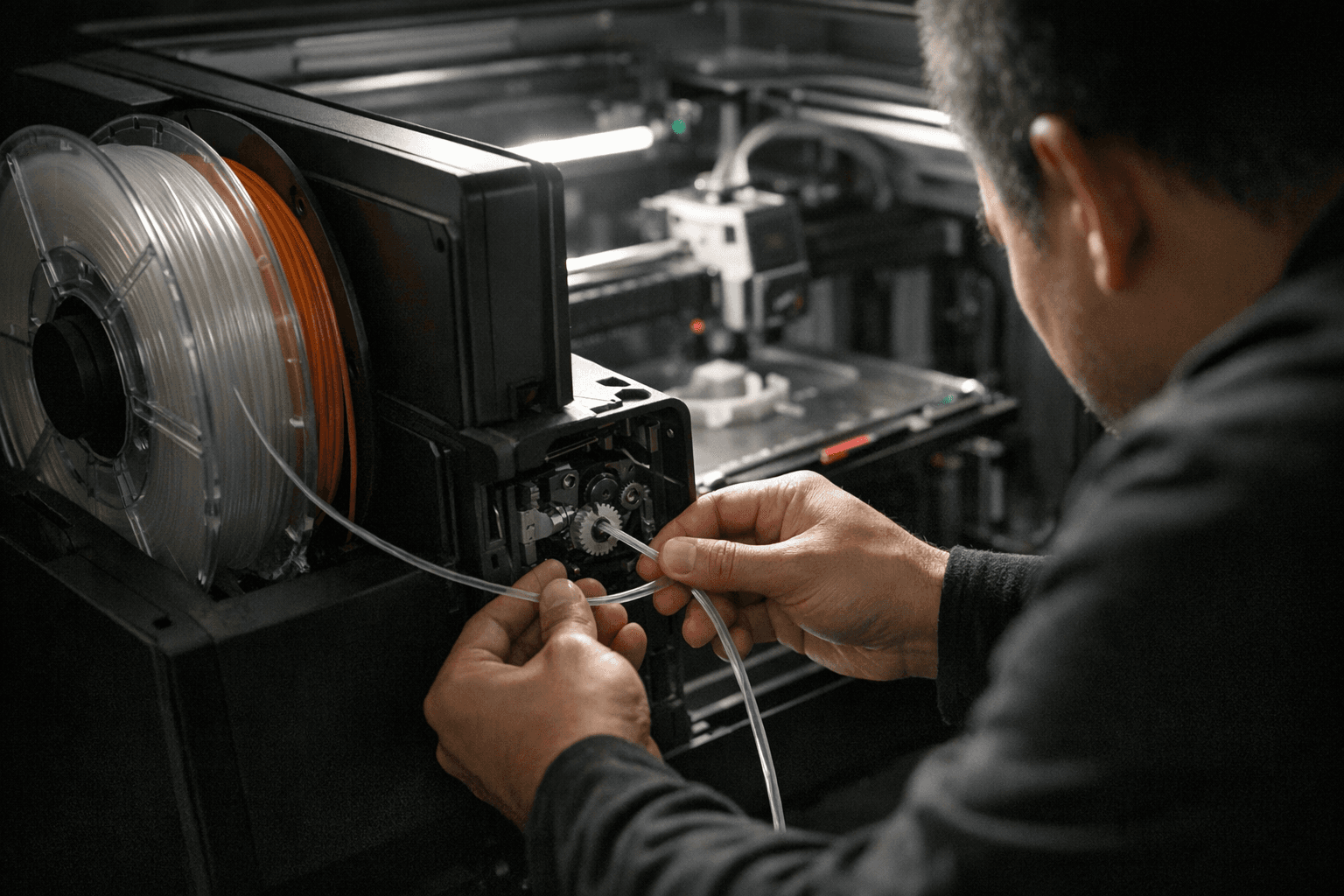
Bambu Lab may be chasing one of the nastiest headaches in desktop printing: getting flexible TPU through an automated feed path without buckling, tangling, or stopping the whole job cold. A fresh patent, CN-224130580-U, surfaced on the WIPO database with a bluntly useful aim, handling harder and softer consumables differently so discharge pressure and speed can stay even and the feed path does not clog.
That is exactly the kind of problem TPU users know too well. Bambu Lab’s own TPU guide says softer TPU can bend during feeding and lead to filament buckling, tangling, or unstable extrusion on standard printers. The company recommends TPU at 85A or higher for stable printing, which tells you how narrow the comfort zone still is when flexible filament meets automated hardware.
Kerry Stevenson of Fabbaloo said the word hopper may be a translation quirk and that the real story is probably filament handling rather than a pellet printer. That reading fits the rest of Bambu’s current TPU playbook. In the AMS family, only the AMS HT can print TPU at all, and even then it cannot use automatic feeding and unloading for TPU. Instead, it acts as a drying box while the filament is manually pushed through. Bambu Lab’s AMS HT documentation says the automatic feed and return function fails too often with soft filament to be reliable.
The company has already been building around that weakness. On April 7, 2025, Bambu Lab introduced a TPU 85A and 90A printing guide for the H2D, and its H2-series guide says the machine can print rigid filament on one hotend and TPU on the other for soft-and-hard multi-material work. Bambu Lab also sells TPU for AMS at 68D Shore hardness, marketing it as optimized for AMS and AMS lite integration with less stringing and cleaner multicolor output.
That makes the new patent worth watching because it hints at a different approach: not just making TPU tolerable, but making it behave more like a normal AMS-friendly material. If Bambu Lab turns this into shipping hardware, the first winners would likely be multicolor figures, functional brackets with flexible gaskets, soft feet, wear parts, and other hobby projects that need TPU without constant babysitting.
For now, though, the practical call is simple. Do not delay a printer or accessory buy on the strength of this patent alone. The real-world answer for TPU today is still the same mix of higher-hardness filament, manual loading, drying, bypass-style handling, and careful profile tuning. If Bambu Lab does deliver this system, it could become one of the most useful quality-of-life upgrades the company has aimed at flexible filament in years.
This article was produced by Prism’s automated news system from verified source data, official records, and press releases, then run through automated quality and moderation checks before publishing. The system is built and supervised by the people who set the standards it runs under. Read our full AI policy.
Did this article answer your question?