China’s print farms challenge injection molding in high-volume production
A Shenzhen farm ran 5,000 printers and filled 40,000 ornaments in a week, showing how print farms are pressuring molding economics.
The print farm that behaves like a factory
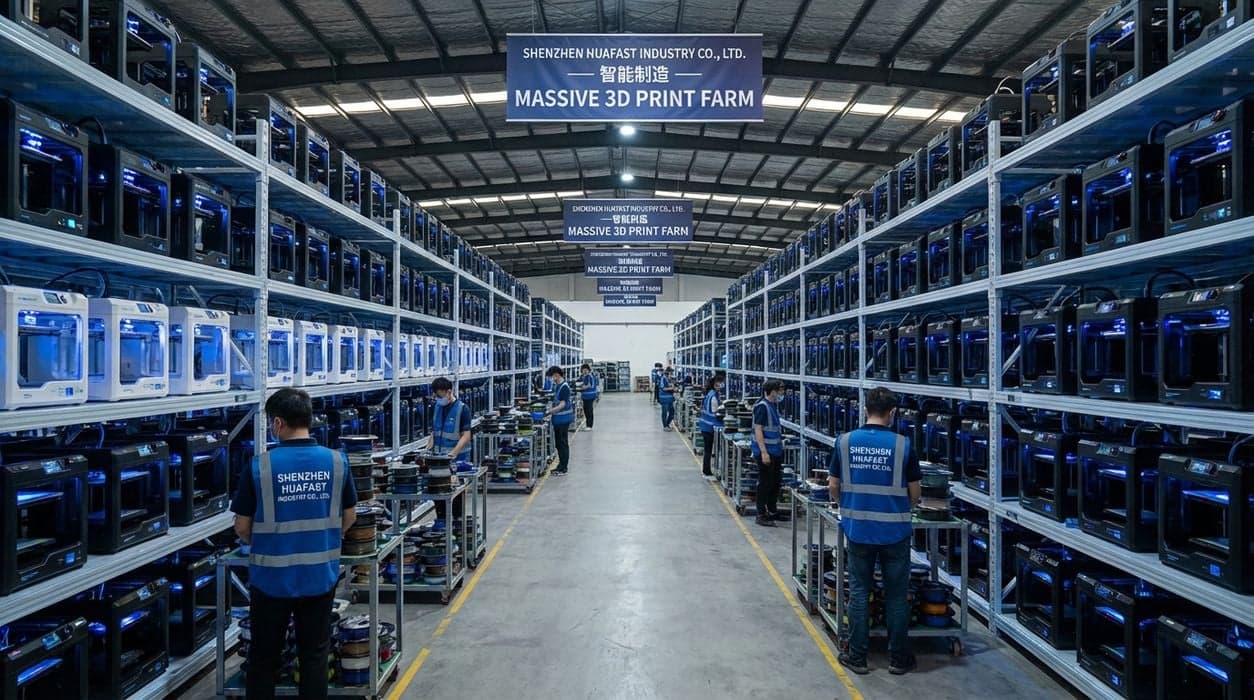
A Shenzhen factory run by Shenzhen Huafast Industry Co., Ltd. landed the kind of order that makes a molding shop pause and do the math: 40,000 table ornaments, completed in a week. The plant, in Shenzhen, Guangdong Province, was running 5,000 3D printers and was flooded with personalized Chinese New Year gift orders, a scale that makes the line between maker printing and factory production look a lot thinner. That is the real story behind the print-farm boom Chris Anderson has been pointing to: additive manufacturing is no longer just for prototypes, and in the right production window it can compete with injection molding on speed, flexibility, and sometimes cost.
Why the economics are changing
Injection molding still has a powerful advantage when a run is huge and stable, because tooling costs can be spread across millions of parts. But the print-farm model bypasses that mold bill entirely, which matters when a product is seasonal, personalized, or changing too quickly to justify steel tooling. Li Jian, who heads Huafast, framed the appeal in practical terms: products can move from design to market almost instantly, without the expense and delay of mold-making.
That shortcut changes the business calculation for a lot of the objects that fill hobby carts and seasonal storefronts. A design that would once have sat in tooling limbo can now be made, tested, and shipped while demand is still hot. For small-batch manufacturers, the win is not only lower upfront risk, but also the ability to treat production like an iteration cycle instead of a one-time mold investment.
What Huafast shows about production-scale printing
Huafast is not a garage full of desktop machines. Xinhua described the factory as making toys and tools from a range of materials, and follow-on reporting said the operation planned to reach 10,000 printers by the end of 2026. That kind of expansion tells you the business is not betting on novelty, it is betting on throughput. When a plant can absorb a flood of Chinese New Year orders and still clear a 40,000-unit ornament run in days, it starts to look less like a print bureau and more like a flexible manufacturing line with software at its core.
The important detail for 3D printing readers is that the machines are being organized as production capacity, not showcase hardware. The value is in keeping a large fleet fed, calibrated, and busy enough to turn filament, resin, or other materials into finished goods on a schedule. That is the operational leap that makes Chinese print farms worth watching: the workflow is no longer one printer, one operator, one part, but thousands of machines working like a coordinated factory.
Where the farms are clustering
The Chinese print-farm boom is not evenly spread across the map. Panda3DP’s landscape reporting says hundreds of farms have sprung up, with many clustered in manufacturing centers such as Yiwu and Shantou, alongside the deeper industrial base in Shenzhen. Industry coverage also points to some farms that have grown from hundreds of printers to nearly 1,000 machines or more, which shows how fast the model is scaling once operators prove they can keep machines maintained and profitable.
That clustering matters because it lowers the friction around labor, supply chains, and downstream finishing. In the same places where consumer manufacturing already lives, print farms can tap into existing logistics and production know-how. Panda3DP also says the country’s print-farm movement is shaping global benchmarks for cost and efficiency, which is exactly what happens when a production model starts being copied, benchmarked, and measured against the old standard.

What this means for cost, speed, and iteration
For the hobby world, the biggest change is not abstract industrial growth. It is the way the product pipeline shortens when a factory can turn out small-batch accessories, seasonal décor, toys, and components without waiting for a mold room to catch up. That makes rapid iteration cheaper, especially for products that need frequent design tweaks, custom names, or region-specific variants that would be too risky to tool up in metal.
This is where print farms blur the line between the maker bench and the factory floor. A product can begin as a printable design, get validated in a run that is too fast and too specific for molding, and then scale into a serious manufacturing order once demand is clear. For buyers, that means more niche accessories and more made-to-order pieces. For sellers, it means a faster path from concept to shelf.
Where print farms challenge molding, and where they still do not
This is not a blanket replacement story. Injection molding still makes sense when a design is locked, demand is predictable, and volume is high enough to amortize tooling across a long production life. The Chinese print-farm model is strongest where the opposite is true: short runs, personalized pieces, fast-turn seasonal goods, and products that may need to change before the mold would even pay for itself.
That is why the comparison matters so much now. The old assumption that molding always wins at scale is getting more complicated, because print farms are showing a different kind of scale: one built on flexibility instead of fixed tooling. When the product cycle is moving fast, the factory that can skip the mold room gets to market first.
The bigger signal for the 3D printing community
Over the last couple of years, the narrative around Chinese print farms has shifted from curiosity to benchmark. Industry coverage describes a system that has expanded sharply in just a few years, with some farms growing from hundreds of printers to nearly 1,000 machines or more, and with China’s manufacturing hubs turning additive into an organized production strategy. That is a much bigger claim than “3D printing can make neat parts.”
The most telling part of the Huafast example is not just that 5,000 printers were running. It is that a week-long 40,000-ornament order could move through a Shenzhen plant as a normal production problem, the same way a mold shop once handled a fixed SKU. That is the moment print farms stop being a curiosity and start becoming a manufacturing answer.
This article was produced by Prism’s automated news system from verified source data, official records, and press releases, then run through automated quality and moderation checks before publishing. The system is built and supervised by the people who set the standards it runs under. Read our full AI policy.
Did this article answer your question?