CurifyLabs Debuts PharmaPrinter Aurum for Automated Pharmacy Compounding and Personalized Medicines
CurifyLabs introduced the PharmaPrinter Aurum, an automated 3D printing compounding system that aims to speed and standardize patient-specific medicine production.

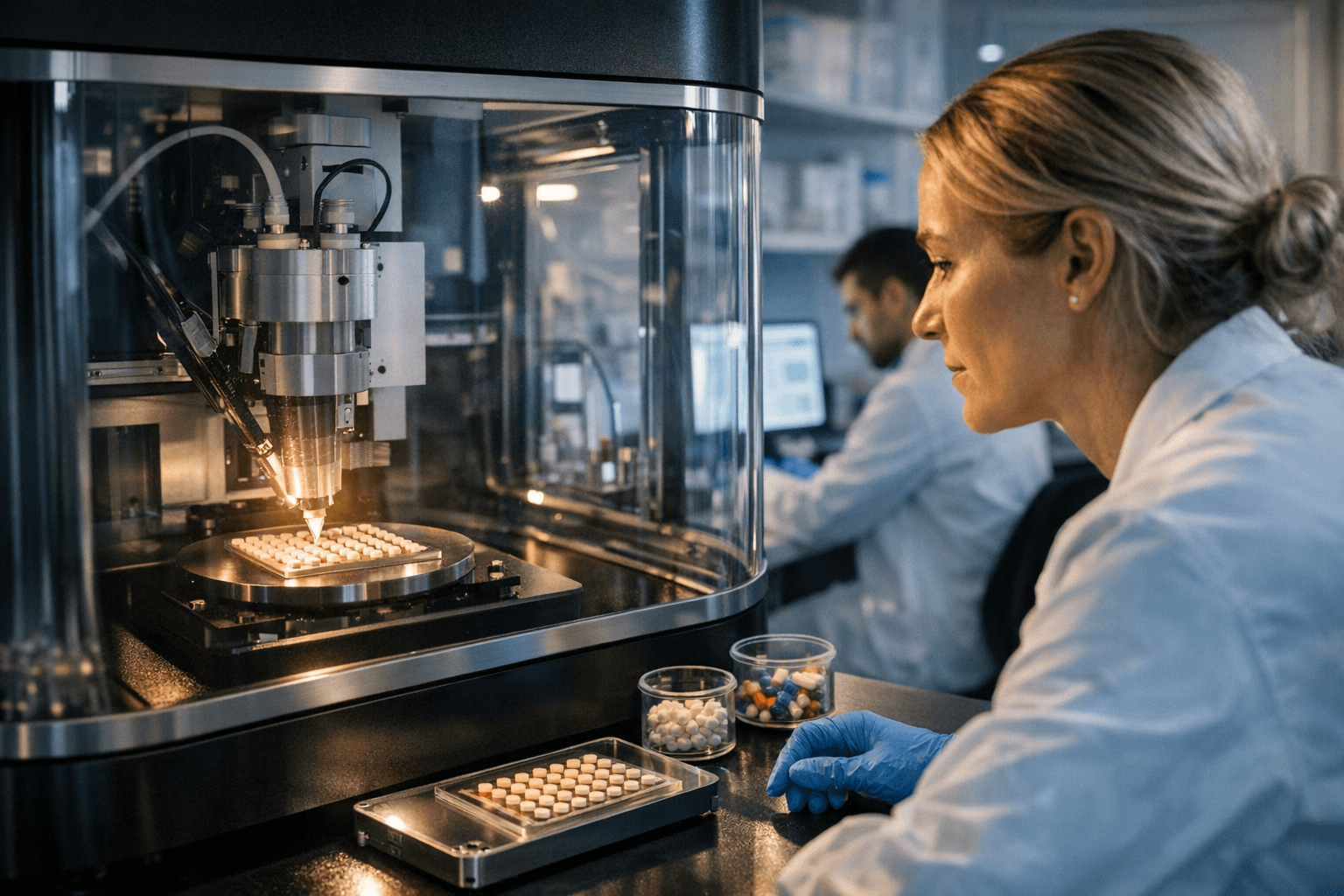
CurifyLabs unveiled the PharmaPrinter Aurum on January 16, 2026, presenting an automated 3D printing compounding system aimed squarely at pharmacy compounding and personalized-medicine workflows. Built as part of CurifyLabs’ Compounding System Solution (CSS), the Aurum automates previously manual steps in non-sterile compounding and deposits semi-solid pharmaceutical formulations layer-by-layer to produce tailored doses and shapes.
The machine prints tablets, films, suppositories and other dosage forms by laying down semi-solid formulation material according to a digital recipe. CurifyLabs framed the Aurum as a way to speed production, increase consistency across batches and deliver patient-specific dosing for pediatrics and other special-dosage needs. The company highlighted automation, formulation library support, and an emphasis on quality and control traceability as core selling points for hospital and community pharmacy environments.
Practical value centers on removing manual variability from compounding workflows. By automating measurement, deposition and in-process documentation, the system aims to stabilize dose accuracy and reduce operator-dependent errors. The Aurum’s in-process documentation and controls are intended to meet compounding quality requirements, providing an auditable trail that pharmacies can use to demonstrate adherence to internal and regulatory standards. For pharmacies that already manage small-batch or individualized preparations, the promise is faster throughput with repeatable results.
Formulation library support is a key operational detail for users. Prevalidated formulations and digital recipes simplify setup for common compounded products while enabling pharmacies to adapt shapes and concentrations to specific patient needs. The layer-by-layer deposition approach also allows creative dosing forms that may improve adherence - slim films for swallowing-challenged patients, custom-shaped tablets for weight-based dosing, or precisely metered suppositories.
For the 3D printing community and compounding practitioners, the Aurum represents another step toward mainstreamed additive manufacturing in regulated medical settings. It addresses hot-button issues in pharmacy compounding: traceability, batch consistency and reproducibility. Implementation will require integration into existing pharmacy workflows, staff training on the CSS platform and clear standard operating procedures for non-sterile processes.
What comes next is deployment and proof in real-world settings. CurifyLabs positioned the device to support hospital and community pharmacies, so watch for pilot projects and adoption announcements that demonstrate how the Aurum performs under daily compounding loads. For now, the Aurum signals growing maturity in pharmaceutical 3D printing - moving from lab demos and one-off prototypes to automated systems designed for routine use and tighter quality control.
This article was produced by Prism’s automated news system from verified source data, official records, and press releases, then run through automated quality and moderation checks before publishing. The system is built and supervised by the people who set the standards it runs under. Read our full AI policy.
Did this article answer your question?