DHR Engineering Robot Automates 3D Print Removal for Non-Stop Farm Operations
DHR Engineering's robot swaps print beds across 44 Bambu Lab printers without a human in the room, and robotics expert Lukas Ziegler's viral demo is making farm operators do the math.
Forty-four Bambu Lab X1C printers. Dozens of completed jobs per day. Not a single human hand touching a build plate. That's the current operating reality at DHR Engineering's automated farm, and robotics expert Lukas Ziegler's viral demo of the system has print farm operators rethinking what lights-out production genuinely requires.
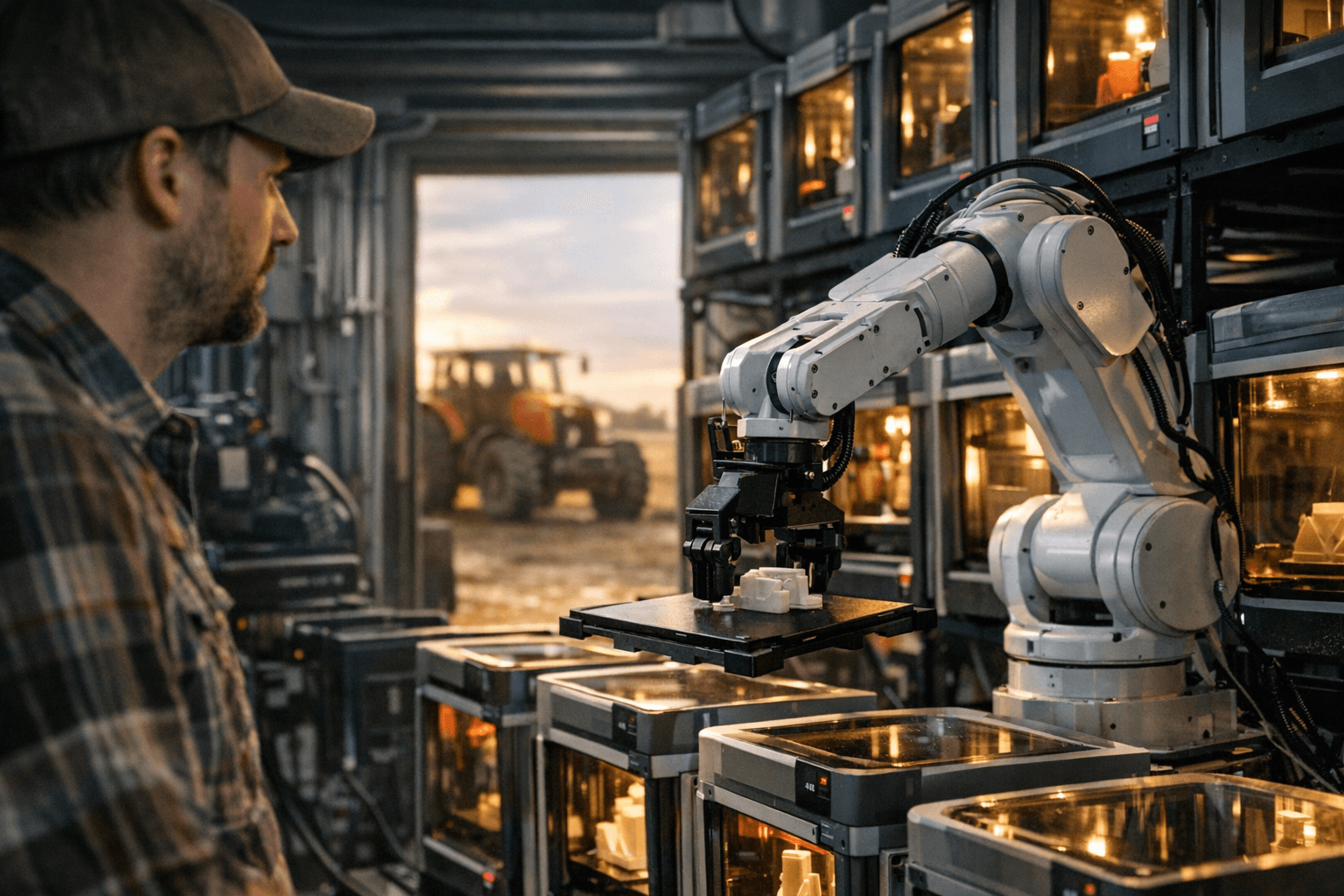
The custom-built robot handles three tasks back to back: pull the finished bed, slot in a clean replacement, and signal the control software to dispatch the next job. All movements are pre-calculated and calibrated to each machine's exact rack position, which means no misalignment and no idle time between prints. DHR built the hardware entirely in-house, and it runs without breaks, scaling as new printers join the fleet.
The proprietary software layer is where the system earns its keep overnight. It assigns jobs to machines based on material availability, monitors print status in real time, and automatically reschedules any job that fails or is interrupted, handling multi-material queues and adjusting speeds for different filaments mid-batch. CEO Dimitar Hristakiev, whose company originally built the farm to produce alignment tools and jigs for CNC clients, described the turning point after integrating Bambu Lab hardware: "Bambu Lab totally transformed our business. Our automated 3D printer farm was finally able to unleash its true potential."
For a farm owner running 5 to 20 printers and wondering whether a DHR-style robot pencils out, it helps to map exactly what the system solves and where it stops. On the wins side: part removal is no longer a bottleneck because the robot swaps the entire magnetic build plate rather than prying parts loose, eliminating the most common mid-farm interruption. Software-driven failure monitoring catches spaghetti events and reschedules affected jobs automatically, keeping utilization high without anyone watching a camera feed at 2 a.m.
First-layer quality is what no bed-swap robot touches. A drifted z-offset or contaminated PEI surface will generate failed print after failed print, and the robot will dutifully remove each one and load the next victim. Physical calibration stays on the operator.
The honest ROI picture below 44 printers is that a bespoke robotic cell is engineering work, most defensible at the scale DHR references in its published case studies of 60-plus printer fleets. Smaller operations can close the same gaps with off-the-shelf options available right now: magnetic spring-steel PEI flex plates reduce manual removal to a two-second bend; Obico, the AI failure-detection service formerly called The Spaghetti Detective, catches disasters and pauses prints automatically; 3DQue's VAAPR bed actively ejects completed parts and chains jobs on Klipper machines; and the 3D Farmers FarmLoop platform adds job queuing and automatic G-code modification for Bambu Lab printers without a robot arm anywhere near the farm.
DHR's own roadmap points to 200 printers and US expansion. The company is already testing automated filament spool swapping through a custom vertical lift module, a compact indexed carousel the robot accesses autonomously, targeting what DHR describes as one of the last manual bottlenecks in continuous FDM production. Once spool swapping ships alongside the bed-change robot, the list of tasks that genuinely require a human in the room shrinks to first-layer verification and hardware servicing; two jobs that toolhead cameras and predictive monitoring are already making smaller.
This article was produced by Prism’s automated news system from verified source data, official records, and press releases, then run through automated quality and moderation checks before publishing. The system is built and supervised by the people who set the standards it runs under. Read our full AI policy.
Did this article answer your question?