How to Reduce 3D Printer Emissions With Ventilation and Enclosures
A consolidated chamber study found personal PM2.5 exposures exceeded the US standard in 63% of print runs; here's the tiered ventilation playbook to fix that.
What desktop printing actually does to your air
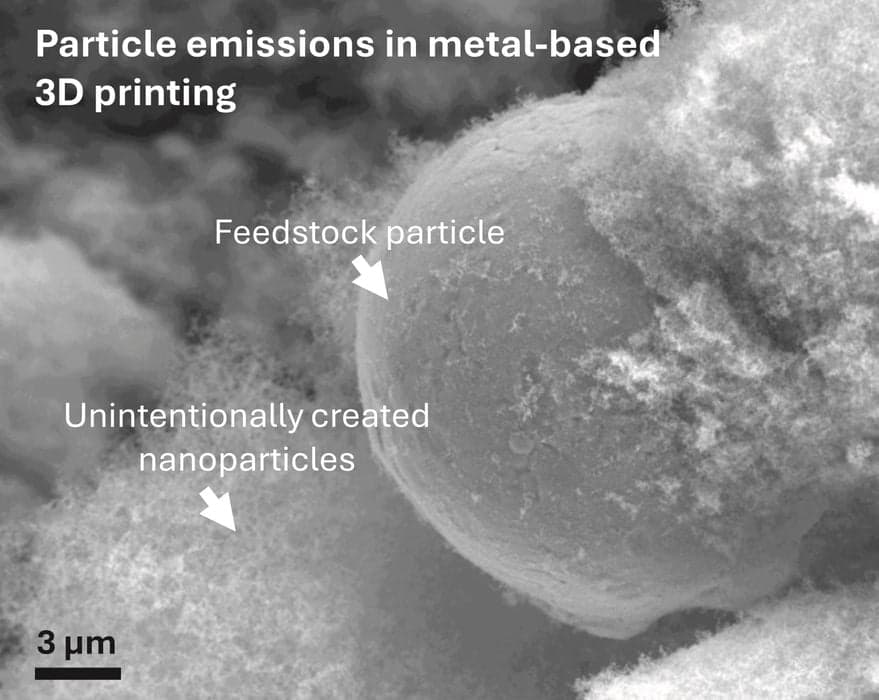
A consolidated analysis of 447 particle emission evaluations published in a peer-reviewed chamber study found that personal exposures exceeded the US PM2.5 standard in more than 63% of documented print runs. Those numbers come from printers sitting on benches not unlike yours. The particle emission rates observed across filament types span 10^9 to 10^11 particles per hour, a spread of two full orders of magnitude, and that gap is almost entirely explained by one variable: what you loaded into the hotend. If that stat is news to you, you're not alone, and the fix is cheaper and simpler than most people expect.
Both NIOSH (in its 2024 guidance document "Approaches to Safe 3D Printing") and EPA researchers confirm that desktop fused filament fabrication printers emit ultrafine particles (UFPs, defined as smaller than 100 nm) and volatile organic compounds during normal operation. The risk level is not uniform. It scales with material choice, print temperature, room size, and how many hours per week the machine runs. That gives you a clear decision tree for upgrading your setup in stages rather than all at once.
Tier 1: Open-air printing with low-emission filaments
If you print PLA in short sessions on a single machine in a reasonably sized room (think a living room or a garage, not a closet), you are already in the lowest-risk category. PLA generates measurably fewer particles than styrene-bearing filaments: research published in Scientific Reports found ABS produces roughly 10 times the particle emission rate of PLA under equivalent conditions. Even so, "low risk" is not "no risk," and the baseline actions here cost nothing beyond a window latch.
The minimum viable setup for PLA printing:
- Print in a room with at least one operable window; crack it open during and for 30 minutes after a print.
- Position a standard box fan behind the printer to move air toward the window rather than across your face.
- Avoid printing during sleep hours in a bedroom, regardless of filament type.
- Keep sessions under two hours if ventilation is limited.
These steps alone meaningfully reduce your time-averaged exposure because UFPs disperse quickly in moving air. They are not sufficient once you move to higher-emission materials.
Tier 2: Adding an enclosure
The upgrade trigger is simple: if you run ABS, ASA, TPU, HIPS, or any resin, or if you print more than roughly ten hours per week in a small room, an enclosure is no longer optional. Measured specific emission rates show ASA reaching 1.7 × 10^11 particles per minute, compared to 2.0 × 10^9 for a PETG-based filament. That is an 85-fold difference. ABS clocks in at around 4.7 × 10^10 particles per minute, and it is also the dominant source of styrene vapors, with one study measuring up to 25 micrograms of styrene per gram of printed object. An enclosure captures that emission cloud at the source rather than letting it fill the room.
A functional enclosure does not have to be a manufacturer-sold unit. Many printers designed for open-frame operation can be boxed in with a rigid acrylic or polycarbonate shell. What matters is that the enclosure seals reasonably well during printing and has a defined exhaust point you can duct. Without an exhaust path, you are simply storing the emissions inside a box and releasing them in a concentrated burst every time you open the lid.
Inside the enclosure, keep print temperatures at the lower end of the manufacturer's recommended range. Higher temperatures increase both particle nucleation rates and VOC off-gassing, so dialing back even 5 to 10°C where the filament still extrudes cleanly is a free reduction in output.
Tier 3: Exhausted enclosure with active filtration
This is the configuration NIOSH's guidance explicitly recommends for higher-risk materials and community settings, and it is what you should target if you run multiple printers, print engineering plastics regularly, or operate in a space with other people present such as a classroom, library, or makerspace.
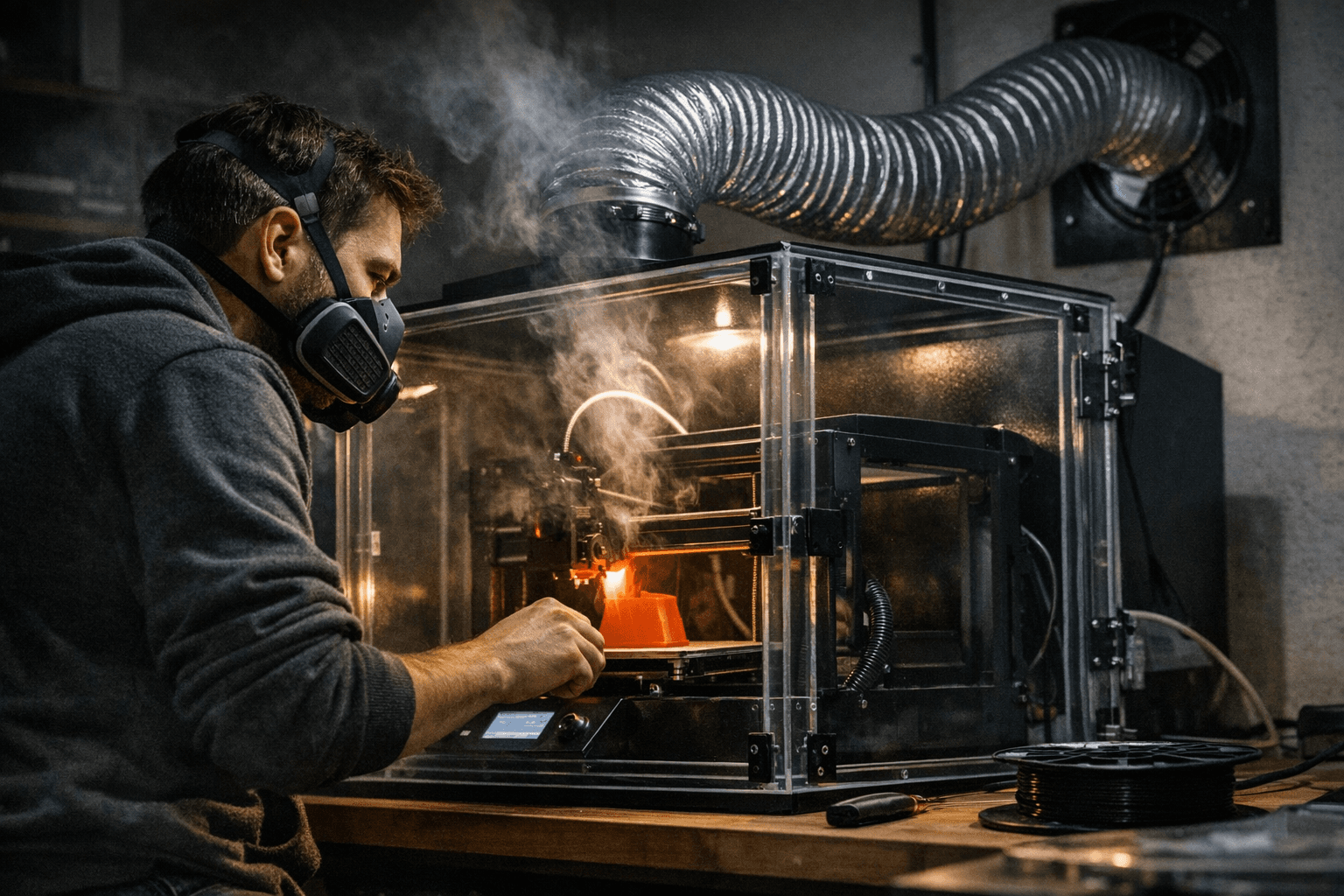
The system works in two stages:
1. Enclosure with a captured exhaust port. Route the exhaust through ductwork to either an external discharge point (the cleanest solution) or a filtration stack before recirculating.
2. Filtration stack: HEPA plus activated carbon. HEPA captures particles down into the UFP range effectively; activated carbon or a chemisorption stage handles VOCs and odors. The EPA's 3D printing research explicitly notes that HEPA alone does not remove VOCs, which is critical for ABS styrene, resin monomers, and ASA combustion products. Filter replacement must follow the manufacturer's schedule; improvised activated charcoal solutions without documented adsorption capacity ratings should not be treated as equivalent.
A dedicated exhaust fan rated for the enclosure volume, a short duct run, and a combined HEPA-plus-carbon filter unit is the practical shopping list for most home setups. Local exhaust ventilation (LEV) hoods, the kind used in laboratory settings, are the commercial equivalent and are worth the investment if you run a bench with three or more machines.
Controls for makerspaces, schools, and libraries
Community settings introduce two complications that a home shop does not face: concurrent multi-printer operation, which multiplies emission rates, and the presence of children or staff who may not have chosen to be in the space. NIOSH's guidance for these environments calls for a combined approach rather than any single control.
Engineering controls come first: enclose printers and duct to external exhaust or a documented LEV system. Real-time particle monitoring is recommended when running many machines simultaneously, because the load on filtration increases nonlinearly. Administrative controls layer on top: restrict access to the printer room during active print jobs, post clear signage, and log maintenance intervals for all filters.
Resin handling requires PPE regardless of room ventilation: nitrile gloves and eye protection are the NIOSH-specified minimum for staff who open resin tanks, handle supports, or perform post-curing. Resins introduce uncured monomers that skin contact can absorb, a route of exposure that exhaust ventilation alone does not address.
Advanced use: post-processing and multi-material labs
Sanding, vapor smoothing with acetone, and continuous resin UV curing all generate exposures beyond what normal printing produces. If your workflow includes any of these, an LEV hood or a dedicated finishing cabinet with captured exhaust is warranted as its own system, separate from the print enclosure. Keep a material inventory and pull the SDS sheet for every filament and resin in the shop; when data on emission characteristics is incomplete for a given material, default to the more conservative controls you would apply to ABS.
Chamber studies consistently show that some engineering filaments generate orders of magnitude more UFPs than PLA. When process requirements do not mandate a specific polymer, choosing lower-emission alternatives and keeping individual prints small are the fastest ways to cut cumulative exposure without adding any hardware at all.
The practical action list
- PLA, short sessions, large room: open window, fan pointed toward exhaust, no enclosure required.
- ABS, ASA, TPU, HIPS, or any resin: enclose the printer before the next print.
- Enclosed but not exhausted: add a HEPA-plus-carbon filter unit and a duct path.
- More than one printer, or a shared space: move to LEV, real-time monitoring, and documented filter maintenance schedules.
- Post-processing (sanding, vapor smoothing): separate LEV setup, consult material SDS sheets.
NIOSH's full "Approaches to Safe 3D Printing" document and the EPA's ongoing emissions research page remain the best sources for updated assessment methods as new filament chemistries enter the market. The ventilation infrastructure you build for today's printer scales directly to whatever you add to the bench next.
This article was produced by Prism’s automated news system from verified source data, official records, and press releases, then run through automated quality and moderation checks before publishing. The system is built and supervised by the people who set the standards it runs under. Read our full AI policy.
Did this article answer your question?