From office fix to prolific creator, Kit Crafters shapes MakerWorld
Mickey Hoang turned an office fix into Kit Crafters, one of MakerWorld’s most downloaded creators. His path shows how niche design and platform leverage can become a real living.

The office problem that grew into a storefront
Mickey Hoang did not start out trying to build a creator brand. He bought a printer to solve an office problem as a technical writer, then set the hobby aside for two years before returning to it with a very different setup and a much bigger ambition. When his wife gave him an X1C, the machine became the restart button, and the hobby slowly turned into a design practice with a market attached.
That shift matters because Hoang did not arrive through a polished software pipeline or a formal design background. He taught himself FreeCAD because he did not want to pay for software, then chose to keep pushing until the work looked less like tinkering and more like a profession. He later said he preferred FreeCAD over Fusion 360, SolidWorks, Onshape, and similar tools because, as a software engineer, he valued open-source software. Four Bambu Lab printers now anchor his prototyping and testing workflow, which is a clue to how serious the operation has become.
Why Kit Crafters stands out on MakerWorld
MakerWorld’s profile of Kit Crafters makes the scale hard to miss. Hoang is one of the platform’s most downloaded creators, and his page shows 188 published 3D models, 4 laser and cut models, 267 posts, and 398 print profiles. The platform badges tell an even bigger story: 514 different models rated or commented on, and 215 successful prints totaling 5,323 hours.
That footprint helps explain why his work resonates beyond a single viral file. Nearly 200 models later, he is still releasing them for free, which gives new users a way in and keeps existing followers checking back for the next release. One of his most successful designs reportedly took only 30 minutes to build, a useful reminder that a strong concept, clear form, and good timing can matter as much as marathon modeling sessions.
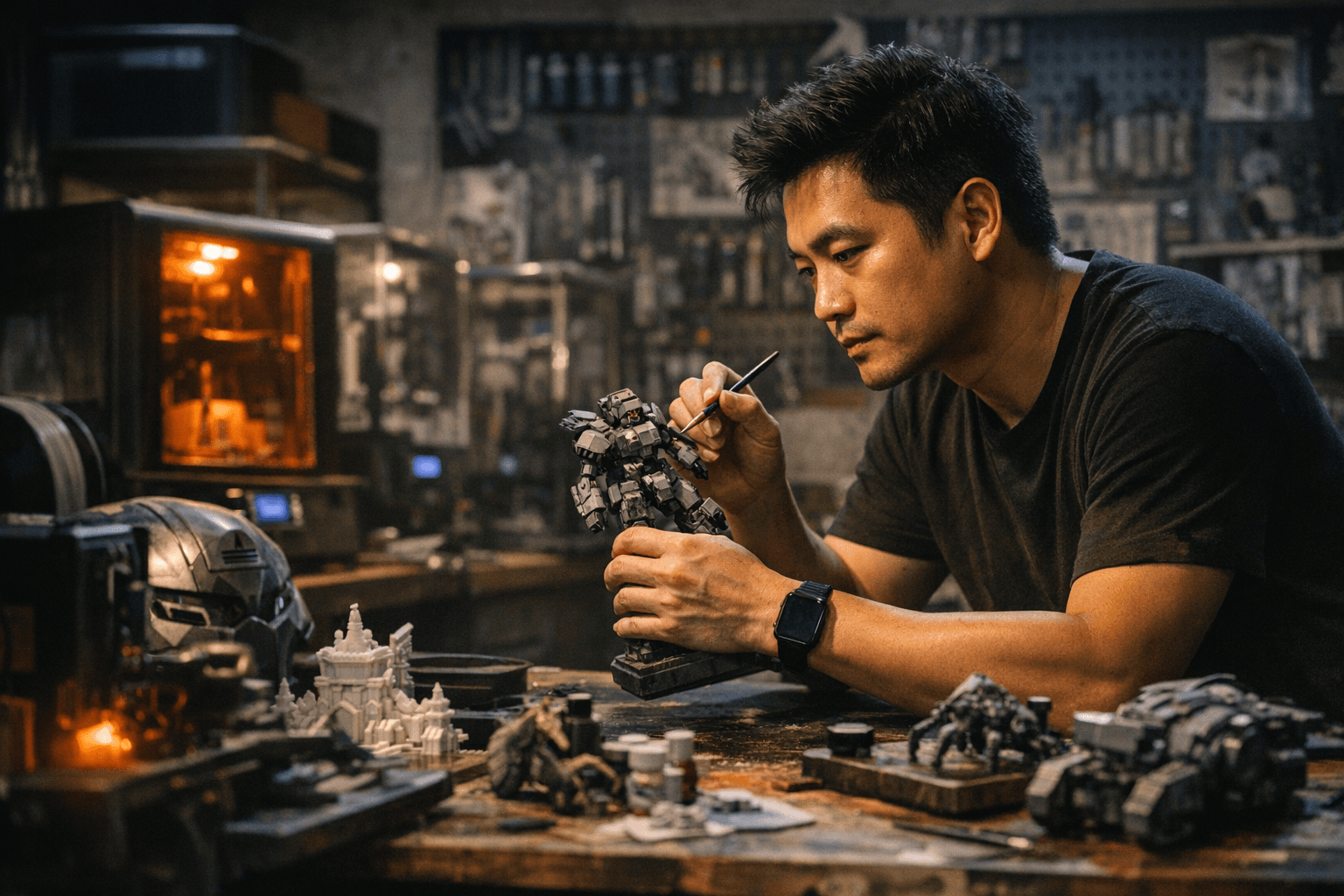
His catalog also shows range without drifting away from identity. There is a modular robot system with swappable arms, a dragon that crowdfunded beyond its stretch goals, a fidget clicker that outperformed the rest of his catalog, and a flamethrower that remains his favorite design no matter what the numbers say. That mix of practical, playful, and occasionally theatrical is exactly the kind of portfolio that can keep a creator visible in a crowded file ecosystem.
How he helped shape MakerWorld’s contest culture
Hoang’s influence on MakerWorld is not limited to downloads. MakerWorld says he launched the platform’s first creator-hosted contest, and his own contest post describes his remix challenge as the first of its kind on the platform. That mattered because it tied creator-led community energy to MakerWorld’s newer digital license for remixable exclusive models, which gave the contest a clearer structure and a stronger platform role.
Contests do more than hand out prizes. They teach a community what kinds of projects are worth making, remixing, and sharing, and they help turn a model library into a living culture. In Hoang’s case, the contest work also fits the kind of builder identity he has been cultivating all along: not just making files, but actively shaping how the platform behaves.
The business mechanics behind the success
The important lesson in Hoang’s story is that the income side did not appear by accident. Bambu Lab’s Exclusive Model Program lets eligible creators convert points into cash and receive copyright support, which gives model makers a clearer route from community participation to earnings. Later, Commercial License Memberships let creators offer commercial print licenses while keeping personal downloads free, which is a useful balance for creators who want reach without surrendering monetization.
Hoang’s own public bio shows how that mix plays out in practice. He designs mini mech model kits, offers a commercial license on Patreon, and invites supporters to his Discord for design help and tips. That is a multi-channel business model built around the same core asset, the model file, but distributed across community, licensing, and support rather than relying on a single storefront.
For creators watching closely, the playbook is starting to look familiar:
- Pick a niche that can repeat. Hoang’s mini mech kits, modular robots, and stylized creatures give him a recognizable lane.
- Make one design lead to the next. A strong remix contest, a license-friendly model, or a swappable system all create follow-on content.
- Use the platform’s mechanics, not just its upload button. Contest hosting, badges, print profiles, and ratings all become proof of value.
- Keep the funnel open. Free models bring people in, while commercial licenses and memberships create the income layer.
- Test fast and often. Hoang’s four Bambu Lab printers are not just a flex, they are a production tool for prototyping, iteration, and reliability.
What other creators can take from Kit Crafters
Hoang’s rise says something bigger about where desktop 3D printing has landed. Owning a printer is no longer the full story, and dialing in a first layer is no longer the end goal. The real opportunity now sits at the intersection of design skill, audience building, and a platform that can turn repeated uploads into a recognizable catalog.
MakerWorld is clearly leaning into that future, and Kit Crafters is one of the clearest proofs of why it works. A printer bought to fix an office problem became the starting point for a free-model catalog, a contest culture, and a creator business that stretches from MakerWorld to Patreon and Discord. That is what the modern 3D printing creator economy looks like when it finally clicks into place.
This article was produced by Prism’s automated news system from verified source data, official records, and press releases, then run through automated quality and moderation checks before publishing. The system is built and supervised by the people who set the standards it runs under. Read our full AI policy.
Did this article answer your question?