How to Choose the Right 3D Filament for Every Project
Wrong filament wrecks prints before the first layer sets; here's the 2026 decision tree that matches every material to your Bambu, Prusa, or Ender-class machine and kills wasted spools.

The spool sitting next to your printer is probably the wrong one. Not because you bought a bad brand, but because filament selection has quietly become one of the most consequential decisions in a print workflow, and the explosion of available polymers and blends in recent years has made choosing correctly far less intuitive than it looks on a product page. The good news: the decision collapses into a handful of clear checkpoints once you know what to ask.
Start with the print's job, not the material
Before you even look at a spool, answer two questions: What will this part actually do? And does your printer have the hardware to process the material it needs?
A cosmetic prop and a load-bearing bracket have almost nothing in common as print targets. The cosmetic part rewards surface finish, paintability, and detail resolution. The bracket rewards layer adhesion, thermal resistance, and dimensional accuracy under stress. Chasing exotic materials for a display piece is a waste of money and tuning time; equally, printing a structural component in PLA because it's convenient is a reliability gamble. Matching function to material is more important than chasing the most advanced polymer on the shelf, and a well-tuned PLA print will outperform a poorly tuned specialty filament in many everyday applications.
The second checkpoint is your machine. An open-frame Ender-class printer, an enclosed Prusa MK4, and a fully sealed Bambu Lab P1S or X1C are not interchangeable platforms for all materials. Enclosure, heated bed temperature ceiling, hotend maximum, and (for multi-material setups) AMS or MMU compatibility all gate which filaments are actually accessible to you.
The core five: what each material is actually for
*PLA and PLA+* are the right starting point for anything cosmetic, decorative, or low-stress. Nozzle temperatures typically run 190–220°C with a bed around 50–60°C, and an open-frame printer handles it without drama. The trade-off is thermal fragility: PLA begins to soften around 50–55°C, which means a part left in a car on a summer day will warp. Prolonged UV exposure causes brittleness. PLA is not an outdoor or under-hood material. One nuance worth knowing: PLA+ (toughened formulations) is stronger, but its surface detail is slightly less crisp than standard PLA, which matters for miniatures and fine-detail prints.
*PETG* is the workhorse upgrade for parts that need durability and mild flexibility without the printing difficulty of ABS. Nozzle temperatures run 230–250°C, and the material tolerates moderate heat and moisture better than PLA. The catch is hygroscopicity: PETG absorbs moisture quickly enough to cause stringing, layer delamination, and micro-bubbling in the hotend. Dry a suspect spool at 55–70°C for 4–8 hours before a critical print, and store it in an airtight container with fresh desiccant. PETG is also a strong candidate for Bambu AMS setups, where consistent dry filament is especially important for multi-material reliability.
*ABS* earns its place only when you need higher-temperature resistance and you have an enclosure and proper ventilation. Nozzle temperatures sit at 230–250°C with a bed at 90–110°C. Without an enclosure to trap heat and prevent draft-induced warping, ABS on an open Ender-class machine produces inconsistent results. The fumes during printing are also a real concern: ABS should be processed in a ventilated space or with active filtration.
*ASA* is the version of ABS that makes practical sense for most hobbyists with enclosed machines. It runs at 240–260°C at the nozzle with a bed between 95–110°C, and the enclosure's ambient temperature should hold 40–60°C. Unlike ABS, ASA is engineered for UV resistance and outdoor weathering, which makes it the correct default for anything going outside. The bed's radiant heat in a properly sealed enclosure is typically sufficient to maintain the required ambient without active chamber heating, even on Prusa or Bambu setups that don't have dedicated chamber heaters.
*TPU and TPU blends* cover every use case that requires flex: grips, gaskets, vibration-damping mounts, snap-fit covers, wearables. Shore hardness varies significantly between formulations (Shore 95A is firm; softer variants compress meaningfully under pressure), so check the spec before ordering. Layer heights of 0.2–0.3mm are a reliable baseline. Direct-drive extruders handle TPU far more predictably than Bowden setups; on long Bowden paths, softer TPU tends to buckle.
Five real scenarios, matched
Cosplay armor panels
Large, curved, lightly structural, needs sanding and painting: this is PLA+'s home territory. Print at 210–215°C with a 0.4mm nozzle and 0.2mm layer height. The tougher formulation handles the minor impacts of costume wear, and its surface sands and primes well for paint adhesion. If the armor pieces need to flex slightly at joints without cracking, a TPU trim layer at 0.25mm layer height gives articulation without swapping the entire part to a flexible material.
Functional household or workshop brackets
PETG at 235–245°C, 0.4mm nozzle, 0.2mm layer height, 40–50% infill with a gyroid or cubic infill pattern. Dry the spool first. The slight flex in PETG prevents the brittle fracture failure mode that catches PLA brackets off-guard under sustained load. If the bracket sits near a heat source (LED driver housing, under-cabinet lighting, motor mount), step up to ASA and verify your printer has an enclosure.
Tabletop miniatures
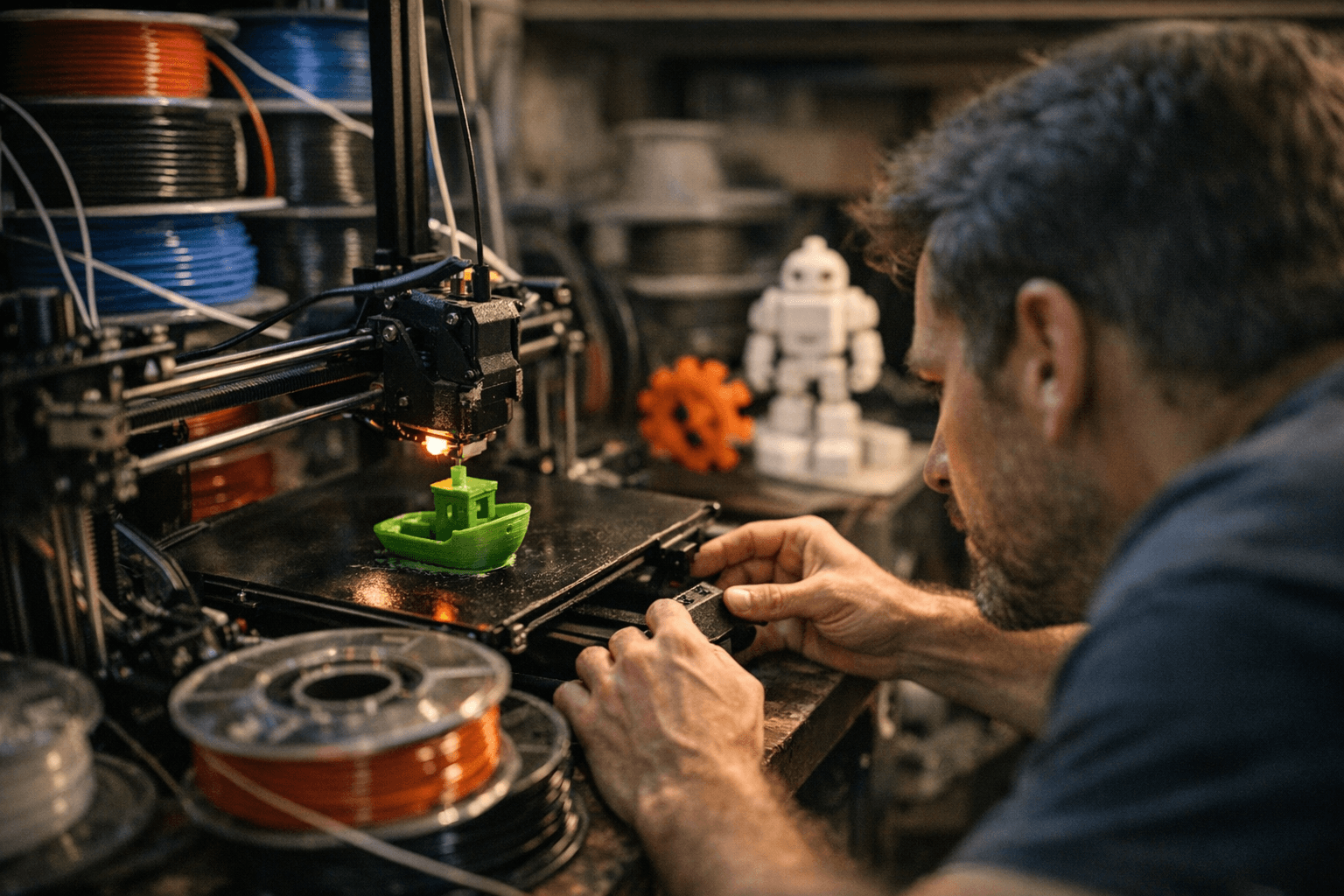
Standard PLA on a 0.25mm or 0.2mm nozzle is the preferred path for FDM miniature printing. Run nozzle temperatures at 195–205°C and slow print speed to 25–35mm/s for outer walls. On a Bambu P2S with a 0.2mm nozzle, optimized profiles are now circulating on MakerWorld and represent a faster starting point than building from scratch. Avoid PLA+ for miniatures: it is stronger, but surface detail is not as crisp as standard PLA. Resin printers will always beat FDM for the finest miniature detail, but at arm's length on a gaming table, a well-tuned PLA print at 0.08–0.1mm layer height is more than competitive and far tougher than resin.
Outdoor parts (enclosure latches, garden tool holders, mailbox hardware)
ASA is the go-to for outdoor use due to its high UV and temperature resistance. Nozzle at 250°C, bed at 100–105°C, enclosure required. Use a smooth or powder-coated PEI sheet with a glue stick for best adhesion and clean release. PLA degrades under prolonged UV exposure and becomes brittle; PETG holds up better but lacks ASA's UV stabilization. If you're on an open-frame machine without an enclosure, low-warp ASA variants have improved meaningfully, but reliable results still favor an enclosed printer.
Engineering and high-load functional parts
Carbon fiber-filled nylon or standard nylon PA12 for stiffness, strength-to-weight ratio, and chemical resistance. Nylon is highly hygroscopic and must be dried at 70–90°C for at least 4 hours, with heavily saturated spools requiring up to 24 hours. A hardened steel nozzle is mandatory for carbon fiber-filled variants; brass nozzles will wear through quickly. Print nylon in an enclosure at 240–270°C depending on formulation, with a PEI or garolite bed surface for adhesion.
Drying and storage: the step most failed prints skip
PETG absorbs moisture quickly, which degrades print quality; drying at 55–70°C for 4–8 hours and storing in airtight containers with desiccants is the standard recommendation. Almost all filaments are hygroscopic, and internal moisture turns to steam inside the hotend, creating micro-bubbles that disrupt melt flow, weaken layer adhesion, and push excess material out during travel moves, causing stringing. The tell-tale signs of a wet spool are popping sounds during extrusion, excessive stringing, and rough layer surfaces on a print that previously came out clean.
PLA in particular will soften and tangle on the spool if dried above 55°C, as it begins to deform at 64°C, so match drying temperature carefully to material. Labeling dried spools with the date and filament type prevents accidental re-use of a spool that has been sitting open on a shelf.
Post-processing shapes the material choice too
If acetone smoothing is part of your workflow, ABS is the only common FDM filament that responds to it. PETG and PLA do not smooth with acetone. ASA responds to MEK (methyl ethyl ketone), though that solvent requires more careful handling. For painted cosplay or display pieces where a glassy surface is the goal, PLA sands predictably and takes filler primer well. For structural parts where surface texture doesn't matter, PETG's slight matte finish and good dimensional stability are more relevant than how well it sands.
The machine-first rule
The most consistent principle across all filament decisions: work outward from your printer's actual capabilities, not inward from the material you wish you could print. An enclosure and a hotend capable of 300°C open access to nylon, polycarbonate, and carbon fiber composites. An open-frame printer with a 240°C hotend maximum and no heated enclosure realistically covers PLA, PLA+, PETG, and TPU. Trying to push ABS or nylon on hardware that isn't set up for it produces failed prints and eroded nozzles, not breakthrough parts.
The filament market in 2026 is richer than ever, with new PLA+, tough PETG, and low-warp ASA formulations specifically designed to close the gap between hobbyist hardware and engineering performance. The fastest route to repeatable results is a clear understanding of what your machine can actually do, what your part actually needs, and which of those two constraints drives the decision.
This article was produced by Prism’s automated news system from verified source data, official records, and press releases, then run through automated quality and moderation checks before publishing. The system is built and supervised by the people who set the standards it runs under. Read our full AI policy.
Did this article answer your question?