IIT Guwahati Develops Seismic-Resistant 3D-Printed Concrete Walls for High-Risk Zones
IIT Guwahati tested three 3D-printed concrete walls under cyclic seismic loading; the modular steel-reinforced version met both Indian and international earthquake safety standards.
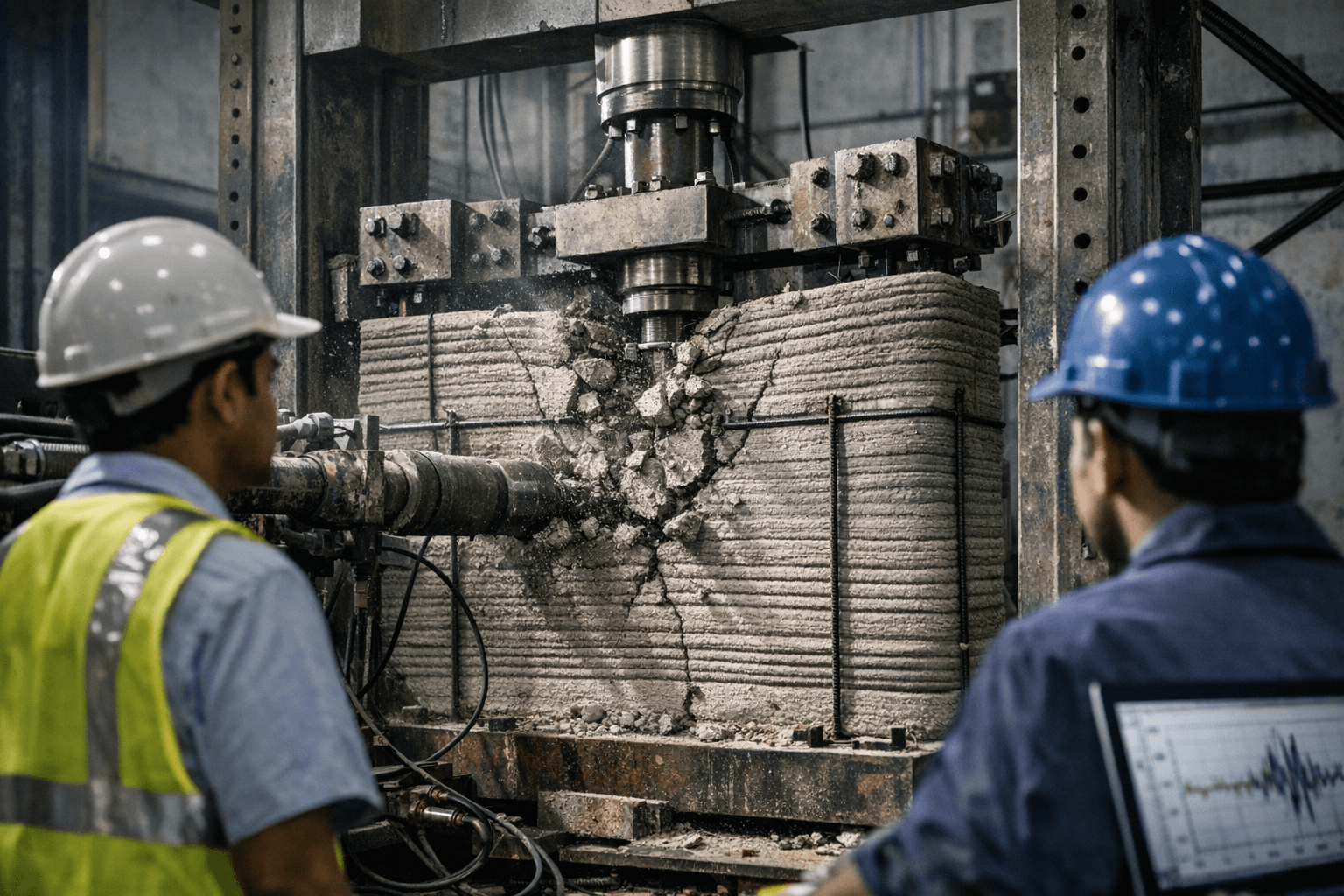
Researchers at the Indian Institute of Technology Guwahati developed and experimentally validated a modular reinforcement framework for 3D-printed concrete walls capable of meeting Indian and international seismic safety standards, with findings published in the Journal of Building Engineering.
Led by Assistant Professor Biranchi Panda from the Department of Mechanical Engineering, the team tested three full-scale wall configurations under cyclic seismic loading: 3DPM, a plain printable mortar baseline; 3DPC-CF, a strain-hardening ductile concrete reinforced with carbon fiber; and 3DPC-CFR, which combined that ductile concrete with a modular steel reinforcement system. The 3DPC-CFR configuration delivered the strongest seismic performance of the three, while experiments were paired with numerical simulations to validate the results beyond the lab.
The location of the research is itself significant. IIT Guwahati sits in Assam, one of India's northeastern states, all of which fall under Seismic Zone V, India's highest-risk seismic classification. That geography makes the problem concrete rather than theoretical: approximately 61% of India's landmass falls within moderate-to-high seismic hazard zones, around 75% of the country's population lives in seismically active regions, and India recorded 159 earthquakes in just four months between November 2024 and February 2025. A World Bank and United Nations report estimates roughly 200 million city dwellers will be exposed to storms and earthquakes by 2050.
3D concrete printing eliminates formwork entirely, reducing construction waste by up to 60%, cutting build time by 70%, and lowering labour costs by up to 80% compared to conventional cast methods. The persistent barrier to adoption in seismic zones has been reinforcement: standard practices for cast concrete don't translate cleanly to layer-by-layer extrusion. Panda framed the gap directly: "Currently, there are no standard procedures for adding steel reinforcement to 3D-printed walls that comply with current building codes."
The modular steel system embedded in the 3DPC-CFR configuration was engineered specifically around that constraint. "We integrated this reinforcement in such a way that it can be constructed using 3D printing without hampering the printing process and meets the safety requirements of Indian and international earthquake safety standards," Panda said. The ductile concrete used in both fiber-reinforced configurations also proved its value under load, confirmed as being able to "support the wall's weight even after damage started."
The team extended its numerical work beyond individual wall panels, modelling a complete full-scale single-storey house, with simulations confirming the framework transfers to entire building structures. Future directions are already mapped out. "We now plan to extend the framework to multi-storey buildings, investigate resistance to other hazards such as impact and blast loading, and contribute to future design standards for structural 3D printing," Panda said.
The research lands at an unusually consequential regulatory moment. The Bureau of Indian Standards recently withdrew its revised IS 1893:2025 seismic code after the Ministry of Housing and Urban Affairs raised concerns, reinstating IS 1893 (Part 1):2016 as the current applicable standard. Independently validated experimental data on 3D-printed structural wall performance is now directly relevant to whatever revision process follows.
The IIT Guwahati study is part of a broader Canada-India research program targeting sustainability through formwork elimination and refined concrete mix design. The commercial context sharpens the stakes: the global 3D concrete printing market sat at USD 481.9 million in 2024 and is projected to reach USD 4,881.8 million by 2030, growing at a CAGR of 47.3%. An industry expanding that fast in seismically active regions needs validated structural frameworks to match its pace.
This article was produced by Prism’s automated news system from verified source data, official records, and press releases, then run through automated quality and moderation checks before publishing. The system is built and supervised by the people who set the standards it runs under. Read our full AI policy.
Did this article answer your question?