Machine Learning Helps Researchers Design Stronger, More Ductile 3D Printed Steel
An ML model analyzing 81 physicochemical properties designed a steel alloy that hits 1,713 MPa while stretching 15.5% before fracturing, with just one six-hour heat treatment step.
Steel has always been a problem for metal additive manufacturing. The alloys running through most LDED machines today, including workhorses like 316L stainless and Inconel 718, were engineered for casting and forging decades before the first powder bed fusion machine existed. Adapting them to the thermal cycles and rapid solidification of laser-based printing means accepting compromises: internal defects, inconsistent mechanical properties, and a maddening tendency to make you choose between strength and ductility. A team from the University of South China and Purdue University decided to stop adapting and start designing.
Their paper, "Interpretable machine learning integrated with physicochemical feature for developing additively manufactured ultra-high strength and ductility steel," published in the International Journal of Extreme Manufacturing, describes an approach that sidesteps the usual trial-and-error alloy chemistry entirely. Rather than working from known compositions and tweaking ratios, the team built an interpretable machine learning model and fed it 81 fundamental physicochemical features of elements, including atomic radius, electron behavior, and acoustic velocity. The model was not a black box. It could explain which elemental properties drove which performance outcomes, which is what makes it useful for materials design rather than just pattern recognition.
What the model produced was not what you might expect from a high-performance steel recipe. Conventional ultra-high-strength steels for additive manufacturing typically demand heavy additions of cobalt, molybdenum, or elevated nickel concentrations. Those elements are expensive, and they still require multi-step heat treatments in industrial furnaces that can stretch across several days. The ML-identified composition, designated Fe-15Cr-3.2Ni-0.8Mn-0.6Cu-0.56Si-0.4Al-0.16C by weight, swaps those costly additions for smaller quantities of silicon, copper, and aluminum alongside a manageable chromium and nickel base.
The team fabricated the alloy using laser-directed energy deposition (LDED), the powder-fed laser process widely used in aerospace and heavy engineering for both new parts and repair work. After printing, the parts needed only a single tempering step at 480 degrees Celsius held for six hours. That single step is the whole post-processing workflow.
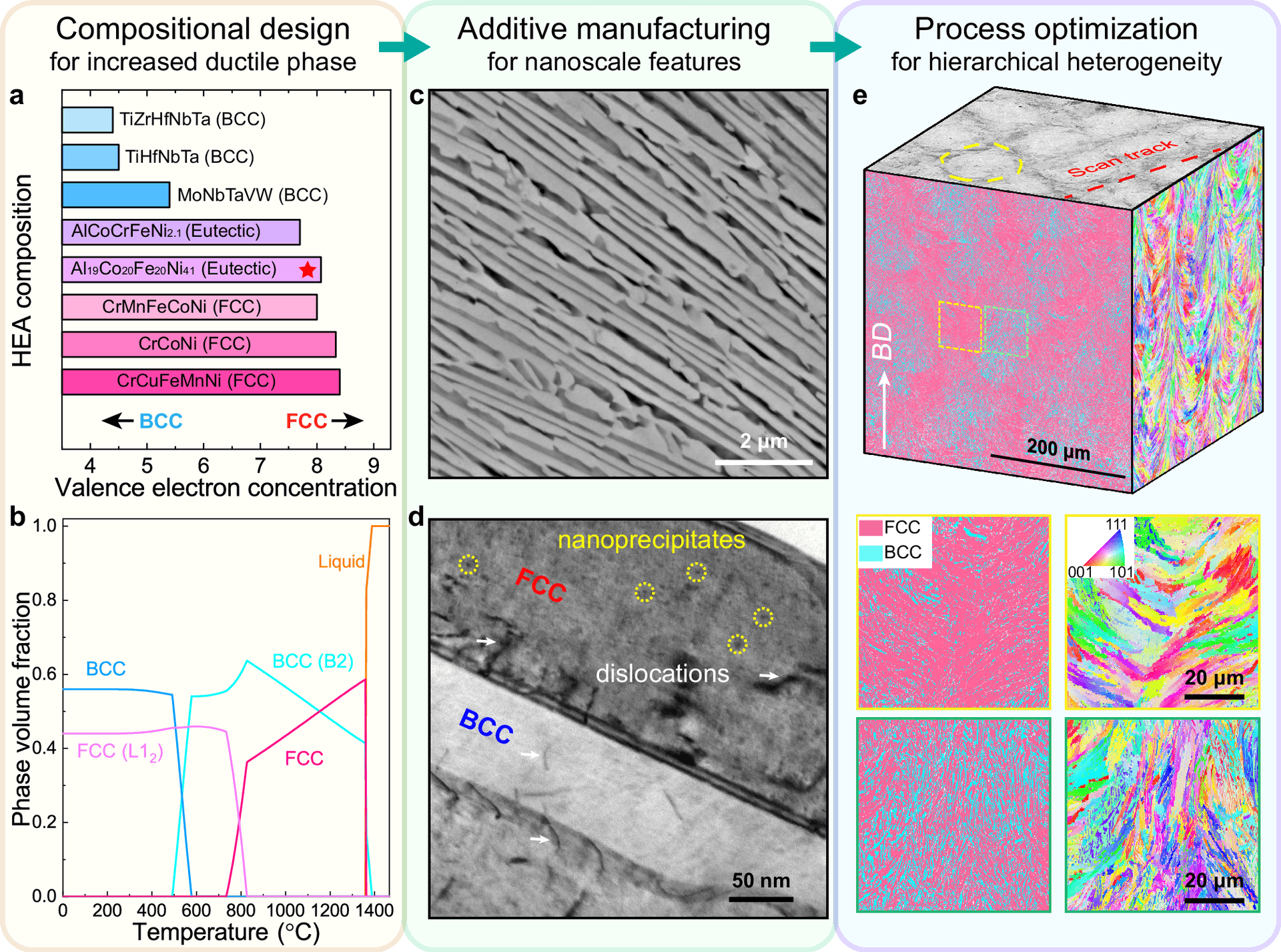
The mechanical results justify the approach. Testing showed the alloy withstood 1,713 MPa before failure and achieved 15.5% elongation at fracture. Compared to the as-printed state, that is roughly a 30% increase in strength and a doubling of ductility. Hitting both numbers simultaneously is genuinely rare. In most alloy systems, pushing tensile strength above 1,500 MPa comes at the direct cost of ductility, which is why so many high-strength printed parts are brittle in practice. The mechanism behind this one's balance is nanoscale copper precipitates that form during tempering. Those particles interrupt crack propagation and create deformation zones that absorb stress instead of transmitting it straight to fracture.
Corrosion resistance, normally a casualty of high-chromium steels because carbide formation depletes chromium from grain boundaries, works differently here. The copper precipitates expel chromium rather than consuming it, keeping it distributed evenly through the matrix. Saltwater immersion testing recorded a degradation rate of 0.105 millimeters per year, a figure that undercuts commercially available AISI 420 stainless steel.
The research was led by Yating Luo, Cunliang Pan, and Xu Ben, and it fits into a broader shift happening across metal AM: the recognition that materials originally designed for subtractive manufacturing will never perform optimally in additive processes, and that building new alloys from first principles for specific printing conditions is the path forward. Widely used alloys such as stainless steel 316L, titanium Ti-6Al-4V, and nickel-based Inconel 718 were all created decades ago for conventional manufacturing and adapted later, which can lead to issues like uneven strength, internal defects, or inconsistent results.
For the metal AM community, the more immediately interesting result might be the processing simplicity. A single six-hour furnace cycle instead of multi-day multi-step treatments represents a real reduction in post-processing overhead, which remains one of the factors keeping printed metal parts expensive relative to machined equivalents. The interpretable ML framework also means the underlying reasoning is available for further refinement, opening the door to alloys tuned for specific LDED machines, deposition rates, or operating environments rather than one optimized composition standing alone.
This article was produced by Prism’s automated news system from verified source data, official records, and press releases, then run through automated quality and moderation checks before publishing. The system is built and supervised by the people who set the standards it runs under. Read our full AI policy.
Did this article answer your question?