Manual 3D-printed book embeds its own G-code instructions
A 26-page TPU book carries part of its own G-code, turning a 3D print into both a readable object and a record of its making.
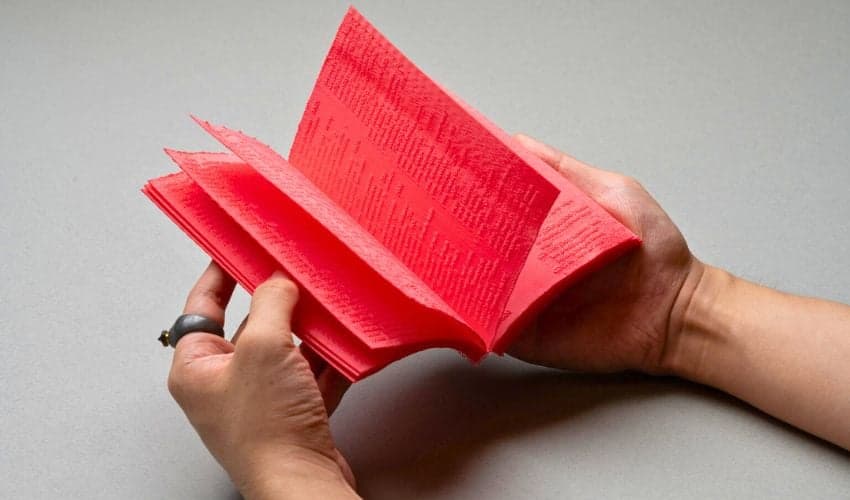
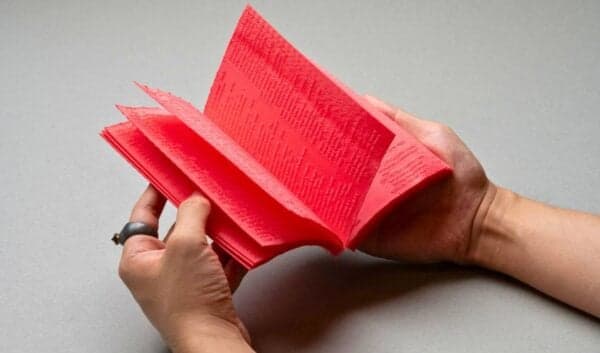
Manual turned a 26-page TPU book into its own fabrication record, with part of the G-code used to print it raised directly on the pages. Created by Darius Ou and Benson Chong through Hyperpress, the book was presented in Toronto and printed on-site from a transmitted digital file.
The build leaned on an unusual XY-for-Z approach on a Bambu Lab printer, with pages printed on edge instead of flat so the book could emerge as one continuous object rather than a stack assembled afterward. That orientation helped the team produce double-sided pages and small, legible text, while temporary deckle-edge supports kept the tall TPU pages from warping during the print. Once removed, those supports left a rough edge that echoed handmade paper.

Hyperpress frames Manual as a “Replicable Book,” or r-book, a format designed to transmit both content and physical form. That is the sharpest distinction from an e-book: the file is not just text to be read, but an instruction set that can be re-made into the object itself. Hyperpress says its broader research program began in 2021 and spans 3D printing, graphic design, and publishing, placing the project inside a larger effort to test how additive manufacturing alters the logic of print.
The limitations are part of the story. Manual is the sixth Hyperpress book, and it was the first to skip a separate printed layer for text and images. Even so, only 2.5% of its own G-code could be written onto the pages because current FFF resolution still limits how much code can stay legible at that scale. That constraint leaves the book in an interesting middle ground: it is self-referential enough to document its own making, but still bound by the nozzle, layer height, and surface detail of desktop fabrication.
Hyperpress has also said it is still working out how to distribute the print file for Manual, although it has offered an STL file for an earlier V1 book. That makes the project feel less like a closed artwork than a prototype for a new publishing model, one where files, remixability, and physical permanence collapse into the same object. The comparison to RepRap is hard to miss: the self-replication movement began in 2005, and by 2008 one machine had fabricated 48% of its own components. Manual does not fully close that loop, but it pushes the same idea into book form, where the instructions sit inside the thing they made.
This article was produced by Prism’s automated news system from verified source data, official records, and press releases, then run through automated quality and moderation checks before publishing. The system is built and supervised by the people who set the standards it runs under. Read our full AI policy.
Did this article answer your question?