Microdroplet Fission Breakthrough Could Transform Ultra-Precise 3D Printing
Tiny charged water drops can now be forced into repeatable microbursts, pointing to a future path for much finer 3D printing. It is promising lab physics, not a hobby-printer upgrade yet.
A new way to split droplets, one burst at a time
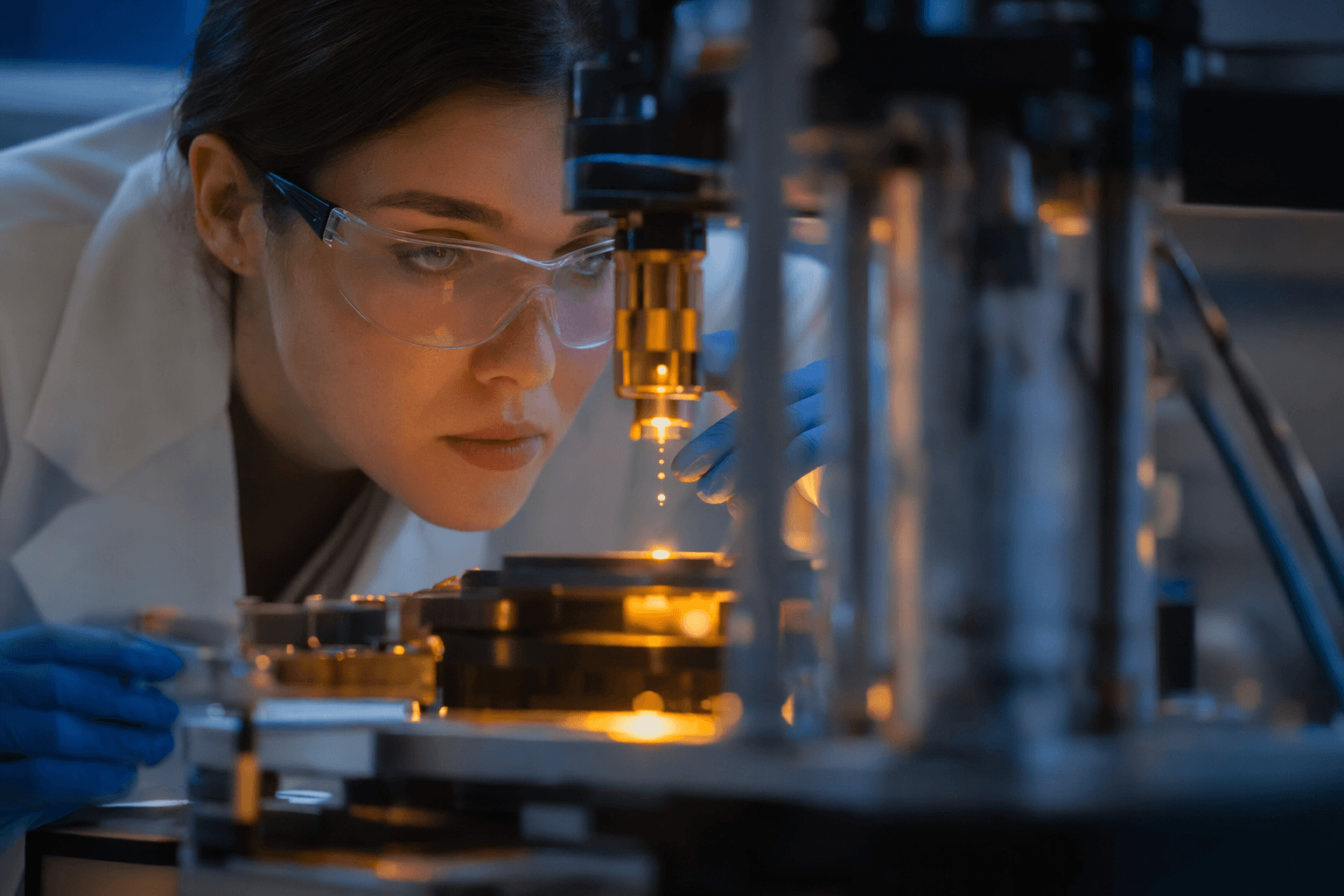
A charged water droplet that looks ordinary at millimeter scale can suddenly turn into a spray of microdroplets, again and again, if the surface physics are tuned just right. That is the striking takeaway from new work that pushes droplet breakup beyond the classic Rayleigh limit and into a regime where the fission is cyclical, controlled, and surprisingly repeatable.
For 3D printing, that matters because the smallest printable feature often comes down to how precisely a liquid can be metered, stretched, and broken apart. If you can control droplet breakup at the microdroplet level, you are talking about a path toward far finer deposition, sharper feature edges, and new printing methods that could eventually sit somewhere between inkjet precision and nanoscale fabrication.
What changed in the Rayleigh picture
Lord Rayleigh established the key stability criterion for charged droplets in 1882, showing that once charge overwhelms surface tension, a droplet should become unstable and undergo Coulomb fission. That framework has been a foundation for droplet science ever since, especially for suspended droplets. What this study adds is a different setting: droplets resting on a surface, where the behavior had not been explored nearly as thoroughly.
The researchers found that a droplet is not just quietly evaporating in place. Instead, as charge builds and the shape shifts, the drop can pass through two distinct fissility thresholds. One threshold marks the point where the droplet begins to elongate. The second triggers fission, sending off a fine liquid jet that breaks into roughly 40 to 50 microdroplets within microseconds.
That two-step behavior is the real mechanism breakthrough. The droplet does not simply pop once and disappear. It can go through more than 60 successive fission cycles over 30 minutes, which means the breakup can repeat many times before the drop is exhausted.
How the experiment made the breakup visible
The team placed tiny water droplets on a plastic surface coated in silicone oil. That lubricated layer removed friction, which let the droplet expand and retract instead of evaporating in a uniform, dull way. The result was a dramatic sequence of spontaneous microdroplet jets, emitted in bursts so fast they happened within millionths of a second.
That setup is important because it changes the boundary conditions. A droplet on a frictionless, lubricated surface can deform more freely, so the electric and capillary forces that shape it become easier to study. In practical terms, this is the kind of controlled environment that reveals whether droplet breakup can be guided rather than merely tolerated.
The scale jump is part of the appeal too. The paper says the phenomenon spans length scales from millimeters to microns and time scales from hours to microseconds. That is exactly the kind of broad physical range that makes a result feel more than academic, because it connects slow evaporation to sudden, engineered release.
Why 3D printing people should care
The long-term dream here is not a tabletop printer that suddenly outputs nanostructures. It is something more ambitious and more distant: a printing or deposition system that can convert one charged droplet into many much smaller, highly controlled daughter droplets on demand.
- finer voxel control in direct-write systems
- smaller and more uniform material deposits
- better handling of delicate inks and functional fluids
- new routes to multi-scale patterning, from microns down toward nanoscale features
For ultra-precise 3D printing, that could eventually mean:
The best way to read this result is as a mechanism platform. If a print head, spray nozzle, or microfluidic emitter could trigger the same kind of threshold-based breakup predictably, it might open a path to much higher resolution without relying on brute-force pressure or extreme electrical conditions. That is especially interesting because the broader context points toward greener, lower-energy processing that does not lean on high voltage.
Why the charge numbers matter
The paper also grounds the phenomenon in everyday and industrial reality. Raindrops typically carry about 1 pC of charge, while routine laboratory pipetting can produce droplets with around 50 pC. Those are not exotic numbers, and that is exactly the point. Charged droplets are everywhere: in thunderstorms, inkjet printing, electrosprays, microfluidics, and even spacecraft plumes.
That makes the new behavior feel less like a laboratory curiosity and more like a missing chapter in droplet physics. If charged droplets are already central to so many workflows, then understanding how they fission on surfaces could feed directly into better spray control, better droplet transport, and eventually better precision manufacturing. In electrospray ionization and nanoscale fabrication especially, controlled breakup is not a side issue. It is the main event.
Who did the work and what it means next
The research team at the Okinawa Institute of Science and Technology, including Dan Daniel from the Droplet and Soft Matter Unit, says the observations open new physical understanding of evaporating charged droplets and may lead to industrial applications. OIST says the findings appeared in Proceedings of the National Academy of Sciences.
That combination of basic physics and application pressure is what makes the result stand out. The study does not claim that ultra-precise 3D printing is ready to run on a hobby machine next month. It does show a plausible route toward controlling droplet breakup with far more finesse than the old Rayleigh picture suggested. For a field that keeps chasing smaller features, tighter tolerances, and cleaner deposition, that is the kind of breakthrough that can sit quietly in the lab for a while and then reshape what becomes possible later.
This article was produced by Prism’s automated news system from verified source data, official records, and press releases, then run through automated quality and moderation checks before publishing. The system is built and supervised by the people who set the standards it runs under. Read our full AI policy.
Did this article answer your question?