MIT 3D-prints cleanroom-free nozzles for drug delivery materials
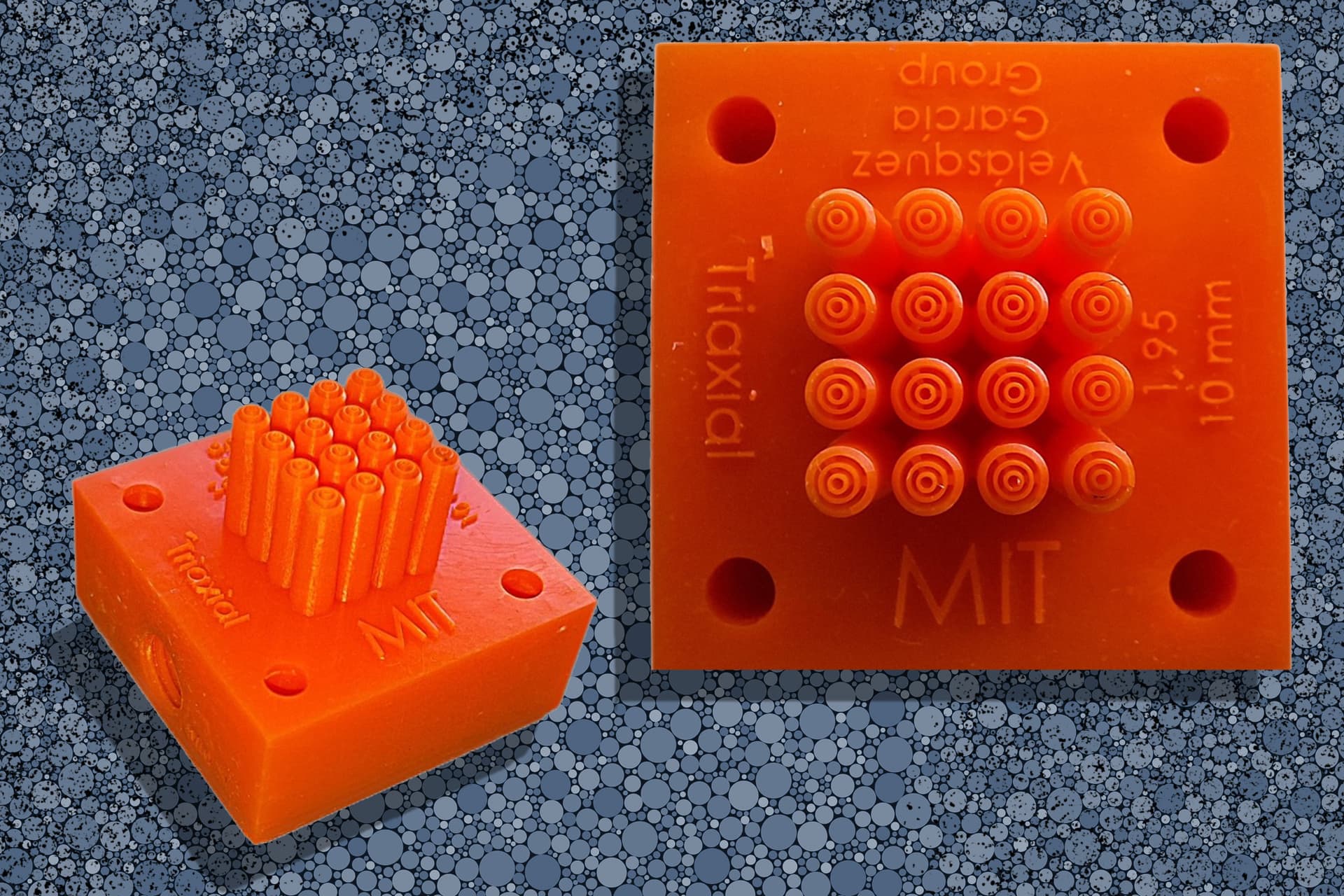
MIT’s 3D-printed triaxial nozzles sprayed three liquids at once, using 16 emitters in 1 cm2 to point toward cleaner multi-material deposition.

MIT researchers have 3D-printed a nozzle array that can push three liquids through microscopic channels at once, a step toward making layered drug particles without a semiconductor cleanroom. The triaxial electrospray emitters pack up to 16 nozzles into about one square centimeter and can be fabricated in only a few hours, turning a process that once depended on expensive microfabrication into something far faster and simpler.
In plain English, the device works like a tiny three-lane spray head. Electricity pulls three fluids into a steady stream with distinct layers, then breaks that stream into multilayered droplets that can solidify into core-shell-shell particles. In the paper, “Additively manufactured arrays of triaxial electrospray emitters for scalable generation of core-shell-shell microdroplets,” the team reported stable cone-jet operation across arrays of different sizes and said layer thicknesses could be tuned by adjusting flow rate and voltage.
That control matters because the obvious first use is not a novelty print, but a functional material. MIT pointed to time-release drug delivery, where an outer layer could erode in the stomach, exposing another layer that controls release deeper in the digestive tract. The same architecture could also support self-healing materials, biosensors that detect chemical substances and artificial cells for tissue regeneration. The paper also frames electrospray as useful for microencapsulation, mass spectrometry and space propulsion, and notes that the method is well suited to temperature-sensitive materials such as proteins and other biomolecules because it does not require extreme temperatures.
For makers, the headline is not that a desktop printer can do this today. The gap is still wide: the MIT devices were made with vat photopolymerization in a lab setting, and the hard part is not just printing the plastic structure, but reproducing the microscopic channels, keeping every nozzle evenly fed and maintaining stable electrical spraying across an array. Any hobby-ready version would need reliable flow control, safe high-voltage handling, clog resistance and repeatable calibration before it could become more than a research demo.
Luis Fernando Velásquez-García, the senior author, said the devices could not be made in a semiconductor cleanroom and that the goal is to democratize the technology so the benefits can reach more people. That is the real promise for the 3D printing world: if the engineering hurdles fall, triaxial electrospray could move from a lab proof of concept to a future class of desktop tools for true multi-fluid deposition, functional coatings and more advanced multi-material parts.
This article was produced by Prism’s automated news system from verified source data, official records, and press releases, then run through automated quality and moderation checks before publishing. The system is built and supervised by the people who set the standards it runs under. Read our full AI policy.
Know something we missed? Have a correction or additional information?
Submit a Tip