New gel-based 3D printing technique enables complex support-free shapes
A gel bath can hold liquid prints in midair, letting complex overhangs cure without supports. That shift matters most for medical implants, microstructures, and faster post-processing.
Why gel changes the geometry game
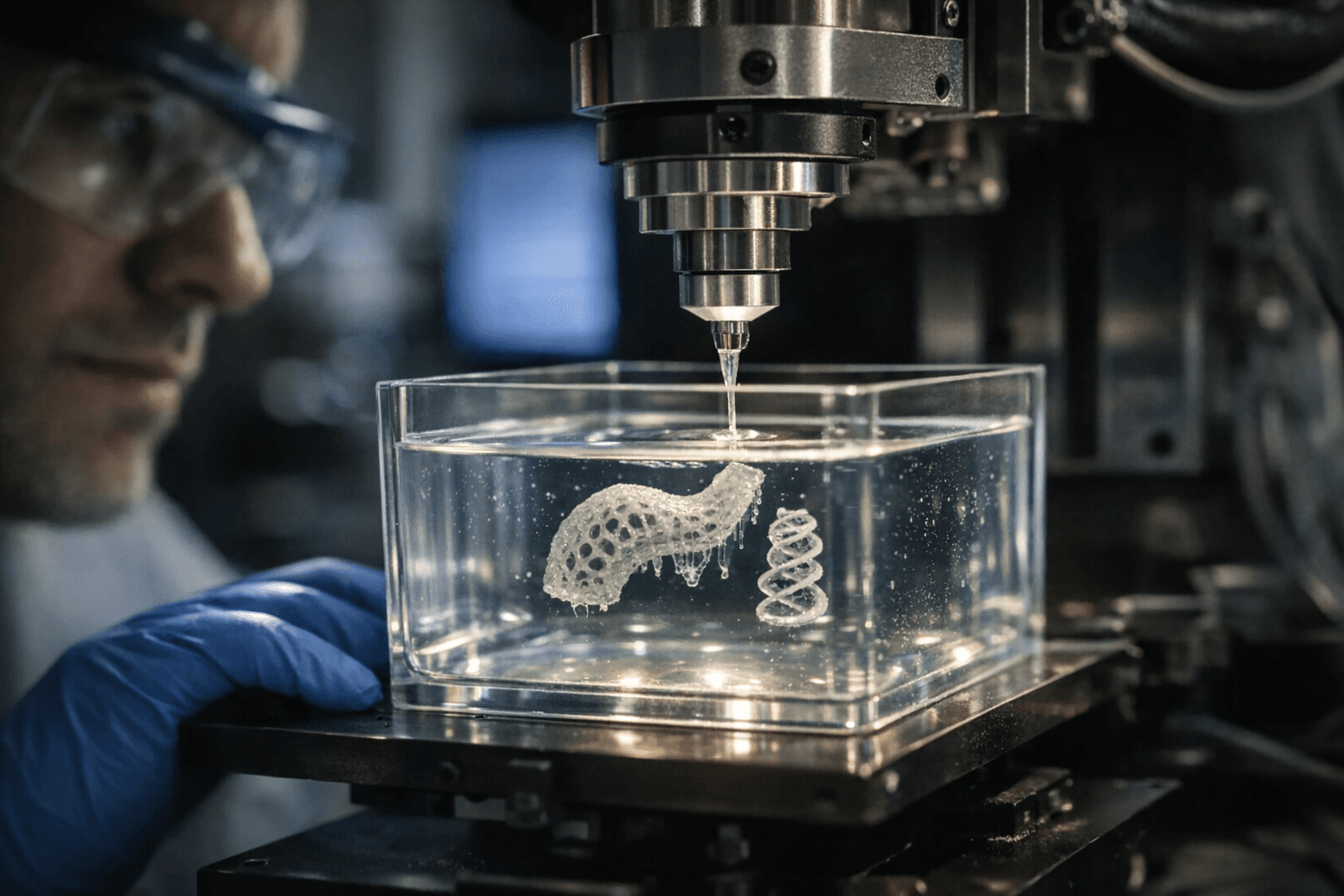
A part that would normally sag, snap, or demand a forest of supports can be drawn directly inside gel and left to set in place. That is the promise of support-bath printing: instead of building from the build plate upward and hoping each overhang survives, you print into a viscoelastic medium that holds the toolpath where it belongs.
For 3D printing people, the important shift is not just convenience. It is geometry. The bath acts like a temporary mold that lets the nozzle trace freeform paths, internal channels, and delicate spans that would be awkward or impossible in conventional layer-by-layer printing.
The technique did not appear out of nowhere
This family of methods has been building for years in bioprinting and additive manufacturing. One of the clearest milestones was FRESH, short for Freeform Reversible Embedding of Suspended Hydrogels, which appeared in Science Advances in 2015. That paper showed soft hydrogels such as alginate, collagen, and fibrin being printed inside a temporary, thermoreversible, biocompatible support bath.
FRESH mattered because it proved you could print hydrated, fragile materials from medical imaging data at about 200 µm resolution without the shape collapsing under its own weight. In other words, the support bath was not just a workaround, it became part of the manufacturing process itself. That is why any new gel-based variant should be read as an advance within an already established playbook, not a one-off trick.
What the bath is actually doing
The core idea is simple, but the materials science underneath is not. A good support bath needs to behave like a solid when the nozzle passes through it, then relax enough to let the printed material settle and cure without distortion. That balance is what keeps overhangs, voids, and branching microstructures from turning into a puddle.
A 2023 optimization paper on FRESH makes the tuning problem very clear. Smaller and more uniform microspheres in the bath improved resolution and geometric accuracy, and one reported way to get there was stirring at 600 rpm for 20 hours. That detail matters because it shows the bath is not a passive jelly, it is a finely tuned microenvironment that can make or break print fidelity.
Why medical implants and microstructures are the big prize
The strongest use case is where shape complexity and material fragility collide. Patient-specific implants, soft tissue scaffolds, and tiny internal channels all benefit when the printer can move freely in three dimensions without obeying the gravity-limited logic of stacked layers. The support bath makes it possible to preserve fine features that would be difficult to print cleanly on a standard FDM machine.
That is also why the technology resonates beyond the biomedical lab. Microstructures need precision, and precision dies quickly when supports are hard to remove or when post-processing damages the part. A support bath can reduce that cleanup burden while keeping the geometry intact, which is exactly the kind of workflow upgrade that catches the attention of people printing functional parts, not just showpieces.
Commercial momentum is already visible
The lab story is now being mirrored by commercial development. Rapid Liquid Print, the MIT spin-off based in Boston, raised $7 million in Series A funding, according to a May 16, 2024 report from 3D Printing Industry. Its process injects a liquid material mixture into gel, where it is held while it cures, eliminating support structures and finishing parts in minutes with minimal post-processing.
That matters because it shows the concept has crossed the line from elegant academic proof to something investors believe can scale. For the broader 3D printing community, the signal is straightforward: gel-suspension printing is no longer just a bioprinting curiosity, it is becoming a manufacturing workflow with speed, cleanup, and throughput advantages that are easy to understand.
Japan’s parallel push against supports and waste
There is also a useful Japanese comparison point, even though it comes from a different route. In July 2023, the University of Tokyo described a method that combines 2D printing, origami, and chemistry to fabricate 3D shapes without waste material, with printed sheets self-folding in hot water in seconds. It is not the same as printing in gel, but it aims at the same pain points: support waste, time loss, and unnecessary material use.
Seen together, these efforts suggest a broader shift in 3D fabrication. Whether the trick is a support bath, a gel suspension, or a self-folding printed sheet, the goal is to stop forcing every shape through the same rigid layer-stack model. The future that is taking shape is one where geometry comes first, and the process bends around it.
What to watch when a gel-printing workflow lands on your bench
If you are evaluating this kind of system, the practical questions are the ones that decide whether a print succeeds or fails:
- How stable is the bath during long toolpaths and fine details
- How uniform are the support microspheres or bath particles
- How easily does the bath release the finished part
- How much post-processing disappears when supports are no longer needed
- Whether the process can handle hydrated, fragile, or highly branched structures without collapse
That is the real story behind the new gel-based technique. It is not simply printing in a different liquid. It is a way of rewriting what a printable shape can be, and it is doing it by turning the support material into the stage where the part is actually born.
This article was produced by Prism’s automated news system from verified source data, official records, and press releases, then run through automated quality and moderation checks before publishing. The system is built and supervised by the people who set the standards it runs under. Read our full AI policy.
Did this article answer your question?