NTU Researchers Develop Glucose-Responsive Hydrogel for Stable, High-Resolution 3D Bioprinting
NTU's CGB hydrogel stacks 60 layers through a 160 μm nozzle at just 2% solid content, then dissolves on cue with glucose to leave hollow microchannels.
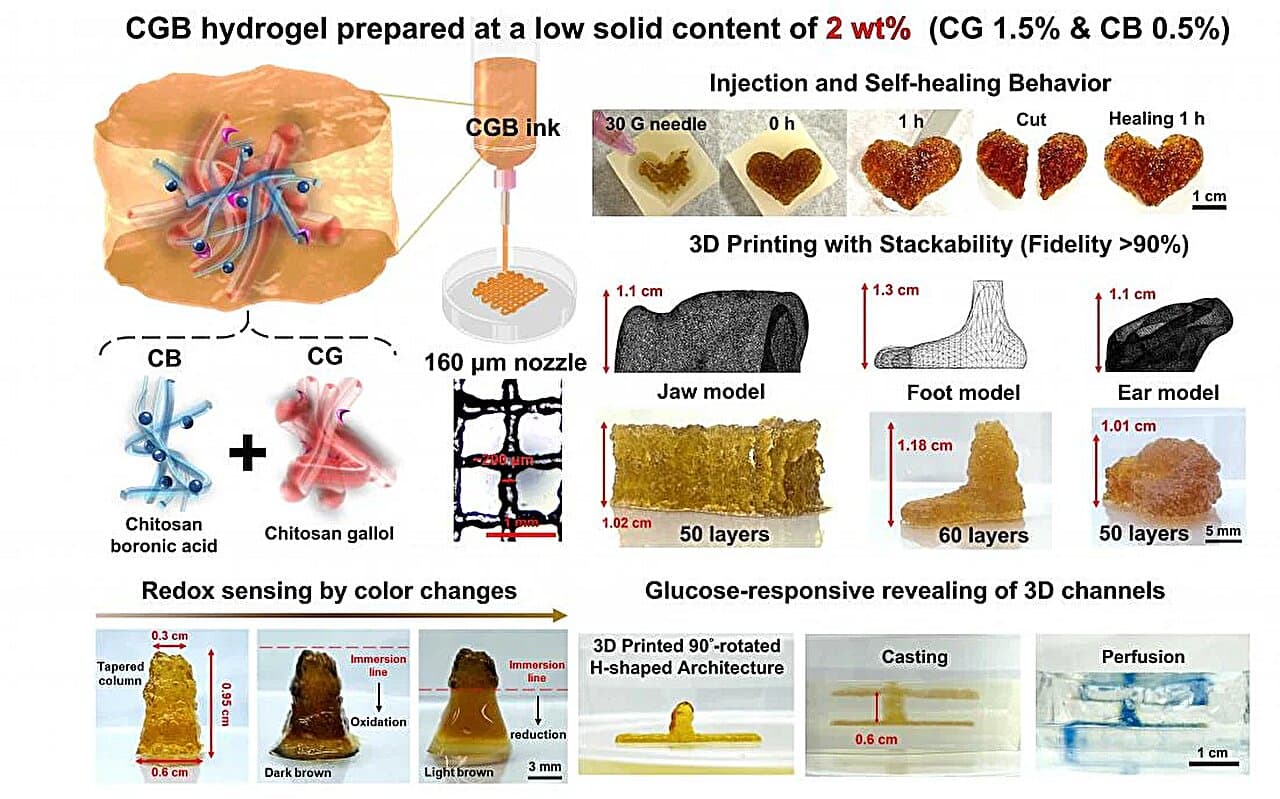
At just 2 percent solid content, most hydrogel inks lose structural integrity before a print job reaches layer 60. A team at National Taiwan University solved that by building a material that holds its shape through chemistry rather than concentration.
The result is CGB hydrogel, a dual self-assembly network formed from two chitosan derivatives: one functionalized with gallol groups, the other with boronic acid. That pairing produces a material mechanically stable enough to extrude through a 160 μm nozzle and stack 60 layers without collapse, while remaining responsive to glucose and redox changes in its environment. The research was published in the journal Carbohydrate Polymers.
For bioprinting, that low solid fraction is the point. Cells embedded in dense polymer matrices struggle with nutrient diffusion and can suffer viability losses before a construct is even finished printing. CGB sidesteps this by achieving structural stability at concentrations favorable to cell health. The NTU team reported over 90 percent cell viability in testing, alongside antimicrobial activity in the printed material.
The glucose-responsiveness is where the work gets particularly interesting from a fabrication standpoint. After printing, the CGB gel can be selectively dissolved by exposing it to glucose, leaving behind hollow channels. The team demonstrated this by fabricating hierarchical microfluidic architectures, including complex rotated H-shaped channel structures. That workflow, printing a sacrificial material that dissolves on cue without disturbing surrounding structures, is precisely the kind of precision control that vascularized tissue models require.
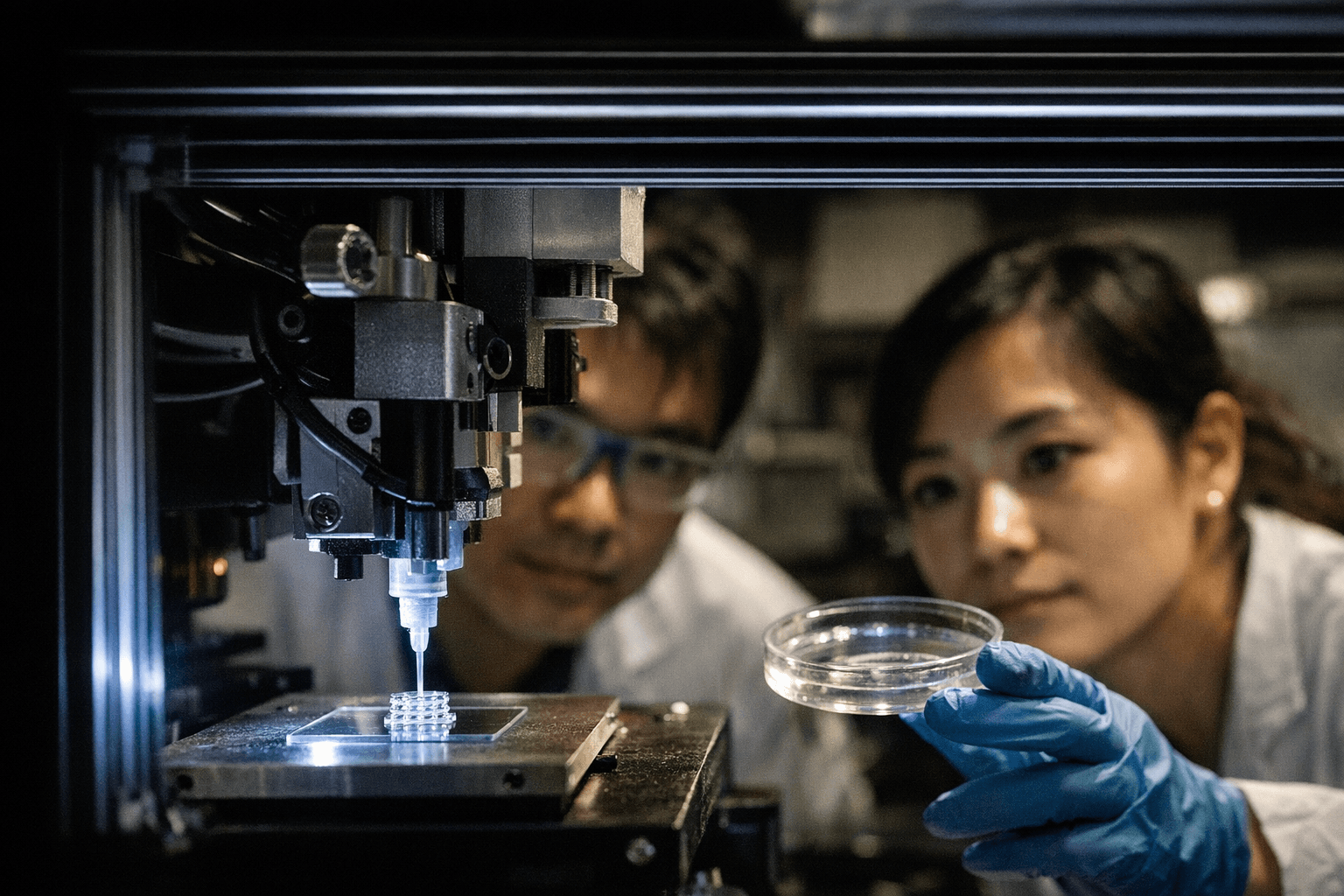
Corresponding author Prof. Shan-hui Hsu led the work, which sits at the intersection of structural printing performance and bioactivity. The ability to form microchannels at 160 μm resolution using a biocompatible, low-concentration ink opens practical pathways for labs building organ-on-chip devices, cell-laden scaffolds, and soft robotics components, without the viability trade-offs that come with high-concentration polymer systems.
Longer-term questions around scale-up, integration with diverse cell types, and extended biocompatibility testing will likely define where the CGB system goes from here, but the foundational numbers are difficult to argue with.
This article was produced by Prism’s automated news system from verified source data, official records, and press releases, then run through automated quality and moderation checks before publishing. The system is built and supervised by the people who set the standards it runs under. Read our full AI policy.
Did this article answer your question?