Old desktop 3D printing habits disappear as printers automate setup
The old desktop 3D printing ritual of clips, shims, and first-layer babysitting is fading fast. Today’s best machines win by removing chores, not adding them.
The habits that are going stale
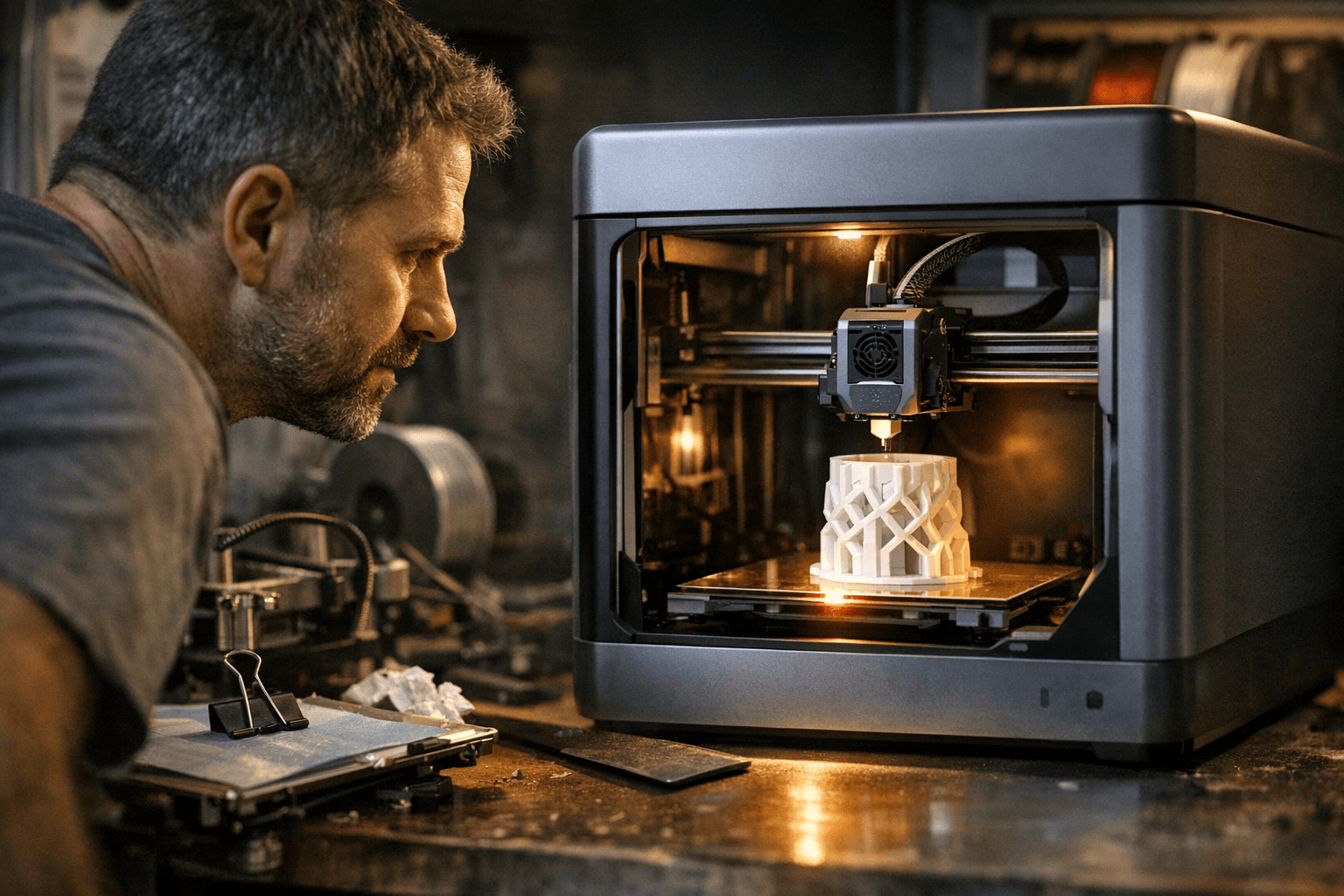
Desktop 3D printing used to reward patience more than productivity. Glass build plates, binder clips, manual bed leveling, endless first-layer tweaking, external control boxes, slow motion systems, and fussy nozzle swaps were all part of the bargain. That bargain is breaking. Newer printers from Bambu Lab, Creality, ELEGOO, and Prusa now ship with auto-leveling, automatic calibration, magnetic flexible plates, WiFi-connected workflows, vibration compensation, and faster tool or nozzle change systems that make old workarounds feel less like craftsmanship and more like baggage.
That is the key shift buyers need to notice: some features that once looked “serious” now signal that a printer is behind the curve. If a machine still depends on repeated bed fiddling or a pile of add-ons just to reach normal reliability, it may still print, but it is no longer where the category is headed.
What used to matter, and what replaces it
The best way to think about the new desktop class is simple: a lot of the old survival skills have been automated away. Glass plates mattered when people needed flatness, and binder clips mattered when beds were inconsistent. Today, magnetic flexible plates, automatic mesh leveling, and load-cell-based first-layer calibration replace that entire routine with a faster start and fewer variables.
Manual first-layer tuning used to be a badge of honor. Now it is mostly a sign that the printer is asking you to do work the machine should already be doing. Prusa’s current MK4, MK4S, MK3.9/S, XL, and CORE One lines use automatic first-layer calibration through load cell sensing and mesh bed leveling. Bambu Lab’s X1 series pairs dual automated bed leveling with LiDAR-assisted calibration, while its calibration guide says LiDAR can scan printed lines for automatic dynamic flow calibration. ELEGOO’s Centauri Carbon leans on 121-point precision auto-leveling and automatic handling of bed-leveling and Z-offset. Even Creality’s Ender-3 V3 KE now pushes Klipper-based smart control, high-speed printing, and auto calibration as standard value.
The message is clear: setup friction is no longer the feature. It is the thing being eliminated.
The appliance phase has arrived
This hobby has crossed into a quieter but more important stage. Early adopters tolerated calibration rituals because the machines were immature. That made sense when every print began with a gamble. Now buyers increasingly expect a printer to boot, level itself, connect to the network, and start producing without a round of mechanical housekeeping.
Prusa’s own history shows how fast the baseline changed. The company said the MK3 line sold more than 350,000 units worldwide and won four consecutive 3D Printing Industry Awards from 2019 to 2022, which tells you how long the manual-calibration era held the center of the market. Then, on March 29, 2023, Prusa introduced the Original Prusa MK4 and said its load-cell sensor could produce a perfect first layer automatically with no user interaction. Prusa also said the MK4 firmware brought Input Shaper and Pressure Advance support, alongside a demonstration print that fell from 80 minutes on the MK3 to under 20 minutes on the MK4.
That same trajectory continued with the MK4S in 2024, which emphasized higher speed, better print quality, and a new Prusa app for remote print management. The hobby is not just getting faster. It is getting more self-sufficient.
What to stop optimizing for right now
If you are choosing or upgrading a printer today, stop paying extra attention to the features that automation has already absorbed. These are the habits that are becoming obsolete as buying criteria:
- obsessing over glass beds when magnetic flexible plates are easier to live with
- treating manual leveling as a sign of precision rather than a maintenance tax
- buying printers that need repeated first-layer babysitting
- valuing external set-top boxes and clunky accessory chains when integrated WiFi and app control do the job better
- tolerating slow motion systems when input shaping and pressure advance are now common baseline upgrades
- accepting fiddly nozzle or hotend swaps as normal in a machine that claims to be modern
The practical question is no longer, “How much tinkering does this printer invite?” It is, “How many chores has this printer already removed?”
Where the new value lives
The fun has not disappeared. It has moved. Once a printer can level itself, compensate for vibration, and manage flow more intelligently, the owner’s attention shifts toward the parts of the hobby that actually expand what you can make.
That means more focus on model design, material selection, multi-material setups, print farm workflows, and dialing in the final quality of the object rather than fighting the machine before every print. Bambu Lab’s P1 series emphasizes vibration compensation and pressure advance, which is exactly the kind of engineering that frees you from babysitting motion artifacts. Prusa’s Input Shaper is framed the same way in its documentation, reducing ghosting while enabling faster printing. Even ELEGOO’s Centauri Carbon 2 Combo now says partial leveling can cut leveling time by up to 75 percent, which is a direct reminder that the value is shifting from setup labor to throughput.
This is why the current market feels like a reset. The best printers are not only chasing speed. They are trying to remove drag from the whole workflow.
Who still needs the old stuff
There are still edge cases where the old habits matter. If you are repairing a legacy printer, keeping an older machine alive, or squeezing the last value out of a budget setup, manual tuning still has a place. Glass beds, manual leveling, and standalone control hardware can still be practical when the goal is low upfront cost, maximum hackability, or support for an older machine that has not been modernized.
That said, these are now niche reasons, not default ones. They make sense for tinkerers who enjoy maintenance as part of the hobby, or for owners who already have an established workflow built around older gear. They do not make much sense as the reason to buy a new desktop machine in 2026.
The buying rule that matters now
A printer’s real spec sheet is no longer just build volume and top speed. It is how many of the old chores are already gone when you open the box. Bambu Lab’s X1 and H2D, Prusa’s MK4 and MK4S family, Creality’s Ender-3 V3 KE, and ELEGOO’s Centauri line all point in the same direction: the next generation of value is convenience, consistency, and connected automation.
That is the survival guide. Stop paying extra for friction. Buy for the setup tasks you will not have to repeat, because the machines worth owning are increasingly the ones that make the old rituals unnecessary.
This article was produced by Prism’s automated news system from verified source data, official records, and press releases, then run through automated quality and moderation checks before publishing. The system is built and supervised by the people who set the standards it runs under. Read our full AI policy.
Did this article answer your question?