Photocentric spins out CosmicMaker after zero-g 3D printing tests
Three CosmicMaker printers ran through 2g-to-0g swings aboard an Airbus A310, showing Photocentric’s spinout could reshape how printers handle materials.

Zero gravity stripped away one of 3D printing’s biggest assumptions: that gravity will help settle material, keep layers honest and punish the feed path when things go wrong. Photocentric’s CosmicMaker tests suggested the opposite is now a design target, not a limitation, as the company turned its parabolic-flight program into a standalone venture after proving the system could keep printing through repeated swings from 2g to microgravity.
Three identical CosmicMaker printers flew aboard Novespace’s Airbus A310 Zero G over three flight days from April 22 to April 24 in Bordeaux, France. Each parabola delivered about 22 seconds of microgravity, and the enclosed machines kept running across the full 2g-to-0g range while printing parts from silicon carbide, alumina and two thermoset polymers. Public reporting says the parts came out dimensionally accurate, a meaningful result for a platform that has to manage material flow without the gravitational cues desktop machines quietly rely on.
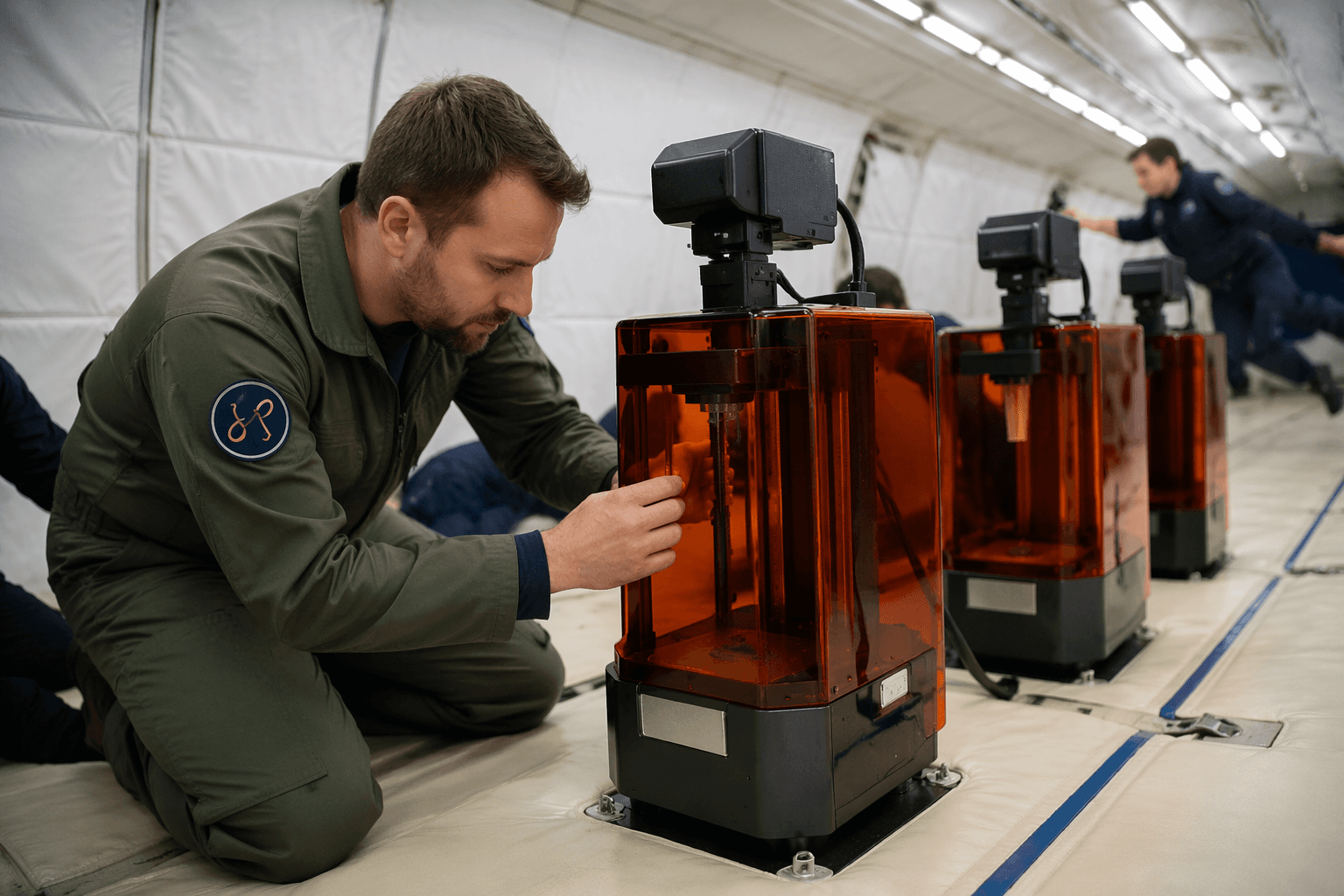
That is where CosmicMaker gets interesting for the wider industry. Photocentric said the project has been under development since 2023 with support from the European Space Agency, work with Catapult Satellite Applications and the Business in Space Growth Network, plus three UK Space Agency grants tied to ESA’s BSGN program. ESA Technology Broker described it in December 2025 as an autonomous, multi-material system for in-orbit manufacturing of polymers, ceramics and potentially metals, which puts it closer to orbital infrastructure than a one-off science payload.
The technical lesson is not just that parts can be printed in space. It is that an enclosed printer can be designed to tolerate positive and negative g-forces, vacuum conditions and unusual orientation while still handling a broad material set. If that architecture scales, the impact could travel back to Earth: better material handling, fewer support-dependent builds and a more aggressive approach to printing in constrained environments where gravity cannot be counted on to clean up the process. Photocentric has said the next step is proving the machine in space itself, and that is the point where CosmicMaker will stop being a clever parabolic-flight success and start showing whether it can define a real category.
This article was produced by Prism’s automated news system from verified source data, official records, and press releases, then run through automated quality and moderation checks before publishing. The system is built and supervised by the people who set the standards it runs under. Read our full AI policy.
Did this article answer your question?