Raise3D B520 targets SLS finishing, automating powder cleanup for users
Raise3D’s $10,000 B520 put SLS cleanup in the spotlight, taking aim at the messy finishing step that often slows nylon parts far more than printing itself.
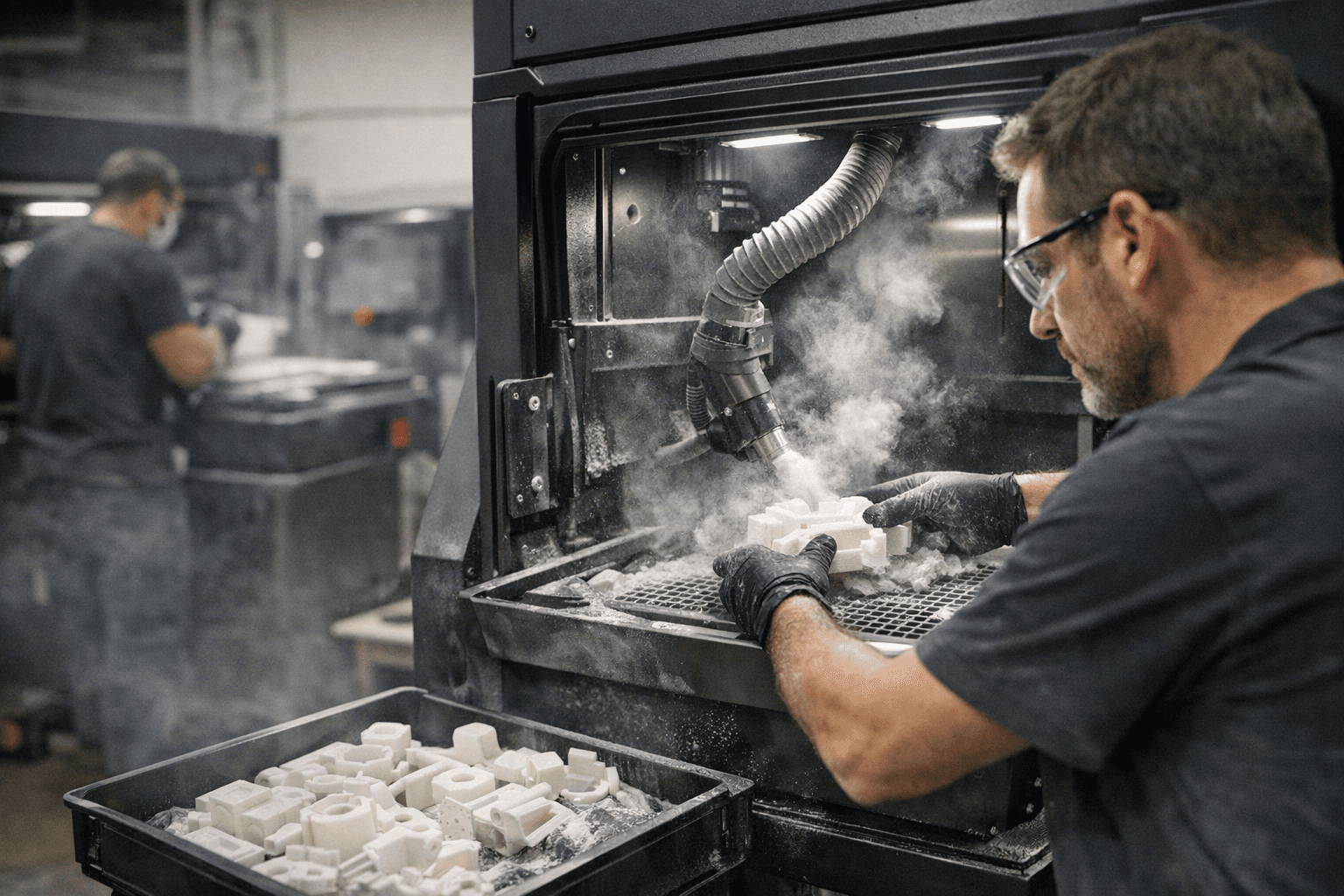
Raise3D did not use Rapid + TCT 2026 to brag about a bigger build volume or a faster laser. It used the Boston stage to go after the part of SLS most users hate most: powder cleanup. The new B520 SLS sandblaster, unveiled on April 14, 2026, was pitched as an automated finishing tool for the last mile between a printed part and something ready to use, and that is why it matters.
All3DP pegged the B520 at $10,000 and framed it as a challenger to Formlabs’ Fuse Blast. That comparison goes straight to the bottleneck that often makes SLS feel slower and messier than the printer specs suggest. Formlabs says Fuse Blast can clean a whole build chamber in as little as 15 minutes, and that its Fuse Sift plus Fuse Blast workflow can take a part from printed to polished in 60 minutes. Raise3D’s answer was not another printer, but a machine aimed at automating the powder removal and cleanup step that follows it.
That positioning has real consequences for small shops and side businesses. If the cleaning stage becomes more repeatable and less hands-on, in-house nylon production stops looking like a special occasion and starts looking like a workflow. For teams that currently outsource SLS parts or run only occasional builds on a benchtop system, a dedicated finishing machine could make prototype runs more realistic, especially when consistency matters more than novelty. The appeal is not just speed. It is whether a part can move from printer to usable object without eating up hours of manual labor.
The B520 also fits into a larger Raise3D push. The company launched its first SLS system, the RMS220, at Rapid + TCT 2025 in Detroit on April 8, 2025, after entering the resin market in 2023. Raise3D said the B520 was part of an integrated SLS workflow built for continuous, high-throughput manufacturing and post-processing, which signals that the company now wants to sell more than hardware. It wants to sell the whole chain.
That strategy showed up again in Raise3D’s partnership with Additive Manufacturing Technologies. AMT said the deal would bring advanced post-processing to the RMS220, with SF2X vapor smoothing scheduled to ship in June 2026. AMT also said it has more than 900 installed systems in 40 countries, a reminder that the finishing market is already established. Raise3D’s RMS220 page points to end-use applications such as helmet linings, custom insoles, custom shoes, and shunt intake manifolds, which makes the focus on post-processing even clearer: the parts are meant to leave the printer as products, not powdery proof of concept.
This article was produced by Prism’s automated news system from verified source data, official records, and press releases, then run through automated quality and moderation checks before publishing. The system is built and supervised by the people who set the standards it runs under. Read our full AI policy.
Did this article answer your question?