Researchers turn mosquito proboscis into ultra-fine 3D printing nozzle
A dead mosquito’s proboscis became a 20-micrometer 3D-printing nozzle, pointing to cheaper routes for microfluidics, bioscaffolds and other tiny builds.
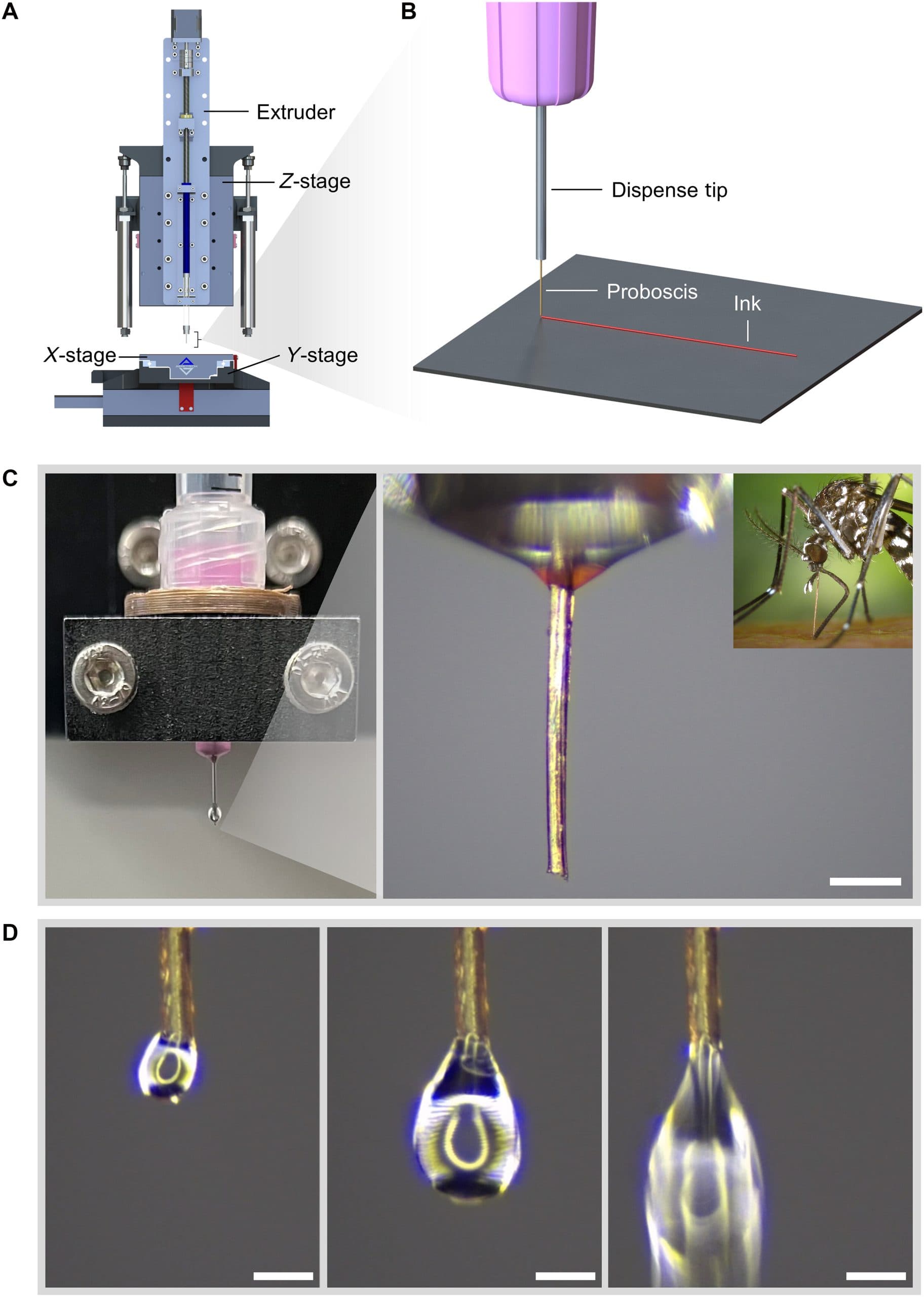
A mosquito’s feeding tube just became one of the smallest nozzles ever used in a 3D printer. In a McGill University and Drexel University collaboration, researchers repurposed the proboscis of a deceased female mosquito to lay down lines as thin as 20 micrometers, a level of resolution that could matter for microfluidics, bioscaffolds and other ultra-fine builds that push conventional nozzle design to its limits.
The study, published in Science Advances on Nov. 19, 2025, was led by McGill graduate student Justin Puma and included McGill assistant professor Changhong Cao plus Drexel assistant professor Megan Creighton. The team called the method 3D necroprinting, a nod to the broader necrobotics field that has already reused biological parts such as dead spider legs in mechanical devices. Here, the mosquito’s proboscis did the work of a high-resolution dispense tip without the cost and fragility of the metal or glass micro-nozzles that often define this part of the print stack.

What made the mosquito part attractive was not just its size. The proboscis is naturally straight and narrow, with an inner diameter of about 10 to 20 micrometers, and it can withstand about 60 kPa of internal pressure while ink is being pushed through it. That combination let the researchers test it as a printable nozzle rather than a novelty sample, although they still had to use a custom printer because the pressure demands of a standard off-the-shelf machine were too high.
Using commercial bioink, the team printed a honeycomb structure, a maple leaf outline and a scaffold for cell samples. Those demonstrations point to the kinds of applications that could make the biggest difference for ambitious makers and biofabrication labs: controlled micro-scale patterning, small conductive traces, and delicate structures that need a nozzle far finer than what most desktop systems can handle.
Cao said the approach could lower costs, while the researchers framed biodegradable biological nozzles as a way to “democratize” precision 3D printing by reducing barriers to entry. Creighton said the development could advance bioprinting research, especially in areas tied to regenerative medicine, drug screening and cancer treatment. For now, the mosquito’s old role has been inverted completely: the same mouthpart built to feed now points toward a future where ultra-fine extrusion is less about exotic hardware and more about rethinking where the nozzle comes from.
This article was produced by Prism’s automated news system from verified source data, official records, and press releases, then run through automated quality and moderation checks before publishing. The system is built and supervised by the people who set the standards it runs under. Read our full AI policy.
Did this article answer your question?