RIC Robotics pushes autonomous concrete printing for scalable construction
RIC Robotics is trying to turn concrete 3D printing into a repeatable jobsite workflow, not a demo. The real shift is autonomy plus deployment support.
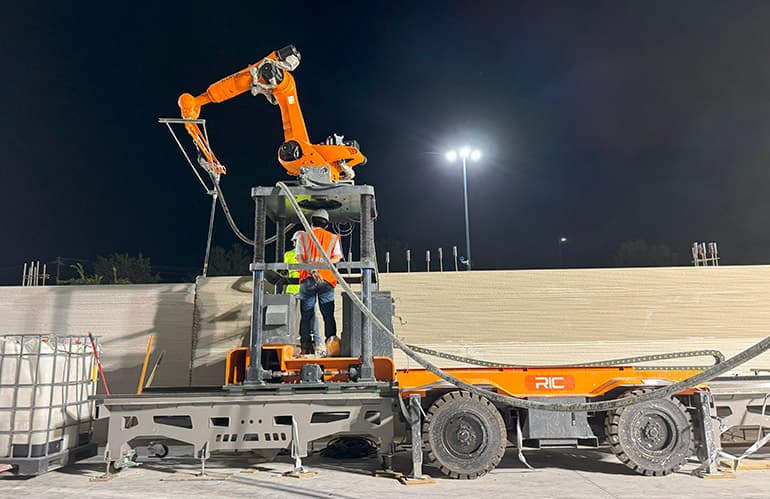
RIC Robotics is pushing construction 3D printing toward something the industry has chased for years: a robot that shows up, gets to work fast, and fits into an actual build schedule. The company is not just selling a machine, it is packaging large-scale concrete printing as a service or deployable equipment, which is a much more practical bet than spectacle-driven one-off demonstrations. That matters because the hard part in construction automation is rarely the print path itself. It is everything around it, from logistics and setup to keeping the system productive on a real jobsite.
From prototype energy to jobsite workflow
RIC Robotics says it is headquartered in Denver, Colorado, and its pitch is blunt: make construction faster, safer and scalable because the world needs more buildings than the existing workforce can deliver. That framing puts the company squarely in the camp of builders trying to solve labor and throughput problems with robotics, not just show off a larger print envelope.
The company says it builds large-scale 3D-printing concrete construction robots and offers them either as a service or as equipment customers can deploy themselves. That distinction is important. In construction, buying hardware is only part of the equation. Contractors also need process knowledge, material supply, field support and a way to avoid turning a capital purchase into a maintenance burden.
RIC’s robotics-as-a-service model is designed around that reality. According to the company, the package removes capital risk and brings hardware, expertise, the material supply chain and support together. In other words, RIC is not just selling a printer, it is trying to sell the result: a repeatable wall-building workflow that can slot into commercial construction without demanding a robotics team in-house.
What automation is actually doing
The most interesting part of RIC’s story is not whether a robot can extrude concrete. It is which parts of the build process are becoming autonomous and which still need people. The company says its systems have already operated on Walmart expansions, 100-house residential developments, single-family residences, ADUs and landscape projects, and that a typical setup can take hours from arrival on site.
That points to a workflow where autonomy is concentrated in the high-volume placement of material and the repetitive geometry that makes concrete printing attractive in the first place. The robot can handle the long, steady, structured part of the job, which is exactly where construction labor gets expensive and hard to scale.
Human labor is still very much in the picture. Site preparation, material logistics, planning, supervision and finish work do not disappear just because the walls are printed by a robot. The real shift is that the robot takes over a chunk of the build that would otherwise demand a crew doing repetitive physical work. That is how autonomous construction starts to feel less like a novelty and more like a field tool.
Why the service model matters more than the machine
Large-format concrete printing has always promised faster builds, lower labor intensity and more design freedom. The obstacle has been field reality. Sites are messy, conditions change, and a system that works beautifully in a controlled demo can stall the moment it has to move, align and keep output consistent outside a lab.
RIC’s answer is to make the technology feel operational instead of experimental. That mirrors what has worked in other corners of 3D printing: users adopt systems more readily when they can buy a workflow or a service instead of having to assemble the whole production stack themselves. For construction, that is a huge difference. A contractor does not just need a printer, it needs a repeatable way to produce building-scale parts under real conditions.
RIC says its robots support data centers, commercial, residential and infrastructure projects, and it is developing one of the largest accurate robotic platforms coming to market for full-scale warehouse building and three-story residential applications. That is the kind of positioning that moves a company out of the demo category and into the production conversation. The market is not asking whether robots can print walls anymore. It is asking whether they can do it reliably enough, fast enough and flexibly enough to become part of the normal build process.
RIC’s place in a changing market
RIC is not alone in trying to commercialize construction printing, and that is part of what makes the moment interesting. ICON announced its Titan program on March 11, 2026 as a commercial robotic 3D-printing construction platform for builders. Alquist has also been pushing real-world work, including a 5,000-square-foot Walmart pickup expansion completed in 75 hours in May 2025. Those examples show a market moving away from headline demos and toward systems that contractors can actually buy into and deploy.
RIC’s own project history fits that trajectory. In 2023, 3D Printing Industry reported that RIC Technology’s robotic arm would print the concrete walls of a fire-resistant ADU in Walnut, California, with printing expected to take around 20 days. In 2024, the same outlet reported that RIC Robotics supplied and operated the printer for Kentucky’s first 3D printed concrete home. Those projects matter because they show the company has already been tied to real job sites, not just concept videos.
That history gives RIC’s current positioning more weight. This is not a company trying to invent the idea of robotic construction from scratch. It is trying to make the category easier to adopt by combining machinery, deployment support and on-site execution into one offering. That is a more mature argument, and probably a more durable one.
The bigger shift in construction printing
What RIC is really betting on is that autonomy becomes valuable when it is packaged as a workflow, not a spectacle. The robot does not need to do everything. It needs to do the right part of the job consistently, arrive quickly, and integrate with the rest of the build process without demanding a robotics lab to keep it alive.
That is where construction printing starts to look less like a curiosity and more like infrastructure. If the industry can move from showing that concrete can be printed to proving that a contractor can rely on the system on Monday morning, the category changes. RIC’s pitch is built around exactly that transition, and that is why its real competition is not another flashy printer. It is the old construction workflow itself.
This article was produced by Prism’s automated news system from verified source data, official records, and press releases, then run through automated quality and moderation checks before publishing. The system is built and supervised by the people who set the standards it runs under. Read our full AI policy.
Did this article answer your question?