UC Santa Barbara wins NSF grant for nanoscale 3D printing system
UC Santa Barbara landed $1.15 million to buy a two-photon nanoprinter, a lab tool that could push 3D microstructures beyond flat, planar fabrication.

UC Santa Barbara won a $1.15 million National Science Foundation grant to buy a 3D rapid nanoprinting system based on two-photon photolithography, and the purchase could give the university’s Nanofabrication Facility a very different kind of toolchain. For desktop 3D printing, the payoff is not immediate, but the technical shift is clear: the system is aimed at true three-dimensional structures at nanoscale resolution, not the planar-only work that still defines most nanofabrication.
The project is led by Galan Moody, a UCSB professor of electrical and computer engineering, with Marley Dewey in bioengineering, Andrew Jayich in physics, Sumita Pennathur in mechanical engineering, and Andrea Young in physics as co-principal investigators. Their proposal argues that current nanofabrication tools already reach roughly 10-nanometer resolution, but only in flat geometries, while complex 3D microstructures still require extra fabrication steps that slow prototyping and limit design freedom.
That is the part hobby makers should file under future signal, not near-term upgrade. No consumer printer is about to absorb this capability, but the architecture matters because it points toward how ultra-fine manufacturing may evolve: more freedom in shape, less dependence on layer-by-layer compromises, and a better bridge between materials research and real device building. UCSB says the new system would enable on-chip 3D printing of microstructures and support researchers across multiple fields, which is exactly the kind of infrastructure that can eventually feed into better micro-optics, specialty components, and the materials science behind finer-detail fabrication.
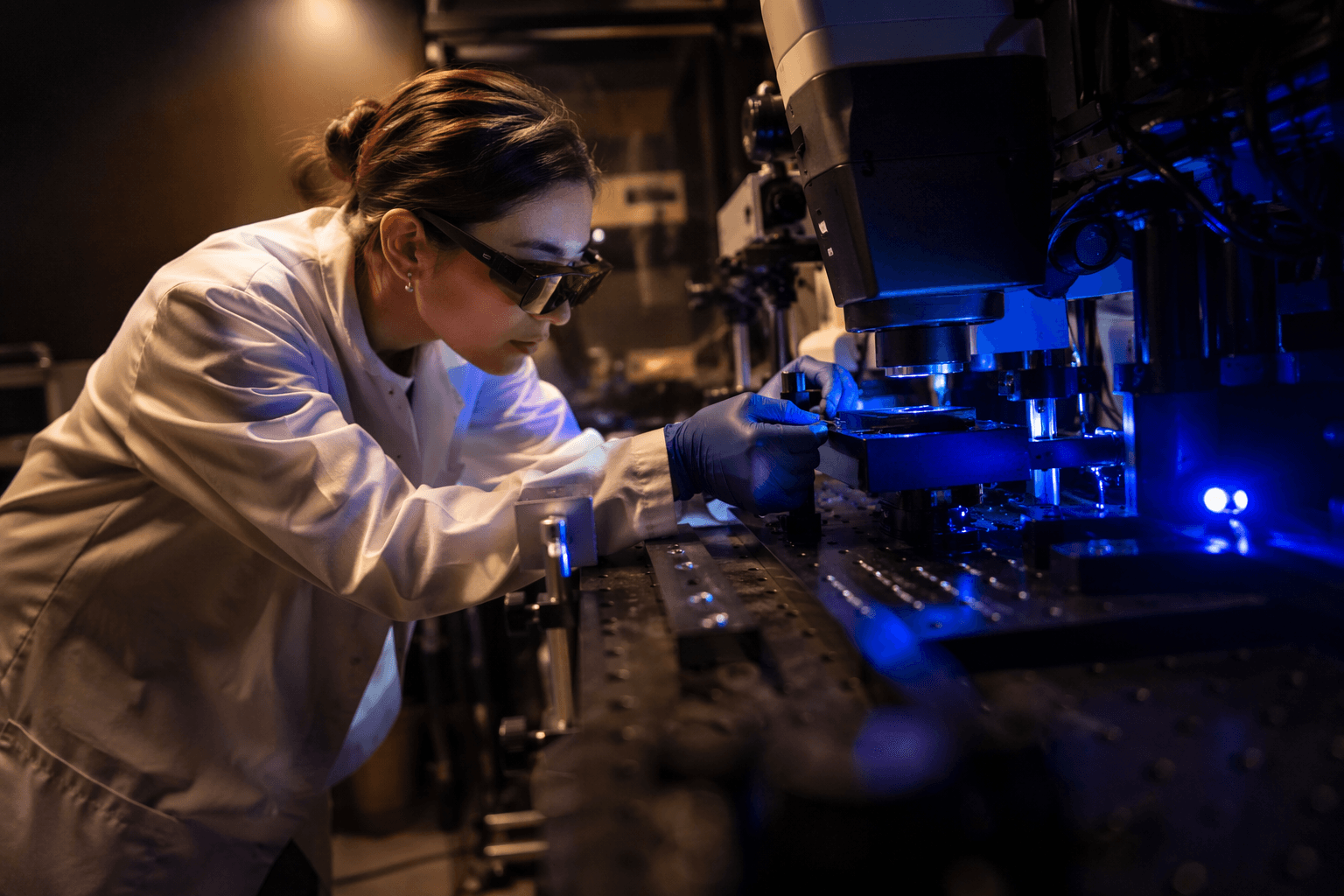
Jayich plans to use the system to build 3D ion traps for optical clocks, while Moody’s work centers on nanophotonic devices and quantum materials for quantum communications and computing, including 2D materials, semiconductor quantum dots, and hybrid quantum systems. That mix makes the instrument more than a single-lab toy. It becomes a platform for problems that need real three-dimensional control at the smallest scales, the sort of thing commercial off-campus foundries can match in 10-nm lithography but still cannot deliver for complex 3D structures with nanoscale resolution and high-throughput prototyping.
The NSF’s Future Manufacturing program is designed to strengthen U.S. leadership in manufacturing, national security, workforce development, and environmental performance, and UCSB’s win fits a wider run of infrastructure-heavy bets from the university. Its earlier wafer-scale photonics work, including a 2024 InGaP-on-insulator paper and a 2022 AlGaAs-on-insulator paper, gives the new nanoprinter a home in an existing quantum and nonlinear photonics pipeline. For the desktop printing crowd, that is the real story: not a new machine to buy, but a glimpse of the kind of precision that may eventually shape the next generation of ultra-fine tools.
This article was produced by Prism’s automated news system from verified source data, official records, and press releases, then run through automated quality and moderation checks before publishing. The system is built and supervised by the people who set the standards it runs under. Read our full AI policy.
Did this article answer your question?