Alabama Indie Filmmakers Can Master Cinematography on Small Budgets
Harsh Alabama sun and a two-person crew aren't obstacles; they're the raw material. Here's the cinematography playbook built for exactly those conditions.
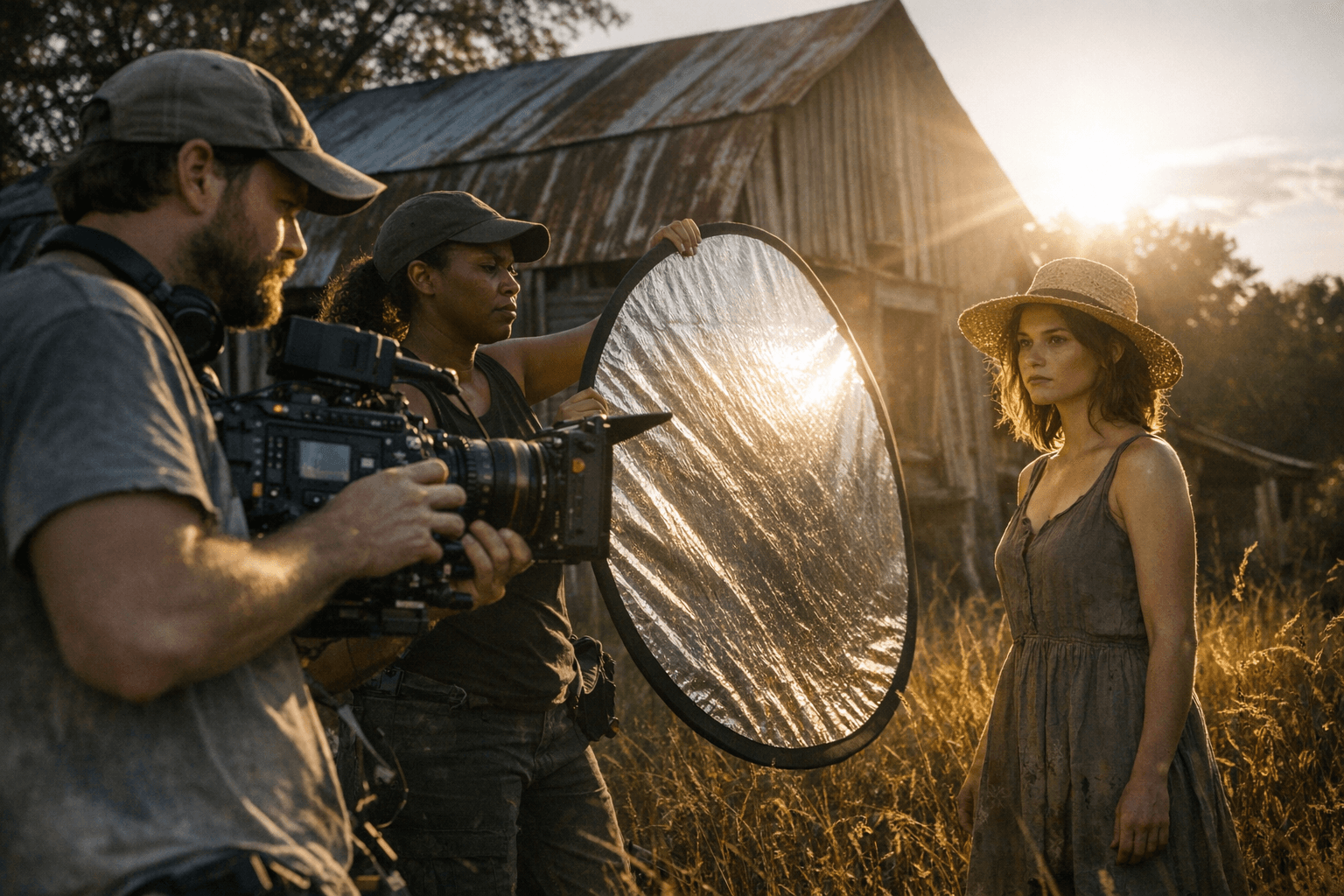
Shooting a short in a Birmingham parking lot at high noon with a mirrorless camera and a single reflector isn't a compromise. It's a constraint, and constraints are where Alabama indie filmmakers tend to get creative fast. The state's production reality, brutal midday sun, thick Gulf-humidity evenings that fog lenses right after you step out of an air-conditioned car, mixed-source lighting in cramped Mobile dive bars or Tuscaloosa storefront venues, doesn't require Hollywood gear to navigate. It requires a system. What follows is that system, built for the budgets and locations you actually have.
Lock In Your Exposure Before You Add Anything Else
Every image problem on a low-budget set traces back to one thing: exposure decisions made reactively instead of intentionally. Treat ISO, aperture, and shutter speed as a single unified system, not three separate dials. On any modern mirrorless or DSLR body, start at your base ISO, the lowest "clean" setting before digital noise creeps in, and anchor everything else to it. Choose your aperture based on the depth of field the scene needs: a wide aperture like f/1.8 isolates your subject from a chaotic background (useful on a Black Belt porch with visual clutter behind your actor), while a stopped-down aperture like f/5.6 keeps an entire room in focus for ensemble coverage. Then set your shutter speed to twice your frame rate, the 180-degree rule, to get motion blur that reads as natural rather than stroby.
One constraint, one solution: Shooting at noon in a Birmingham parking lot, your auto settings will underexpose faces to protect a blown-out sky. Lock your base ISO, set aperture to f/2.8 or wider for subject separation, and let the background clip. The face is what matters.
For lens choice, a two-lens kit covers most of what you'll shoot: a 35mm or 50mm prime for intimate coverage and shallow focus work, paired with a 24-70mm zoom for wide establishing shots and flexible medium coverage. This combination handles the full range of shot sizes without requiring a lens swap every five minutes on a tight crew.
- Set base ISO before calling talent to set
- Write your aperture and shutter speed on the shot list so the whole crew knows the look you're protecting
- If you change lenses, recheck exposure before rolling
Checklist: Exposure discipline on set
Lighting Alabama on No Budget
Three-point lighting, key light, fill, and a back or rim light for separation, is the foundation, but it doesn't require three expensive fixtures. For interviews and small dramatic scenes, bounce a single LED panel or even a work light off a white foam core board or a large reflector to produce soft, flattering key light. Add a small secondary LED as a rim to pull your subject off the background. That's a professional-looking two-light setup that fits in a hatchback.
Daylight is your biggest free resource, and Alabama's light is particular. Golden-hour windows in old downtown Birmingham buildings or open-sided porch spaces in the Black Belt deliver warm, directional light that a $10,000 HMI package can only approximate. The catch is that golden hour lasts fifteen minutes, so pre-light, rehearse, and be ready to roll the moment the quality is right.
One constraint, one solution: Shooting a dialogue scene on a humid Huntsville evening where practicals and window light are fighting each other for color temperature: gel your key light to match the dominant source (usually daylight or tungsten) and switch the other source off entirely. Committing to one color temperature in-camera costs nothing and saves hours of mixed-light color correction.
For the other challenging condition, midday sun, the fix is diffusion. A sheer shower curtain stretched on a cheap PVC frame, or even a white bedsheet held by two crew members, softens direct sun into workable, even illumination. Variable ND filters let you maintain your chosen aperture in bright daylight without blowing exposure, protecting the shallow depth of field you set at the start of the day.
- One adjustable LED panel (key)
- Two large white foam core boards (bounce/fill)
- A bedsheet or sheer curtain (diffusion for outdoor midday)
- Variable ND filter for your most-used lens
- Gaffer tape, clamps, and a light stand or two
Checklist: Budget lighting kit for an Alabama shoot
Composition and Movement: Less Is More
The rule of thirds and negative space are starting points, not gospel. Place your subject slightly off-center to suggest tension or isolation; fill the frame edge-to-edge with negative sky or open field for a sense of scale that is free to shoot anywhere in the Black Belt. But know when to break those rules: a centered, symmetrical frame communicates authority or threat depending on context, and an intentional rule-breaking composition reads differently than an accidental one.
On a low-budget shoot, camera movement should be earned. A well-planned dolly or slider push-in carries more emotional weight than forty-five minutes of handheld wandering. When movement is genuinely required, a gimbal stabilizes a walking shot for a few hundred dollars, while a tripod with a slow, deliberate pan from a trained operator achieves the same read for nothing. Plan moves in storyboards before arriving on location: a movement that takes thirty seconds on paper takes twenty minutes to rig and execute, so every unnecessary move costs you coverage.
One constraint, one solution: Interior shoot in a small Montgomery venue with no room to dolly: a slow zoom-in on a 24-70mm, executed smoothly by hand during a monologue, creates intimacy without a single moving part on the floor.
How Small Crews Stay Efficient All Day
The workflow that survives a two-person crew is built on three pillars: a minimal A-camera kit, an available-light B-camera setup for coverage you cannot light, and an absolute priority on clean production sound. Post-sync ADR is expensive and time-consuming; if your production sound is clean on set, you've saved yourself a full day in post. Bring a solid boom mic, use a lav as backup on critical dialogue scenes, and record room tone every time you move locations.
Keep a daily shot list short and realistic: six to ten setups per day is achievable on a lean crew; twenty setups is how you end a day without anything usable. Shoot in coverage blocks so you can pre-light an entire section of the location, knock out all shots in that space, then move. Rehearsal and pre-lighting are among the highest-return activities on any indie set; thirty minutes of rehearsal before rolling consistently reduces takes and protects battery and media cards.
Log every setup: write down the lens, stop, ISO, and any notable lighting notes, and photograph the setup from two angles. When you return for pickups or need to recreate a look three months later on the next project, those notes are worth more than any equipment upgrade.
- Pre-built shot list with setups grouped by location and lighting condition
- Exposure and lens log updated after each new setup
- Boom mic primary, lav backup on every dialogue scene
- Room tone recorded at every new location
- Battery and card inventory checked at lunch
Checklist: Small-crew daily workflow
Building the Practice Routine
Technical fluency in cinematography comes from repetition on real projects, not from reading alone, but reading the right things accelerates the curve. No Film School publishes practical, community-grounded guides on lighting and camera technique that are directly applicable to the kind of small-venue and outdoor shooting common in Alabama productions. StudioBinder's breakdowns of shot sizes, lens storytelling, and blocking are valuable references for student crews in pre-production. For deeper craft development, the American Society of Cinematographers materials and the American Cinematographer Manual provide the professional-level framework behind the techniques.
Structure your practice with intention: daily camera exercises to internalize exposure decisions, weekly lighting drills recreating a specific look with whatever gear is available, and monthly short projects at festival-submission length, typically two to fifteen minutes, to practice the full production workflow under realistic time pressure. The Sidewalk Film Festival in Birmingham and the Troy International Film Festival at Troy University both accept student and indie short work, which means your monthly practice project can become a submission with a real deadline attached.
Longleaf Studios at Jacksonville State University offers one of the most direct on-ramps into Alabama's professional filmmaking community: the experiential learning program pairs students with professional filmmakers on real-world projects, and its partnership with Alabama Public Television has produced Emmy-winning documentary work. If you're building a production résumé in Alabama, the community structures are already in place to grow alongside your craft.
The filmmakers who make the leap from shorts to features in Alabama consistently describe the same process: they built a practice routine, documented every setup, showed their work at local screenings, and kept producing. The gear matters far less than the discipline to keep shooting and the community to hold you accountable for what ends up on screen.
This article was produced by Prism’s automated news system from verified source data, official records, and press releases, then run through automated quality and moderation checks before publishing. The system is built and supervised by the people who set the standards it runs under. Read our full AI policy.
Did this article answer your question?


