Tuskegee footage of George Washington Carver reveals Alabama indie roots
Alabama indie film starts earlier than the festival circuit. A private Tuskegee color portrait of George Washington Carver shows how local, restrained footage can become lasting history.
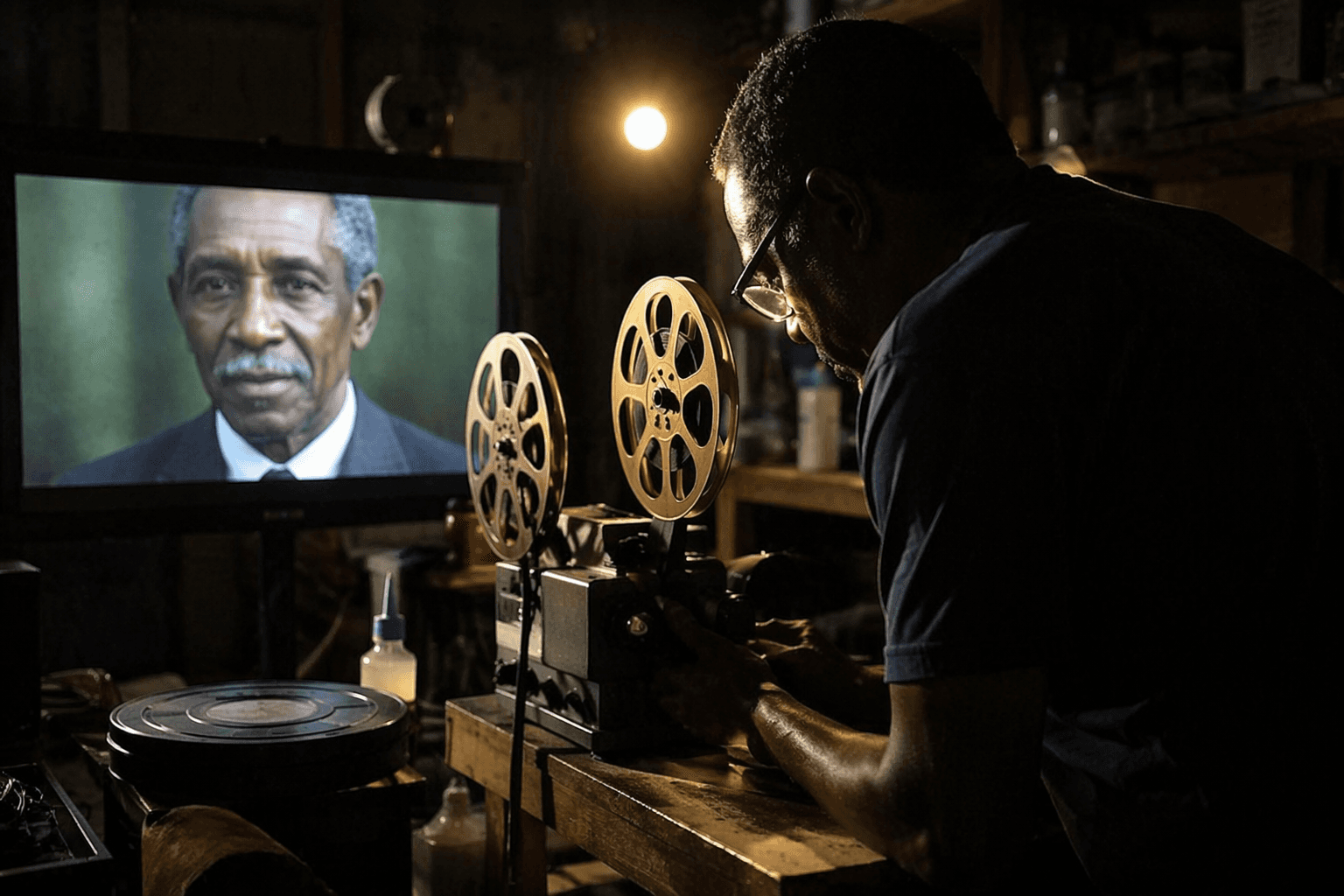
Alabama independent film did not begin with a festival submission deadline or a buzz title from Birmingham. One of its deepest roots is a private color film made at Tuskegee, built from a camera, a willing subject, and a place that already understood the value of self-documentation. The surprise is how small it was, and how much it has lasted: a roughly 15-minute amateur record of George Washington Carver, shot on early Kodachrome and still vivid enough to feel current.
That is the useful lesson for filmmakers now. The film did not need a studio machine to matter. It needed access, restraint, and a sharp eye for ordinary motion. That is still the core of Alabama microbudget work when it is done well.
Carver on film, not as monument but as daily life
The National Archives identifies the footage as an amateur color record of Carver, likely shot in 1941 or 1942 by Dr. C. Allen Alexander, an African American surgeon from Kalamazoo, Michigan. Carver had earlier agreed in 1937 to allow private movie sequences, and that agreement matters because it shaped the film into something intimate rather than staged for public spectacle.
What survives in the film is the kind of detail independent filmmakers spend years trying to earn. Carver appears in his apartment, his office, and his laboratory. He tends flowers, displays paintings, and interacts with colleagues. Nothing in that setup depends on scale; everything depends on proximity. The camera is close enough to catch a life being lived, not reconstructed, and that is exactly why the footage still reads as alive.
For Alabama filmmakers, that is the practical takeaway. A film does not have to announce itself as important with size. It becomes durable when it knows where to stand and what to watch. In this case, the subject was already historically significant, but the form is what gives the material its staying power.
Tuskegee is not just the backdrop, it is the logic
Tuskegee gives the story its Alabama backbone. The National Park Service describes Tuskegee Institute as a legacy project of Booker T. Washington, founded in 1881, and built as a center for education, industrial training, and self-sufficiency. That history is not decoration around the film. It explains why a private moving image of Carver belongs here in the first place.
Tuskegee was already a place where making and teaching were linked to Black advancement and to the preservation of Black achievement on Black terms. Put the Carver footage inside that context and it stops looking like a one-off curiosity. It becomes part of a broader culture of self-recording, where the campus itself functions as a kind of visual archive before the word “archive” becomes the point.
That matters to Alabama indie identity now because so much of the state’s strongest independent work still comes from the same instinct. It is local, specific, and grounded in lived space. It trusts a neighborhood, a room, a front porch, a lab, a storefront, or a campus more than it trusts generic production value.
Why the Kodachrome matters more than nostalgia
The film’s early Kodachrome capture helps explain why the color still feels unusually vivid today. That is not just a technical footnote. It is part of the film’s authority. The color gives weight to the ordinary gestures, the flowers, the paintings, the workspaces, and the calm human presence of Carver himself.
A lot of low-budget filmmaking chases impact by piling on coverage, movement, or explanation. This footage does the opposite. It lets color and place carry meaning. If you are building a microbudget feature or a documentary portrait in Alabama, that should sound familiar: the strongest image is often the one that trusts a real room and a real face instead of trying to fake scope.
The lesson here is not to imitate Kodachrome. It is to understand what the medium is doing when it preserves texture. In the Carver film, texture is history. The footage does not merely show who Carver was. It shows the environment around his work, the pace of his day, and the dignity of a life captured without flattening it into spectacle.
What modern Alabama filmmakers can borrow from this model
The Carver footage offers a working model for how Alabama indie film can define itself without waiting for outside approval. It points toward a practice built on access to people and places that already matter, not on creating artificial significance in post-production.
- Film the spaces that actually shape your subject. In the Carver footage, the apartment, office, laboratory, and garden-like moments are the story.
- Favor observation over explanation. The film’s power comes from watching Carver move through his world, not from over-stating who he is.
- Treat small-scale material as if it could outlive the moment. This footage was private, but it is now part of the state’s cultural record.
- Build for specificity. Alabama stories become sharper when they stay rooted in the exact campus, block, room, or institution that made them possible.
That approach fits the best current microbudget practice in the state. The sharpest work is usually the work that knows its own geography and does not apologize for it. A film made in Birmingham, Tuskegee, Mobile, or Huntsville can feel larger than its budget when it is anchored in real textures and real social memory.
Preservation is part of the art, not an afterthought
The National Film Registry exists to protect films of cultural, historical, and aesthetic importance, and George Washington Carver at Tuskegee Institute is part of that heritage. That fact turns preservation into a live issue for Alabama filmmakers, not a museum concern somewhere else.
If a small private film from Tuskegee can end up as a preserved artifact of national importance, then today’s Alabama indie scene should think differently about what it is making and saving. The rough cut, the campus portrait, the neighborhood profile, the no-budget short, and the homegrown feature are not disposable just because they are modest. They may be the records that future viewers need in order to understand how the state saw itself.
That is why the Carver footage still matters. It begins as something intimate and local, then becomes a standard for what Alabama cinema can be when it trusts its own places, its own subjects, and its own memory.
This article was produced by Prism’s automated news system from verified source data, official records, and press releases, then run through automated quality and moderation checks before publishing. The system is built and supervised by the people who set the standards it runs under. Read our full AI policy.
Did this article answer your question?