USA Pickleball Announces Historic 2026 Wheelchair National Championships for Athletes
USA Pickleball's first-ever dedicated wheelchair national championship arrives in Colorado Springs this June, with 24 oversized courts and zero qualifying requirements to enter.
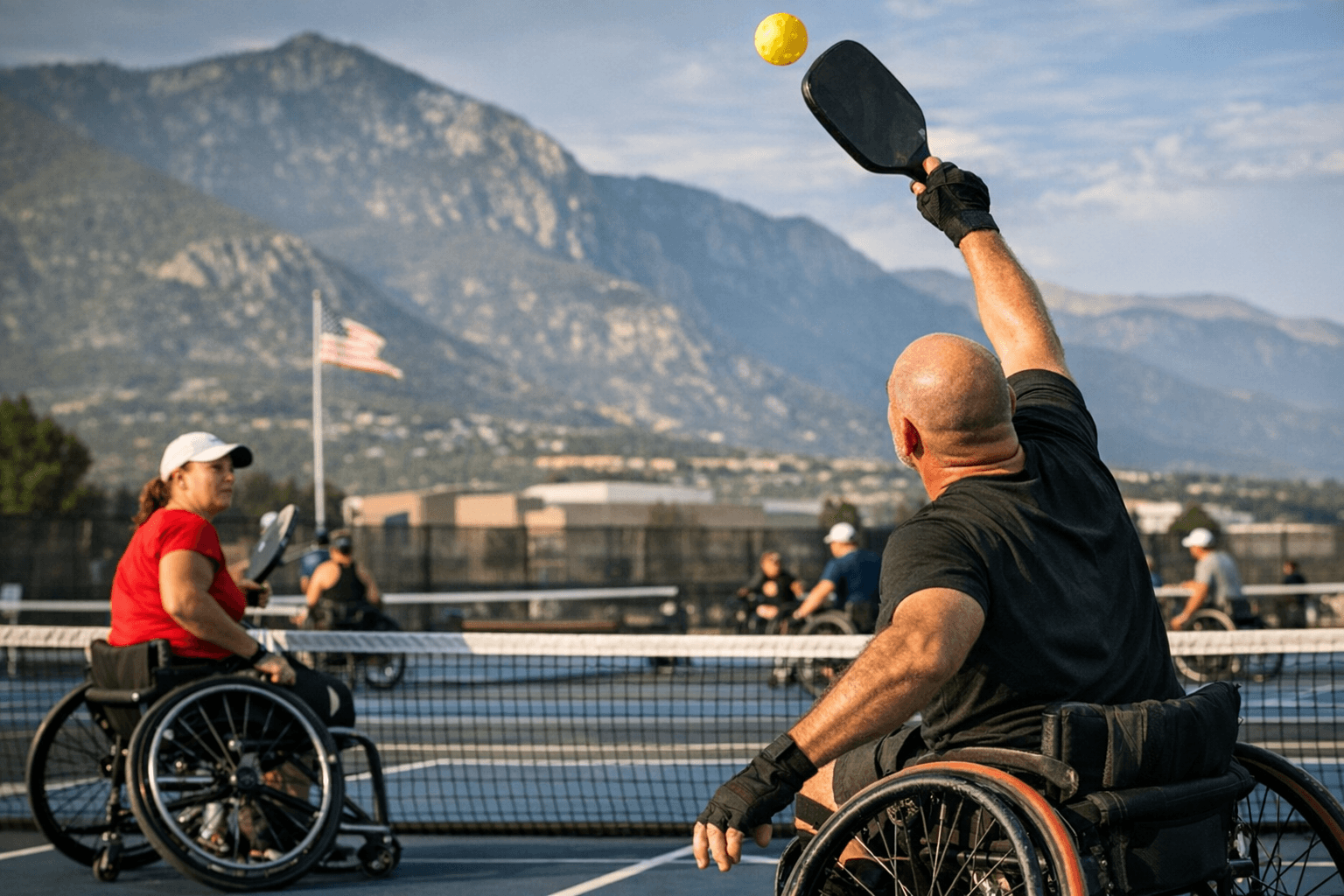
Pickleball spent its first boom decade chasing growth in numbers. Now it is chasing something harder: genuine depth. The announcement of the inaugural USA Pickleball Wheelchair National Championships, set for June 19-21 in Colorado Springs, Colorado, signals that adaptive competition is no longer a footnote in tournament programs but a standalone pillar of the sport's national infrastructure.
Peak Pickleball, the indoor complex at 1730 Briargate Boulevard, will host the event across 24 oversized courts purpose-built for the movement requirements of wheelchair play. The format covers three divisions: singles, doubles, and hybrid doubles, welcoming everyone from first-time competitors to national-caliber athletes. There are no Golden Ticket qualifying requirements, no Tiered Point System threshold to clear. Wheelchair athletes register directly once the window opens, which USA Pickleball says will be announced separately.
"This is a defining moment for our sport," said Mike Nealy, CEO of USA Pickleball, "and we are proud to be an integral part of it. By introducing a national championship for wheelchair athletes, we are not only expanding opportunities, but we are helping shape a more inclusive future for the sport at every level."
For club organizers wondering what inclusive open play actually looks like in practice, the 2026 rulebook offers a clear framework. Wheelchair players may allow the ball to bounce twice before returning, with a third bounce constituting the fault. Serving requires rear wheels to stay behind the baseline, and front wheels may enter the non-volley zone during a volley but must return before the player hits the ball. The chair itself is considered part of the player's body for any contact calls. In hybrid doubles, where one player competes in a wheelchair and one stands, the two-bounce allowance applies only to the adaptive player, not the standing partner, which makes integrating open-play sessions at any club a straightforward scheduling decision rather than a rulebook overhaul.
The physical plant matters, too. Standard courts measure 20 by 44 feet, but USA Pickleball recommends 44 by 74 feet for regular wheelchair play and 50 by 80 feet for stadium-level competition. Facilities looking to host adaptive sessions should audit their spacing between courts, not just the court surface itself, since wheelchair maneuvering demands clearance that standard side-by-side court layouts often compress.
Peak Pickleball's event sweetens the entry point considerably: the registration fee is kept low, a free dinner is included, national championship rings go to division winners, and the Open division carries cash prizes. The club is also working to arrange discounted accommodations for traveling athletes.
For clubs that want to build a pipeline before June, USA Pickleball's adaptive program page functions as a hub for connecting existing programs with its ambassador network, and the organization accepts direct donations through its website to fund adaptive growth grants. Adaptive Sports for All, which runs wheelchair pickleball clinics and provides equipment loans to new competitors, offers a ready-made model for any club looking to launch its own introductory session, and reaching out to coordinate a Play-With-A-Pro style clinic mirrors the format Peak Pickleball is already deploying.
The Colorado Springs venue sits in a city with deep adaptive sports roots, home to the United States Olympic and Paralympic Committee headquarters. That geography is not incidental. It frames wheelchair pickleball's national championship not as an accommodation, but as a legitimate competitive endeavor arriving in Olympic City on its own terms.
Know something we missed? Have a correction or additional information?
Submit a Tip