How tokonoma displays shape advanced bonsai presentation
A tokonoma setup turns a bonsai into a complete scene, and the width, stand height, and accents tell viewers exactly what season and mood you mean.
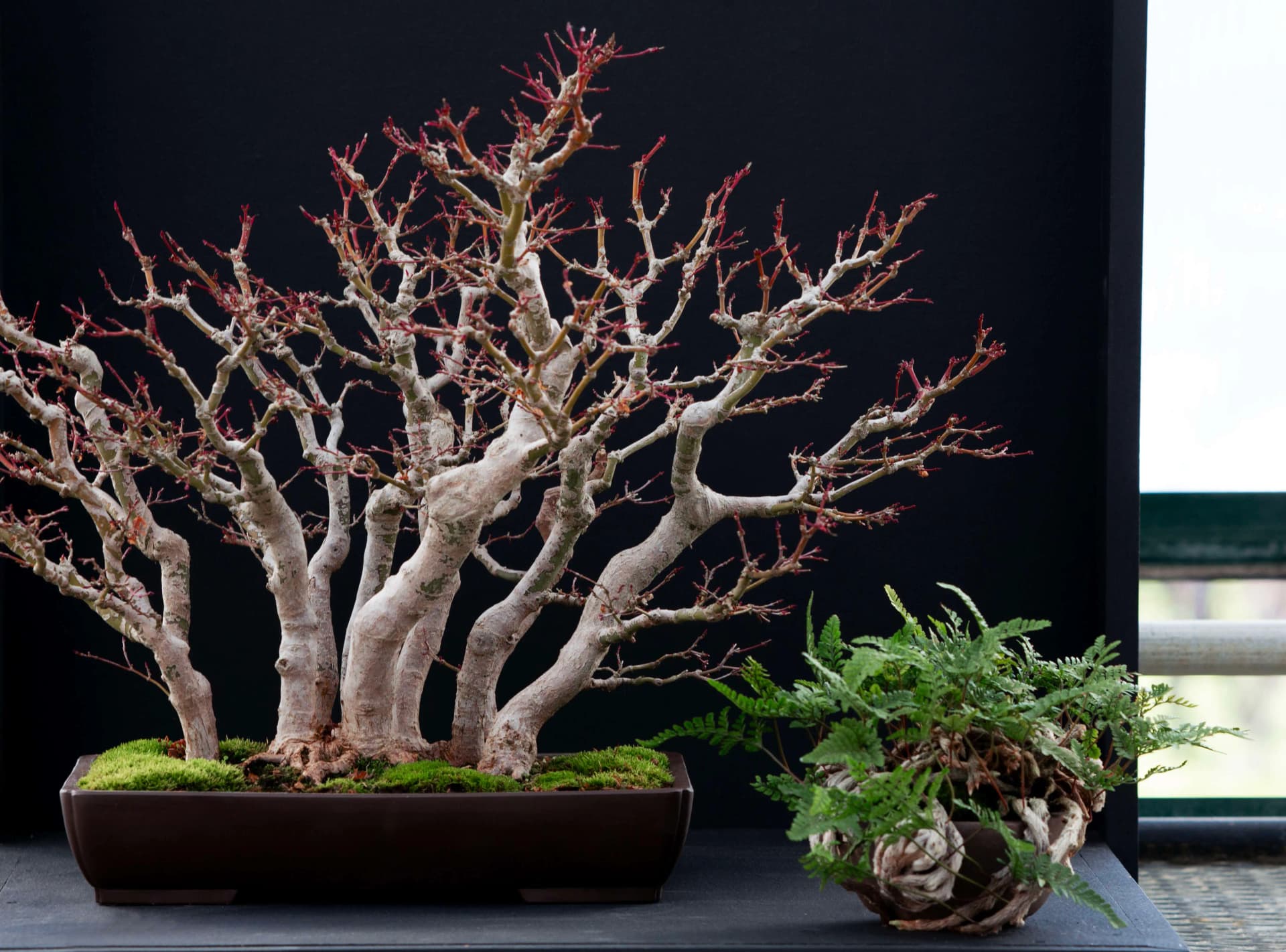
A bonsai displayed with a stand, a scroll, an accent plant, and a suiseki stone reads differently from a tree set on a bench. In tokonoma-style presentation, the tree is the lead actor, but those elements shape how it is read. Advanced bonsai presentation often looks restrained at first glance and richer the longer you study it.
The display begins with space
A formal bonsai presentation is not just a tree on a table. It is a composition that may include a stand, a suiseki stone, an accent plant, and a scroll, all working together instead of competing for attention. Most bonsai shows feature tokonoma presentations arranged on a single table length of about eight feet, according to the East Bay Bonsai Society.
Display design is really about proportion. A tree that feels powerful on a bench can look awkward if it is given too much empty space or crowded by accessories that are too large. The tokonoma model solves that by giving the tree a defined stage, with enough room for the eye to move but not so much that the composition loses focus.
Why six feet can be enough
Jonas Dupuich wrote on Bonsai Tonight on November 26, 2023 that bonsai displays at Japanese exhibits are commonly six feet wide, about the length of one tatami mat. In that space, one or more small trees can be presented in a balanced composition. That is a practical benchmark for anyone trying to set up a small display at home, at a club meeting, or on a photo table.
The six-foot measure forces decisions. If the display is only as wide as a tatami mat, every object has to earn its place, and the tree’s silhouette, pot, and support all have to read cleanly from a viewing distance. It also explains why formal bonsai presentation often feels calmer than a nursery bench: the rules of the space keep the composition from spreading out into clutter.
What the companions are doing
The accent plant is not filler, and the scroll is not decoration in the casual sense. In bonsai display literature, the accent plant is called shitakusa, and suiseki, tenpai, and other accompaniments can reinforce seasonality or the passage of time. That is the real job of the side elements in a tokonoma arrangement: they give the main tree a context.
A suiseki stone can suggest mountains, cliffs, or shoreline forms without turning the scene into a literal landscape. A scroll can set a mood or suggest weather, while an accent plant can point to the season with a smaller gesture than the tree itself can make.
The tree still leads
The most common mistake in a first formal display is to treat the accessories as equal stars. The tokonoma approach says otherwise: the bonsai remains the focus, and the other elements support the story without overpowering it. That is why restraint matters so much in advanced presentation, especially when the tree already has strong movement or a dramatic trunk line.
A good test is whether the stand, pot, and companions help the tree breathe. If the scroll repeats the same visual idea too loudly, or the accent plant is larger than the tree can justify, the composition starts to read as crowded rather than composed.
What club shows already prove
The East Bay Bonsai Society’s coverage of its 58th Annual Show in Oakland, California, published October 18, 2019, shows that most trees were displayed on wooden stands with scrolls or accents. Tokonoma thinking is not limited to major Japanese exhibitions or museum settings. It is already built into club show culture in the Bay Area, where many trees are judged as part of a larger visual arrangement.
Bonsai Tonight documented accent displays at the 94th Kokufu-ten on February 25, 2020. Major Japanese exhibitions do not treat accents as afterthoughts; they present them as part of formal exhibition culture.
Museum practice keeps the style alive
Aarin Packard, Assistant Curator of the National Bonsai & Penjing Museum, has used Capital Bonsai to publish seasonal tokonoma display posts, including material from 2012 and 2014. At the National Bonsai & Penjing Museum, tokonoma remains a living interpretive framework used to teach how bonsai is meant to be seen. Seasonal variation is central to that teaching, and the display changes with the calendar even when the tree itself does not.
Presentation is part of bonsai art, not a separate stage after cultivation. A winter tokonoma display can feel quiet and spare; a spring display can feel lighter and more open.
How to use tokonoma thinking at home
If you want to apply this in a club room, at a local show, or while photographing a tree, start by limiting the stage. A table around eight feet long, or a display space about six feet wide, is enough to make the composition feel intentional without losing intimacy. Then choose only the companions that strengthen the season or setting.
- Use a stand that lifts the pot enough to separate it from the surface.
- Add one accent plant or a single suiseki stone, not both unless the composition can support it.
- Keep the scroll visually quieter than the tree.
- Leave enough empty space for the eye to move, but not so much that the display feels unfinished.
- Match the accessories to the tree’s mood, not just to whatever looks attractive on its own.
This article was produced by Prism’s automated news system from verified source data, official records, and press releases, then run through automated quality and moderation checks before publishing. The system is built and supervised by the people who set the standards it runs under. Read our full AI policy.
Did this article answer your question?