Japanese Artist Fujita Preserves Dead Bonsai as Dry Artworks
Shigeo Fujita turns dead bonsai into preserved artworks, and the result is forcing a split: revival art, sustainable display, or bonsai's own next chapter.
Dry bonsai starts with an ending
Shigeo Fujita has built a second life for trees most bonsai growers would have already written off. Instead of discarding withered or dead stock, he preserves it as dry bonsai, a form that keeps the silhouette, texture, and drama of a tree while stripping away the need for ongoing cultivation.
That is exactly why the idea lands so hard inside the bonsai world. Fujita, born in Chiba Prefecture in 1965, began working as a bonsai artist in 1992, presented his first dry bonsai in 2016, and trademarked the term in 2018. He later opened the DRY BONSAI Tokyo GINZA Salon in March 2019, a move that pushed the concept beyond novelty and into a branded, physical practice with a clear public face.
How Fujita turns dead wood into a finished piece
The process starts with dead or dying material sent to him from across Japan, which already tells you this is not just a studio gimmick. Fujita removes the soil, sterilizes and cleans the tree, dries it thoroughly, prunes the branches, and refines the root shape before finishing the piece by hand with preserved conifer needles, artificial cherry blossoms, and other materials.
That labor takes time. Each piece can require one to three months, depending on the size and condition of the tree, and that time investment makes the work feel closer to restoration art than simple decoration. The rhythm is familiar to anyone who has worked a difficult bonsai specimen: the original tree still matters, but the final result depends on what the maker can save, clarify, and emphasize.
The method also explains why dry bonsai reads differently from a typical display tree. In living bonsai, the artist is always managing growth, response, and seasonal change. Here, Fujita is preserving form after decline, which shifts the emphasis from horticulture to composition without losing the scale and character that make bonsai immediately recognizable.
Why the style gets attention so quickly
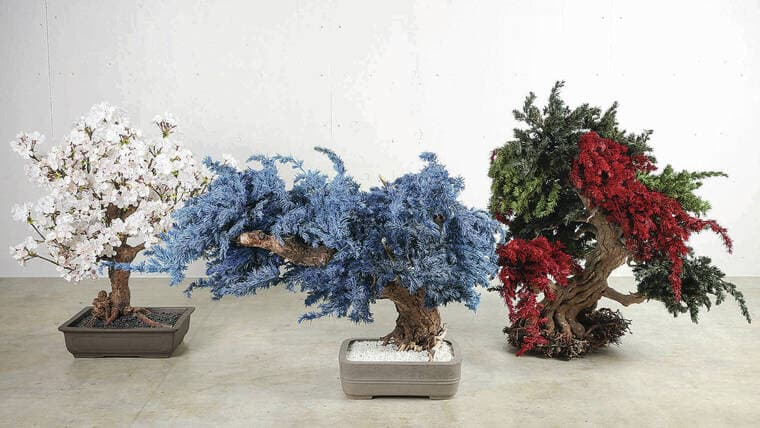
The visual range is part of the hook. One Japanese black pine dry bonsai has blue leaves, while an azalea is set with blossoms, and other pieces are styled with exposed roots. That willingness to mix classic silhouettes with contemporary color choices gives the work an experimental edge that traditional display trees rarely try to claim.
It also helps explain why dry bonsai has traveled well outside a collector’s cabinet. Fujita’s official materials describe it as a maintenance-free bonsai style, and the form has been shown in Ginza, Kyoto, and other venues, including luxury-brand collaborations. For homes, shops, and offices, the appeal is blunt and practical: no watering, no pruning, no seasonal rescue work, just a preserved tree form that keeps its presence without asking for daily attention.
That practical side matters more than it first appears. A piece that can sit in a store or office without a care routine solves a real problem for people who love the look of bonsai but cannot maintain living material. It is easy to dismiss that as convenience, but convenience is often what decides whether an art form stays niche or moves into wider public view.
Where dry bonsai fits against traditional bonsai values
This is where the debate gets interesting, because dry bonsai sits right on the fault line between bonsai as living cultivation and bonsai as sculptural expression. Traditional bonsai values care, patience, and the slow management of living material. It also prizes impermanence, which is part of the emotional contract of the art: the tree changes, the artist responds, and the display never stays fixed for long.
Dry bonsai keeps some of that language but removes the central discipline of keeping the tree alive. For purists, that may make it feel like a separate category, closer to preserved floral art or decorative sculpture than to bonsai in the strict sense. For others, the second-life angle is the whole point. A tree that would have been discarded can be transformed into something durable, and that reuse has a sustainability-minded logic that is hard to ignore.
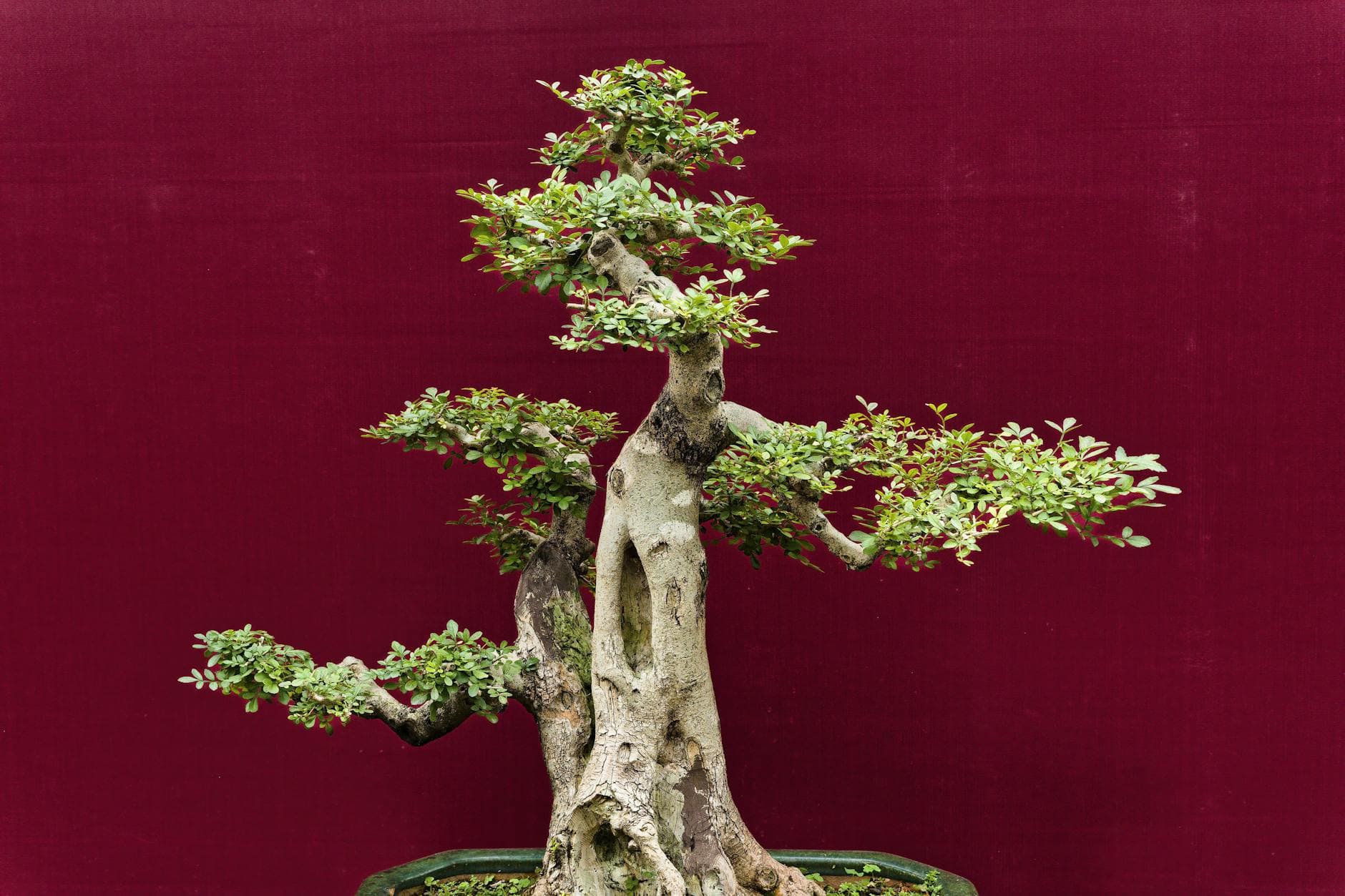
The strongest argument in Fujita’s favor is that the work still asks for bonsai literacy. The proportions, trunk movement, exposed roots, and branch structure all need to read as bonsai first. If the form works, you still recognize the language immediately, even if the material has crossed a line from living to preserved.
From Ginza to Kyoto, the idea keeps expanding
Fujita has not treated dry bonsai as a single studio experiment. His materials say the concept has been pushed through salons, classes, and overseas expansion, and that he later introduced IKE BONSAI as another related format. The opening of the DRY BONSAI Tokyo GINZA Salon in 2019 gave the idea a headquarters in one of Japan’s most visible districts, while the DRY BONSAI KYOTO SALON opened in November 2023, extending the footprint into another city with deep cultural weight.
That expansion matters because it shows the work is not surviving on shock value alone. It has become a system, with exhibitions, a retail and salon presence, and enough public interest to move beyond a one-off artistic stunt. In a hobby where authenticity is often measured by years of cultivation, that is a notable shift: the saleable object is no longer a living tree under care, but a finished, preserved statement about what the tree once was.
Why the divide may be the point
Dry bonsai is persuasive precisely because it does not pretend to be neutral. It preserves the visual poetry of bonsai while breaking one of the hobby’s oldest rules, that the tree must remain alive and under constant stewardship. That tension gives the form its energy.
If you want bonsai defined strictly by living cultivation, dry bonsai sits outside the line. If you judge the art by structure, memory, restraint, and the power of a tree form to hold a room, Fujita’s work makes a strong case for itself. Either way, he has taken the most fragile part of the hobby, the moment when a tree declines, and turned it into a finished object with a clear audience and a growing place in contemporary display culture.
This article was produced by Prism’s automated news system from verified source data, official records, and press releases, then run through automated quality and moderation checks before publishing. The system is built and supervised by the people who set the standards it runs under. Read our full AI policy.
Did this article answer your question?