Japanese DIY Bonsai Kit Sparks Frenzy, Turns Easy Craft Into Big Project
A 2,200-yen bead-and-wire bonsai kit sold out fast, then asked buyers for five hours and 80 wire cuts to make a palm-size sakura tree.
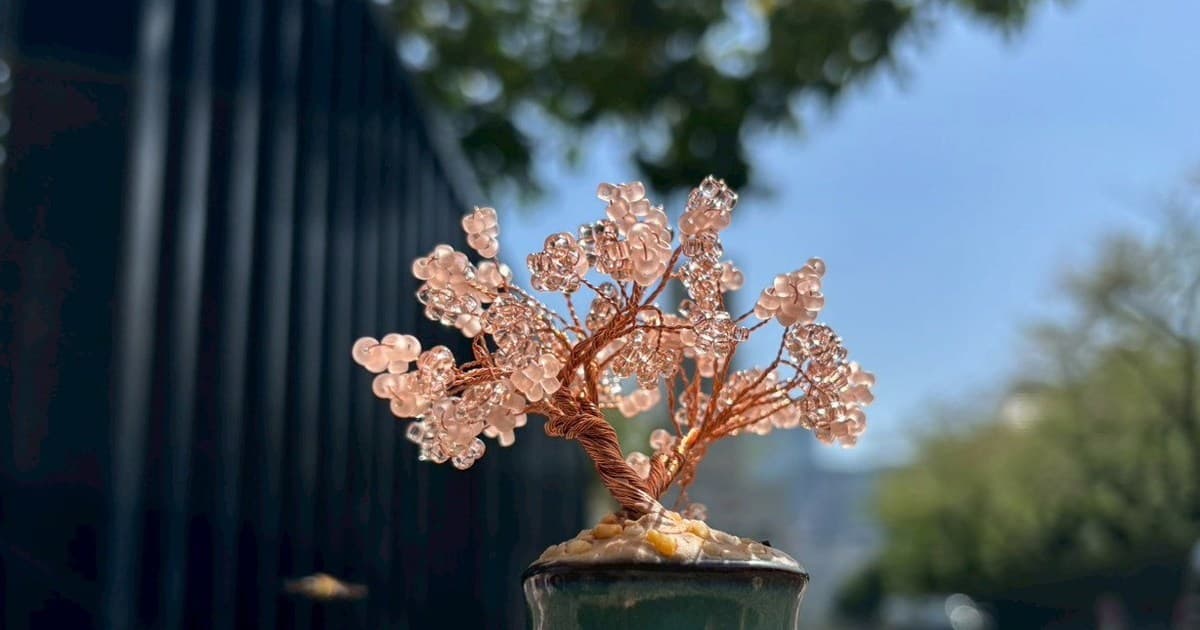
A tiny bonsai kit sold as a springtime diversion ended up demanding the kind of patience that defines the real art. MIYUKI’s Nejitte BONSAI, priced at 2,200 yen, moved quickly through online shops and stores before being restocked, a reminder that bonsai-themed crafts can generate real demand when they promise the look of a miniature tree without the years of tree care.
The appeal is obvious at first glance. MIYUKI, the Hiroshima company founded in the mid-1930s as a glass seed bead maker, packages the project with beads, wire, clay, gravel, a pot and instructions, all made in Japan. The finished piece is small enough to sit between fingertips, measuring about 6.5 to 9.5 centimeters tall and 5 to 7.5 centimeters wide. The official lineup goes beyond cherry blossom imagery to include pine, plum, sakura, wisteria, autumn leaves and ginkgo, which gives the kit a broader bonsai palette than a one-season novelty.
What turned the project from cute to consequential was the build itself. The box labels it difficulty level 2 out of 5, but the instructions run through nearly 20 steps and begin with cutting 80 wire pieces to the same length. That alone took about 20 minutes before any twisting began. From there, beads had to be threaded wire by wire, pieces were dropped, momentum slowed, and the work stretched to five hours. For a kit meant to feel approachable, it still asked for the same concentrated handwork that gives bonsai its reputation for discipline and repetition.
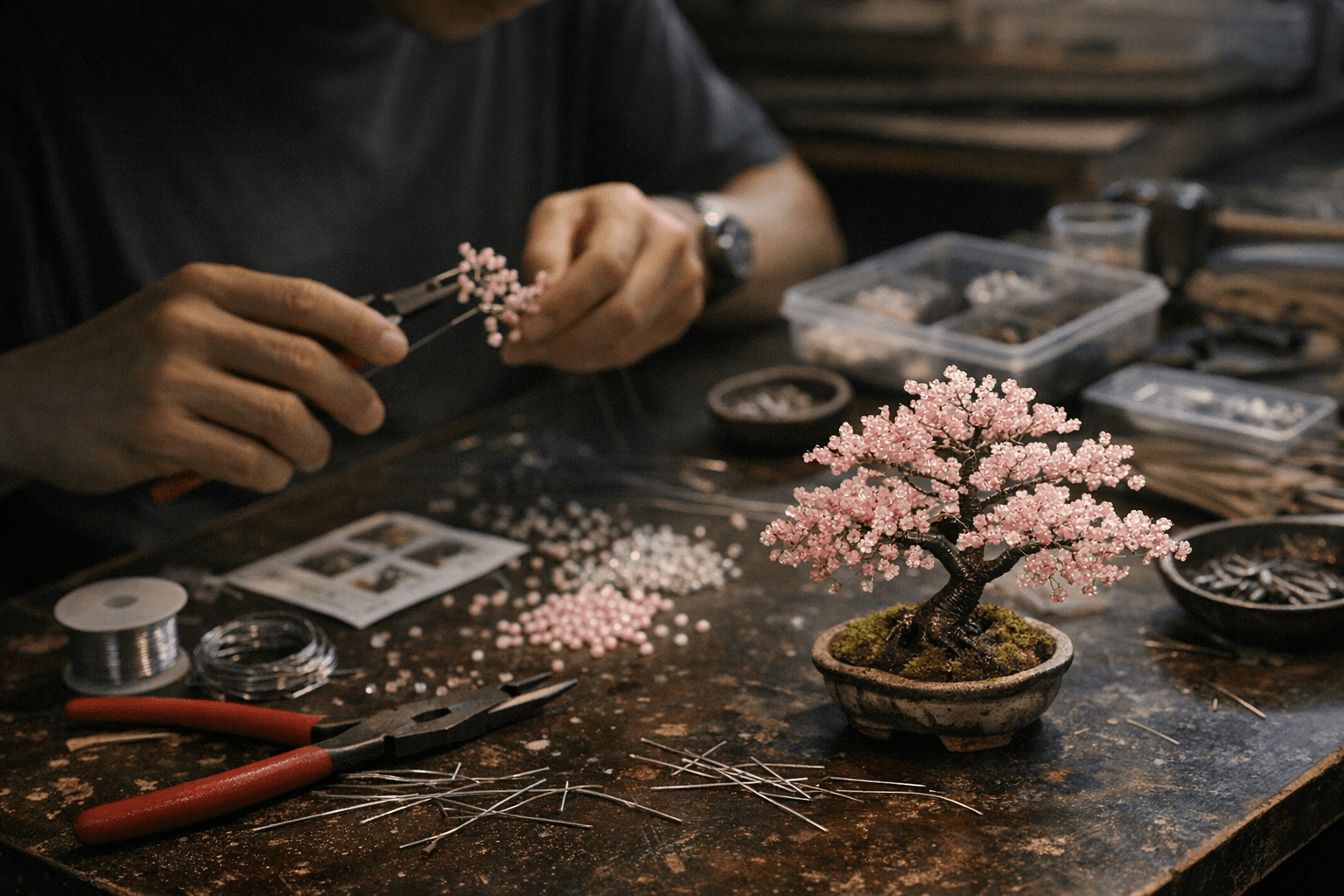
That tension is what makes Nejitte BONSAI more interesting than a simple craft trend. It is not a real tree, and it is not trying to be one, but it borrows the central ritual of bonsai culture: shaping something small through patience, precision and restraint. That connection matters in a field with deep roots. Japan’s Tourism Agency notes bonsai became increasingly popular around the turn of the 20th century, while the Omiya Bonsai Art Museum is described as the world’s first public museum devoted entirely to bonsai. Omiya Bonsai Village was established in 1925 after bonsai gardeners relocated from Tokyo after the Great Kanto Earthquake of 1923, and the museum’s 2025 special exhibition marks the village’s 100th anniversary.
Seen in that context, the frenzy around a 2,200-yen bead kit looks less like a gimmick than a signal. People are not just buying a miniature tree form; they are buying access to bonsai’s look, its pacing and its ritual, compressed into an afternoon that still took five hours.
Know something we missed? Have a correction or additional information?
Submit a Tip