Kat Rivier Kai Bonsai Club spotlights rock landscapes at autumn festival
Kat Rivier Kai turns its autumn festival into a masterclass on rock landscapes, with root-over-rock, suiseki, and two days of demos in George.
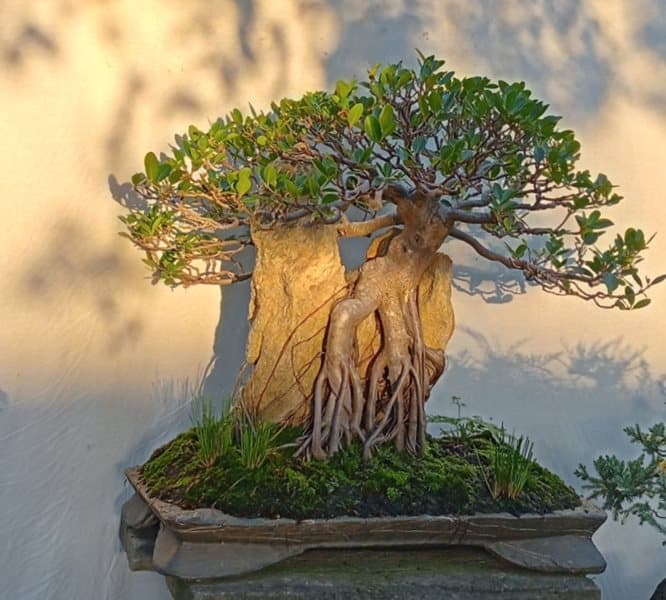
Bonsai gets sharper when the stone comes first
Kat Rivier Kai Bonsai Club is turning its 2026 Autumn Bonsai Festival into a study of how rock changes everything. At George Garden Centre on Airport Road in George, the club will spend Saturday and Sunday, 25 and 26 April, exploring the harder, more sculptural side of bonsai design: root-over-rock, artificial rock, bonseki, suiseki, outcrop planting, and landscapes that try to echo whole ecosystems in miniature.
That focus gives the festival unusual destination value. This is not a routine club show where trees sit in rows and the eye moves quickly from one pot to the next. It is a curated weekend around composition, where the stone is not a backdrop but the engine of the design. The challenge is different too: a good rock planting asks where roots can grip, how a trunk breaks the line of the stone, and how the whole scene suggests age, weather, and geography before a single needle or leaf gets read.
Why the rock theme matters
Rock-centered bonsai asks for a different kind of thinking than the familiar tree-first display. A conventional bonsai can rely on trunk movement, branch structure, and container choice to carry the composition. With stone work, the artist has to solve a landscape problem: how to suggest cliffs, fault lines, riverbeds, wind-blasted slopes, or isolated outcrops without making the tree look planted on top of a prop.
That is why this festival stands out. Kat Rivier Kai is using the weekend to show how rocks and stones can replicate specific natural environments and ecosystems inside a bonsai composition. The result should feel less like a collection of specimens and more like a set of tiny places, each with its own terrain and logic. For visitors, that means seeing bonsai as landscape design, not just horticulture.
The club’s vice chairperson, André Swart, has framed the event as a chance to share and celebrate ideas, and that is exactly what the line-up suggests. The weekend is built for people who already know the basics of styling and want to see how the hardest surfaces in bonsai, literal rock, can make a tree look older, more exposed, and more believable.
Saturday: a full day of rock-based demonstrations
Saturday is the densest teaching day, and the program reads like a field guide to different ways stone enters the composition. Dawn Collier will work on Japanese black pine on the rocks, a pairing that immediately promises tension between rugged conifer character and the fixed geometry of stone. Robbie Leggat will cover outcrop plantings and perspective, which is where the eye is tricked into reading scale and distance in a very small space.
The collaborative ficus session with Clifton Marais, Sally Sanders, and Marlene Smith should be one of the more practical demonstrations on the schedule, especially for seeing how teamwork can shape a rocky planting around a living, fast-reacting species. Ray Kingma will present mystical rock landscapes, a title that suggests the more atmospheric side of the art, where feeling and scene matter as much as technical placement.
Willem Pretorius will introduce bonseki, the Japanese art of arranging fine sand and stones on a tray to suggest landscape, while William Pringle will focus on root-over-rock work, one of the most revealing tests of a bonsai artist’s patience and planning. Liam O’Flaherty’s session, playfully called a pretty place between a rock and a hard place, adds another layer of experimentation to a program that is clearly aimed at people who want more than a finished-tree display.
- how roots are guided over uneven stone instead of into ordinary soil lines
- how outcrop plantings create the illusion of height and distance
- how bonseki uses restraint, not foliage, to tell a landscape story
- how collaborative work changes the feel of a composition when several hands shape the same scene
What to watch for on Saturday:
Sunday shifts from making to refining
If Saturday is about building the idea, Sunday is about correction, presentation, and finish. Earl Jeffereys will address how to correct root-over-rock plantings using camouflage, which sounds deceptively simple but is actually one of the most useful skills in the whole discipline. The goal is not to hide the structure, but to make the composition read naturally, so the eye accepts the illusion of age and settlement.
Neville Wilkens will cover planting in artificial rock and cleaning newly collected suiseki. That pairing matters because it links two different kinds of stone practice: the crafted and the found. Artificial rock can help shape a scene when the right natural material is unavailable, while suiseki asks the viewer to appreciate stone for its own form, surface, and story. Together, they show how broad the rock conversation can be inside bonsai culture.
For attendees, Sunday should be the day when the weekend’s ideas click into place. The technical sessions are not just about technique for its own sake. They show how composition survives scrutiny, how a planting keeps its illusion over time, and how a finished piece earns the quiet authority that good bonsai demands.
A George-based club with a bigger context
Kat Rivier Kai describes itself as a George-based bonsai community built around learning, shared knowledge, and connection among enthusiasts. Its events page places the club at 50 CJ Langenhoven Street in George, and that local anchor helps explain why the festival can feel both intimate and destination-worthy. The club knows its audience, but it also knows how to draw people beyond the immediate circle.
That wider reach has been visible before. In 2024, the club’s Autumn Bonsai Festival, titled Into Africa, drew about 40 bonsai enthusiasts and displayed around 30 trees. Eight experienced bonsai experts gave demonstrations and talks, and attendees came from as far as KwaZulu-Natal, Ceres, Bloemfontein, and Cape Town. Organiser Tobie Kleynhans said the point of that African-themed programming was to show techniques that create an authentic African feeling in bonsai rather than simply copying Japanese or Chinese styles.
That history matters for this year’s theme. Rock landscapes fit the same editorial line. They push bonsai toward place, climate, and terrain, which is exactly where South African bonsai has been developing its own voice. The South African Bonsai Association, founded in 1975 to unify the national bonsai community and promote bonsai across the country, has also noted that local artists have built distinctive styles around native plant species. In that context, a weekend devoted to stone and landscape feels less like a novelty and more like a continuation of a long local conversation.
Why this festival has real destination value
The 2026 festival is also clearly becoming a calendar event, not just a club gathering. Stone Lantern Bonsai Nursery listed the weekend and identified a full-weekend fee of R600, a sign that the event has enough recognition to attract advance attention from outside George. Combined with the expectation of a large turnout of both bonsai enthusiasts and members of the public, that gives the festival a broader public face than a typical society meeting.
That public-facing quality is part of the appeal. Visitors will not only see refined trees and technical demonstrations, but also get a close look at the parts of bonsai that rarely headline a casual show: stone selection, visual weight, root anchoring, illusion of scale, and the art of making a landscape feel inevitable. In a hobby where so much value lies in patience and subtlety, the rock theme makes the invisible work visible.
By the time the weekend ends, the lesson should be clear. A bonsai can be a tree in a pot, but when rock enters the design with purpose, it becomes a place, and that is what gives Kat Rivier Kai’s Autumn Bonsai Festival its strongest pull.
This article was produced by Prism’s automated news system from verified source data, official records, and press releases, then run through automated quality and moderation checks before publishing. The system is built and supervised by the people who set the standards it runs under. Read our full AI policy.
Did this article answer your question?