Park Hotel Tokyo Transforms Discarded Bonsai Into Maintenance-Free Sculptural Art
Park Hotel Tokyo's Executive Museum Lounge now holds bonsai sculptures by artist Shin Suzuki made from trees rescued from discard, asking: is a preserved trunk still bonsai?
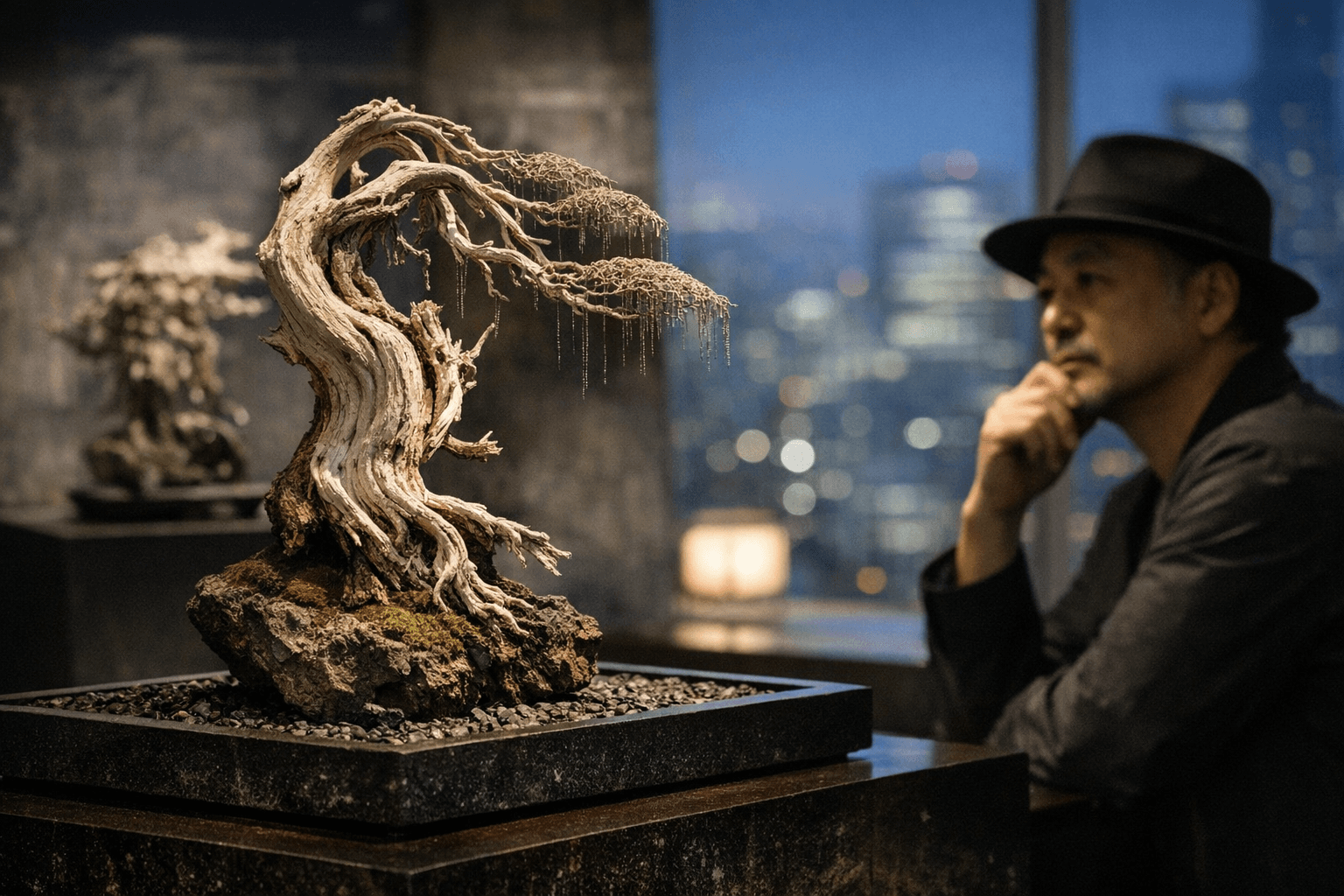
Standing in Park Hotel Tokyo's Executive Museum Lounge, with the Tokyo skyline framing the atrium behind them, visitors encounter bonsai that no one will ever water again. The WITHERS TAIZAN BONSAI installation, launched April 1 through a collaboration between Park Hotel Tokyo and TAIZAN Co., Ltd., presents preserved trunks and botanical material collected from withered specimens that would otherwise have been discarded. No misting schedules. No light rotation. No soil.
The works are the creation of Shin Suzuki (鈴木 辰), who founded the recycled bonsai art brand WITHERS in 2023 after traveling through 33 countries and developing a fascination with Japanese bonsai culture that led him toward what his artist profile describes as "a unique approach to visual aesthetics." The production process begins with the collection of end-of-life specimens from across Japan, followed by cleaning, drying, preservation processing, and final assembly with additional preserved botanical materials to produce the finished pieces.
Park Hotel Tokyo, operated by Shiba Park Hotel Co., Ltd. under President and CEO Noriyoshi Tanaka, positioned the initiative within its continuing program of integrating Japanese art into its public spaces. The hotel's press materials frame the project around the Japanese phrase "枯れてなお美しい," meaning "beautiful even in withering," a wabi-sabi sensibility that locates aesthetic value in transience and imperfection. The release states the initiative was born from a desire to "transform the long years etched into the trunk" into a form that carries the bonsai's story forward, and describes the resulting works as embodying "Wabi-Sabi Luxury."
For the bonsai community, the installation sharpens a question that preserved botanical work has always implicitly raised: at what point does bonsai become something else? A living tree in a pot carries its history in the movement of every branch. Suzuki's pieces carry that same physical record, the nebari, the accumulated deadwood, the jin and shari of a long life, but the horticultural relationship has ended. The hotel markets the works not only as exhibition pieces but as collectible objects suitable for homes and offices, with prices ranging from small works in the tens of thousands of yen upward to larger, more elaborate compositions.
The broader context matters here. TAIZAN Co., Ltd. formally consolidated the WITHERS brand as a sustainable art business in April 2025, roughly a year before the Park Hotel Tokyo installation opened. That hospitality collaboration signals that preserved bonsai art has moved beyond studio and gallery contexts into luxury public spaces where traditional horticulture would be impractical. Institutions that want the visual weight and cultural resonance of aged specimen material, without the infrastructure of a living bonsai maintenance program, now have a concrete precedent to point to.
Whether the purist concedes the label "bonsai" to a preserved trunk or not, the installation at Park Hotel Tokyo represents something the community will need to reckon with: there is now a viable, design-oriented audience for the afterlife of these trees, and Shin Suzuki is building a practice around serving it.
This article was produced by Prism’s automated news system from verified source data, official records, and press releases, then run through automated quality and moderation checks before publishing. The system is built and supervised by the people who set the standards it runs under. Read our full AI policy.
Did this article answer your question?