Taisho-en in Japan shows bonsai excellence across all sizes
Taisho-en is more than a destination. Taiga Urushibata’s garden shows how elite bonsai training holds up across shohin, medium, and large trees alike.
Taisho-en is a working lesson in scale, not just a place to admire famous trees
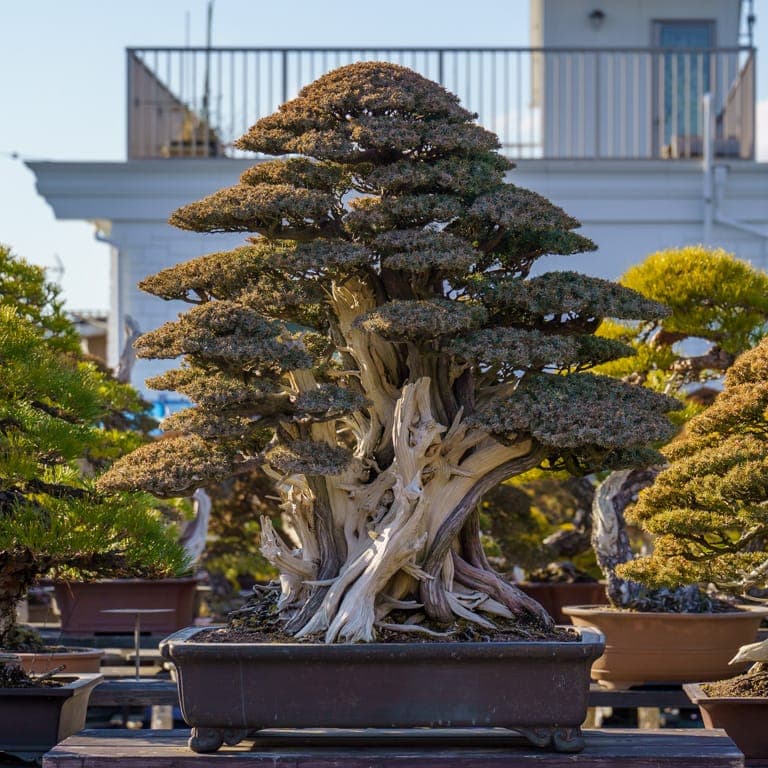
Taisho-en in Shizuoka City stands out because it proves a simple but important point: excellent bonsai does not depend on size. Jonas Dupuich’s look at Taiga Urushibata’s garden captures a place where shohin, medium trees, and larger compositions all carry the same standard of finish, and that makes the garden valuable far beyond travel envy.
What matters here is the feeling of the whole place. Taisho-en is not presented as a showroom of isolated masterpieces. It comes across as a living training environment where trunk movement, branch structure, ramification, canopy balance, pot choice, and presentation are being refined together, tree after tree. For anyone serious about bonsai, that is a stronger lesson than simply seeing one famous specimen at its peak.
The Urushibata line explains why the garden matters
Taisho-en is run by Taiga Urushibata and his father, Nobuichi Urushibata, and that family structure gives the garden its depth. Nobuichi has long been recognized as one of Japan’s top shohin bonsai artists, so the garden’s reputation is built on more than a single generation’s enthusiasm. It is a continuation of a disciplined family approach to bonsai, with shohin expertise at the core and a broader range of sizes on display.
Taiga himself brings another layer to the story. Bonsai Today reported that when he was 20, his father sent him into a six-year apprenticeship with Masahiko Kimura, one of the most influential names in modern bonsai. That training background matters because it explains the confidence behind Taisho-en’s work: the garden reflects both shohin sensitivity and the bold, structural thinking associated with Kimura’s school.
A garden built for international study as well as domestic reputation
Taisho-en is not only admired by visitors passing through Japan. Bonsai Empire notes that the garden accepts foreign students for studies of a few months, and Bonsai Today described it as one of the first Japanese bonsai gardens to offer short-term apprenticeships to overseas students. That makes Taisho-en part of a bigger shift in bonsai culture, where serious training has become more accessible without losing its rigor.
The practical side matters too. Taiga speaks English, which has helped make the garden usable as a training stop for international students rather than a place that only the already-connected can navigate. The garden is listed in Shizuoka City at 1872-2 Ikeda, Suruga Ward, and Bonsai Empire places it on the Shinkansen corridor between Kyoto and Tokyo, reachable via Shin-Shizuoka, Higashishizuoka, and then taxi. Near Mt. Fuji and inside a major travel route, Taisho-en sits in a setting that is both geographically convenient and culturally serious.
What you learn by walking the trees one by one
The biggest lesson from Taisho-en is not that the trees are beautiful. It is that the garden rewards close observation. Walking tree by tree lets you see how refinement really happens, not as a single dramatic transformation but as a series of choices that add up over time. The branch placement is one clue, but so are the pot, the silhouette, the degree of ramification, and the maturity of the canopy.
That is the kind of reading skill every bonsai grower needs. A garden like Taisho-en shows that you should not judge a tree only by its size or species. You judge the clarity of its structure, the quality of its movement, and whether every part of it is being pulled toward a coherent finished image. The lesson is especially useful for hobbyists who tend to focus on one dramatic front or one strong feature and miss the smaller signs of progress.
What to borrow at home from Taisho-en’s discipline
Taisho-en’s appeal is that its principles translate directly to the home bench. You do not need a large nursery to use the same mindset. What you do need is the habit of evaluating every tree as a long-term project and making decisions that improve the whole rather than chase a quick effect.
A few habits stand out:
- Put structure first. Taisho-en’s value lies in the way trees of different sizes are all being trained with attention to branch architecture, trunk movement, and overall composition.
- Learn to read ramification. The more refined the branching, the more mature the tree feels, and that refinement usually comes from patient pruning and consistent direction.
- Treat pot choice as part of the design. At Taisho-en, the container is not an afterthought; it supports the tree’s scale, tone, and presentation.
- Think in seasons, not weekends. A six-year apprenticeship under Masahiko Kimura is a reminder that real development happens over long stretches, not in quick bursts.
- Compare trees by purpose, not by size. Taisho-en shows that shohin and larger bonsai can be judged by the same standards of discipline, even if the techniques differ.
This is the part that changes how you work at home. Once you start looking at your own benches the way Taisho-en asks you to look at a garden, you stop treating trees as isolated projects and start seeing a system of priorities. Growth control, branch selection, and canopy building begin to feel connected instead of separate.
Why the garden’s scale story matters to the whole bonsai community
Taisho-en matters because it broadens the picture of what elite Japanese bonsai training looks like. Too often, gardens are imagined as collections of finished trophy trees, when the real value may be in the discipline behind them. Here, the family lineage, the shohin reputation, the Kimura apprenticeship, and the openness to foreign students all point to a place where technique is actively transmitted, not merely displayed.
Taiga Urushibata has been in bonsai for about 20 years and is the youngest of three brothers, details that help explain how deeply rooted this work is in family life and daily practice. That continuity gives Taisho-en its weight. It is a garden where reputation is earned across sizes, across generations, and across the steady repetition that turns good stock into great bonsai.
For anyone studying bonsai seriously, Taisho-en is the kind of garden that recalibrates expectations. It shows that excellence is not tied to a single size class or a single finished look. It comes from a long, disciplined process, and that is exactly why the garden deserves attention.
This article was produced by Prism’s automated news system from verified source data, official records, and press releases, then run through automated quality and moderation checks before publishing. The system is built and supervised by the people who set the standards it runs under. Read our full AI policy.
Did this article answer your question?